


 Francais
 Deutsch
 Italiano
Refine Your Search
Tontouta New Caledonia 1943 stock footage and images
- Showing 2377 to 2382 of 10521 results more
more Hide
Hide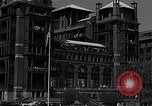
Ticker tape parade in New York City for General Douglas MacArthur
The Bellevue Hospital in New York City. Military leader General Douglas MacArthur is welcomed by the City of New York when he arrives there after being relieved of Command by President Harry S. Truman. Views of the parade from viewpoint of newsreel cameramen surrounding the general's open car. Fireboats in the harbor create a huge fountain with their pumps. Trees are inundated with ticker tape.
United States Army Redstone missile is displayed at the Grand Central Station in New York, United States.
Scene opens shows spectators looking at a U.S. Army Redstone missile lying in its side in Grand Central Station, New York City (89 E 42nd St, New York, NY 10017, United States). The Ordnance Corps logo is painted on the missile side. Some workmen use a manual hoist to raise the 5-ton missile upright. View from above of the missile being slowly tilted upright. Closeup of spectators looking upward as it moves. Another view from above as the missile is about half-way raised. Exhibit is a salute to the International Geophysical Year. Closeup of more people watching the missile being pulled up. Among others, they include a woman with two small girls, and a U.S. Airman in khaki uniform. View from above of the missile finally standing completely upright on the station floor with a large American flag displayed on the wall behind it.
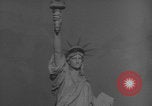
United States Army and Red Cross volunteers prepare Camp Kilmer in New Jersey for arrival of Hungarian refugees from the Hungarian Revolution
View of the Statue of Liberty. View of New York City and the Statue of Liberty. Sign saying “Camp Kilmer named in honor of Sgt. Joyce Kilmer Soldier Poet. Born December 6, 1886, New Brunswick, N.J. Killed in action World War I in France June 30, 1918”. A United States military jeep approaches the entrance of Camp Kilmer. Soldier at Camp Kilmer entrance allows Jeep to enter. Soldiers march and then sprint inside Camp Kilmer. Using crane attached to truck, soldiers unload crates containing furniture for incoming Hungarian refugees who will stay in Camp Kilmer. Soldiers carry mattresses into the barracks. Two soldiers carry a crate to a barrack. Soldiers carry a cabinet to the barracks. Inside the Camp Kilmer paint shop, soldiers prepare signs in Hungarian such as “Varás és asztalos munka (sic.)” (“Sewing and Carpentry”) and “fö üzlet” (“main shop”). Camp Kilmer dentists disinfect clinic. Camp Kilmer pharmacists prepare medicine for incoming refugees. An army pharmacist pour medicine into a bottle using a funnel. An army pharmacist grounds with using mortar and pestle. Pharmacists stack medicine such as aspirin in shelves. Army nurse making hospital bed with freshly laundered white bed sheets. Red cross volunteers filling comfort bags containing toiletries for refugees. Soldiers unload piles of second-hand clothes donated by Americans through the Red Cross. Red Cross volunteers organize second-hand clothes by type and size. African American woman Camp Kilmer staff enter the Recreation Center, with sign in English and Hungarian. African American staff at Camp Kilmer hang paintings and arrange furniture in the Recreation Center.
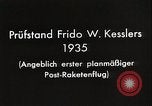
Frido W. Kessler's rocket-propelled mail plane launches on frozen lake Greenwood, New York, United States, 1936
Frido W. Kessler and his rocket-propelled mail plane. (Allegedly, the first scheduled mail-delivery rocket flight) Kessler is seen in his workshop with his test stand and apparatus. Launch of Kessler's first winged liquid-fueled (liquid oxygen and Kerosene) mail rocket plane on frozen Greenwood Lake, New York, February 23,1936. Launch team opens the nose to insert mail into the rocket-propelled glider plane (reportedly designed by German rocket pioneer Dr. Willy Ley). Kessler poses with a little girl, Gloria Schleich Quackenbush, for whom the plane is named. She holds a silver cup of snow. They are surrounded by a cluster of men. Photographic equipment is set up next to them. The girl, Gloria, empties the cup of snow onto the tail of the rocket plane, to Christen it "Gloria (I)." Launch team fueling the rocket from containers. A technician in fireproof protective suit lights fuel at tail of the plane. It flares up in flames and then settles down with normal rocket burn, and leaves the launch stand. (A second rocket plane is seen sitting on the ice near the launch stand.) The rocket glider only goes about 20 feet before falling onto the ice. Team members look over the stand and prepare to try again with Kessler's second plane, the "Gloria (II)." They load the mail (6000 letters and postcards) into the nose and set the plane on the launch stand. It launches very nose high, and strikes the ice near the stand. But the rocket motor continues to propel it across the ice until it takes off again and continues, a way in the air until flipping over and crashing on the ice. View of people surrounding the broken plane on the ice. (Note: The second attempt carried the Gloria II and its mail, about 2000 feet, far enough to cross the border from New York into New Jersey, constituting an interstate mail delivery, and making the letters and post cards worthy mementos of the event.)
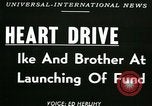
President-elect Dwight D Eisenhower, his brother and Mayor Dewey help launch The Heart Fund in New York.
President-elect Dwight D Eisenhower, his brother and Mayor Dewey help launch The Heart Fund in New York. Dignitaries and guests seated at the venue. President Eisenhower's brother with the chairman of the Drive Mrs. Preston Davie. Governer of NY Thomas Edmund Dewey also seated on stage. President Eisenhower arrives for the function. Speeches by Mrs. Davie and Eisenhower's brother. A standing ovation by the guests. Certificates distributed.
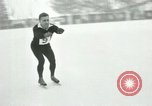
Barrel jumping contestants do their best to win in New York.
A barrel jumping contest in New York. A skater on ice skates takes a start for an attempts to hurdle ten barrels. Ten barrels placed on the snow. He takes a long jump and lands on the last barrel. Spectators watch the contest. Referees move forward to measure the jump distance. Photographers click pictures.
CRITICALPAST.COM: About Us | Contact Us | FAQs - How to Order | License Agreement | My Account | My Lightboxes | Shopping Cart | Advanced Search | Featured Collections | Website Terms & Conditions | Privacy Policy ©2026 CriticalPast LLC.
License Agreement |
Terms & Conditions |
Privacy Policy
©2026 CriticalPast LLC.