


 Francais
 Deutsch
 Italiano

Refine Your Search
Tontouta New Caledonia 1943 stock footage and images
- Showing 43 to 48 of 10542 results more
 Hide
Color Sound
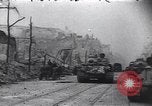
Contrasting views of Berlin, Germany from 1945 to 1943, to 1945 again, during World War II
Soviet Forces battling in Berlin during 1945, in World War 2, employ tanks and heavy machine guns. A Soviet soldier herds two German prisoners from a building. Groups of German soldier prisoners struggle through rubble as they are led from buildings, under guard. Soviet tanks firing as they pass a church building. A Soviet heavy gun being fired point blank on a Berlin street during Battle of Berlin. Buildings on fire. Soviet soldiers firing artillery field pieces. Views of destroyed and damaged German military aircraft on and in hangars of an airfield. Soviet Ilyushin II aircraft land on the airfield. Closeup of distressed German General rubbing his eyes. Flashback in time to 1943, in World War II. Field Marshal Hermann Goering is seen reviewing flyers of a German Luftwaffe (Air Force) unit. A Junkers Ju 52 trimotor aircraft lands and parks on an airfield. Italian leader Benito Mussolini steps from the aircraft after his rescue from imprisonment by the Italian Government at the Hotel Campo Imperatore. He is personally welcomed by Adolf Hitler, who had ordered the mission to rescue him. Change of time, again, to 1945, when Berlin, Germany is attacked by Forces of the Soviet Union. Closeup of a despairing German General. Scenes of utter destruction as Soviet troops batter Berlin, Germany with artillery. Soviet soldier steps down from his tank and gives a Soviet General a handgun, which he pockets and then leads a group of Soviet officers into a building
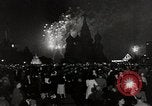
Fireworks in Red Square. Tehran, Iran, conference in 1943. Potsdam conference, 1945.
A crowd enjoys fireworks in Red Square, Moscow, Soviet Union, at night. Past events show Soviet Premier Joseph Stalin, U.S. President Franklin D. Roosevelt and Prime Minister Winston Churchill of the United Kingdom in Tehran, Iran for the Tehran Conference of 1943. U.S. President Harry S. Truman in Germany during the Potsdam Conference of 1945. The Grand Kremlin Palace in Moscow, Soviet Union. Soviet people along a street in Moscow. Foreign Minister of the Soviet Union, Vyacheslav Molotov with others applauding at the Bolshoi theater, in Moscow. Anti-soviet disorders. Street cars being overturned. (Hungary?).
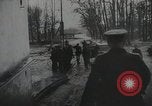
Spanish General is decorated and German and Italian military leaders coordinate defense of Italy during World War 2
Commander of the German 18th Army, Colonel General Georg Lindemann, arrives to personally recognize Spanish Army General Emilio Esteban Infantes, commanding officer of the Spanish "Blue Division" (German 250th Infantry Division) for successfully repelling attack by the Russian 55th Army, in the Battle of Krasny Bor on the Eastern Front in February, 1943. Other officers help General Esteban Infantes to place an Iron Cross decoration around his neck. Scenes of German General Field Marshal Albert Kesselring reviewing Italian and German troops in Italy at an airfield and presenting award to some of the soldiers. In next scene, Benito Mussolini enters a room and then is seated in the first meeting of the leaders of the new Fascist Republican Party, including Alessandro Pavolini and Italian Minister of War Rodolfo Graziani. Next segment covers arrival of German Field Marshal Erwin Rommel to Italy, touring fortifications and inspecting defenses in Italy. He is seen reviewing port lookouts and defense points with German artillery. In once scene he passes an elderly Italian civilian and gives him the Nazi salute, which is returned weakly by the Italian. Next segment covers further expansion of Italian defenses, with the laying of barb wire by troops, including one soldier cutting his pants knee on the barbed wire. Also shows demolition of trees using dynamite. Explosions as trees are blown up. Then shows placement of new artillery guns and positions. German soldier reviewing a map while on phone receiving enemy position information. German soldiers in hills fire artillery at enemy position in a valley.
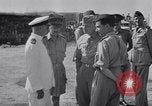
Allies force German forces almost completely out of Tunisia, North Africa, during World War II
Opens with General Dwight D. Eisenhower, Supreme Commander of Allied forces conferring with his deputy for land forces, British Field Marshal Harold Alexander, his deputy for sea forces, British Admiral Andrew Browne Cunningham, and his deputy for air operations, British air marshal Arthur William Tedder, during North African campaign in World War 2 . Map illustrates Allies military plans as analogous to internal combustion engine. General Eisenhower on an airfield consulting with his British Deputy commanders. B-17 bomber in background. Eisenhower salutes the British officers as he walks away. Lieutenant General Carl Spatz, Commander of the North West African Air Force, confers with British air marshal Tedder. Major General Jimmy Doolittle briefs airmen and smiles for camera. Strategic bombers with nose art names Pluto, Yankee Doodle, Jersey Jackass, Alice the Goon, and Fancy Pants. Picture of British Air Vice Marshal, Sir H.P. Lloyd, chief of Coastal air Force. A British Avro Anson aircraft flying air cover over a convoy of Allied ships. Diagram shows how all British and American fighter aircraft and attack bombers were placed under the command of British Air Marshal Cunningham, who is seen stepping from an airplane. British Field Marshal Harold Alexander in command of all ground forces is also seen stepping from an aircraft. Both are seen at a small camp trailer that they shared in the Tunisian mountains, where they work together, at a planning table. Marshal Cunningham is seen briefing air crews in mid March, 1943. B-24 Liberator bombers fly in formation and drop bombs on German Mareth fortifications in Tunis. German anti-aircraft guns create many black flak clouds among bomber formation. View from B-24 aircraft of the bombs exploding on the ground. British Field Marshal Harold Alexander is seen walking with a member of his staff across the sands. Diagram shows planned advance of the British 8th Army. Numerous British heavy guns fire nighttime barrages against the German positions, as British infantry advance during battle. They use scaling ladders and sappers detonate charges. Soldiers carry sticks to line trenches and set up defensive fortifications. Tanks advance. Heavy rain creates problems and some armor bogs down in mud. The next morning British troops are seen in their trenches as smoke drifts across the area. British soldiers moving cautiously under fire. German Field Marshal Rommel looks through binoculars. Additional German armored units entering the area. British gunners firing field artillery and mortars. Map illustrates how 2nd New Zealand Division under Lieutenant-General Bernard C. Freyberg, swings around behind the German line. Formation of British B-26 Marauder aircraft flying over desert. British Vickers Wellington bomber in flight. Bombardier in aircraft pressing a release button and close-up view of open bomb bay door with bombs away view as each bomb is released, followed by huge explosions on ground. British mosquito bomber flying low. Bomb explodes on ground and Mosquito aircraft pulls up and away. Another Mosquito aircraft flying low on a strafing run. Tanks of 2nd New Zealand Division welcomed into El-Hamma, Tunisia, in the Battle of the Mareth line. View of South African army engineers using caterpillar tractor to build roads for Allied forces. Glimpse from rear of three British warships underway in the Mediterranean sea. Front view of a British Queen Elizabeth Class battleship underway. The battleship firing her 15-inch guns. U.S. P-38 fighter planes in formation. Glimpse of pilot in cockpit wearing leather helmet and earphones. Formation of German Junkers Ju-52 aircraft flying low over sea, carrying German troops to reinforce those in Tunisia. View of German soldiers inside the cabin of a Ju-52. Closeup of three Ju-52 transports flying very low over water. Several U.S. P-38 fighter planes attacking the transports. Pilot in one, pressing button to fire his guns. Scenes of aerial dogfight combat between U.S. Army Air Force aircraft and German Luftwaffe aircraft. Gun camera images of P-38s shooting down German transport planes. Map shows American, British, and French forces pressing Eastward against Germans. Views of battle and U.S. Lieutenant General George Patton at the front as his forces move forward during Battle of Guettar. American patrols of light tanks meet up with British patrols from their 8th Army on April 7. Views of the U.S. and British soldiers happy to meet one another and sharing cigarettes. Map shows Allied forces pushing the Germans further. Allied infantry walking into town of Enfilaville. Local families returning to their homes with all their belongings, in carts pulled by donkeys and other animals. In the town, encouraged by British troops, a group of Jewish boys remove Jewish star of David emblems from their jackets that had been used by occupying Germans to identify them as Jewish. British army doctors tending to local women and children.
The Allied Military Government (AMG) begins immediate efforts to cleanup and rebuild Liberated areas of Sicily in World War II.
Allied Military Government efforts to rebuild Sicily after capturing it from Axis forces during World War 2. Italian men needing employnent board an open truck for transport to a job site. Workers standing with American soldiers preparing to work. A huge crowd of men pushing and shoving outside an Allied Military Government (AMG) labor hiring headquarters where they were offered decent wages to begin rebuilding after the war's destruction. Italian men, as well as American soldiers, rebuilding roads in the Alpine region of Italy, where German forces had destroyed them as they withdrew. U.S. Army engineers using a bulldozer, to clear and smooth a road. A large dump truck spreading new gravel for a highway bed. A team of workers manning a cable to pull down a damaged portion of a building. A British Army officer and a Colonial soldier in a turban, set explosive charges to destroy a bomb-damaged building. They detonate the charges and bring down the entire large building. Bulldozers at work on huge piles of rubble. A steam shovel being employed to clear large piles of debris. Men at work in Palermo, to clear entire streets buried in rubble. Men clearing rubble near piles of twisted steel building girders. Rubble being moved by horse-drawn carts and dumped into the sea. Italian masons at work building new homes and refurbishing old ones. In views three months after the original Allied landing in Sicily during July,1943, Palermo is seen well on the way to restoration. School children, including girls with brooms, walking to a place needing cleanup. Views of them cleaning steps and windows. Citizens picking up debris from streets and sidewalks. A man using a hose to clean a street and sidewalk in the city.
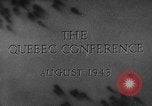
British Prime Minister Winston Churchill in many meetings before and after America's entry into World War II
Opening slate reads: "Quebec Conference August 1943." The English battleship, Prince of Wales, is seen in fog off the Coast of Newfoundland, in August 1941. View of sailor on fore-deck of the British ship. View inside engine room of the ship where sailor manipulates her power. Closeup of engine crankshaft stopping as she drops anchor in Placentia Bay. View of Prime Minister Winston Churchill, greeting U.S. President Franklin D. Roosevelt aboard the Prince of Wales. He proffers a letter to the President, from the King of England. View of Roosevelt and Churchill seated on deck with their respective military leaders standing behind them. Admiral Ernest King, U.S. Chief of Naval Operations converses with U.S. Army Chief of Staff, George Marshall, as they stand behind Churchill and Roosevelt. Wider camera view shows the larger military entourage accompanying the Prime Minister and the President. Glimpse of prisoners and enslaved workers taken by Nazi Germans in Europe. Glimpse of bombs falling from an airplane. Classic film views of the Japanese attack on Pearl Harbor in December 7, 1941. Bombs exploding along "Battleship Row." Heavy smoke rising from the bombed ships. The USS Arizona tilted heavily and burning. Camera pans along the path of destruction, as the voice of President Roosevelt is heard in the background, asking the Congress to declare that the Japanese attack created a state of War between the United States and the Japanese Empire. View of President Roosevelt speaking to the U.S. Congress. Seated behind him are Vice-President Henry Wallace and Speaker of the House, Sam Rayburn. Glimpse of Congress members applauding. Change of scene shows President Roosevelt and Winston Churchill meeting in Washington, DC, in December of 1941, during World War 2. Views of war preparations in the United States, including the building of new war production plants and facilities. A large steel ingot being forged into an artillery gun barrel. Machinist at work turning a gun barrel on a lathe in a munitions factory. Views of manufacturing plants in operation and steel being made. A railroad train carrying new Army trucks. Another meeting of Churchill and Roosevelt in Washington, D.C. June, 1942. Standing behind them is President Roosevelt's special assistant, Harry Hopkins, a British naval officer, and an American navy Captain. American soldiers boarding a troop ship, and closeups of them as they enter the ship, looking out of portholes, and waving from the ship's deck. Glimpse of Washington Monument and its image in the reflecting pool in Washington DC. Closeup of a book entitled, "Time Table for Invasion." General George Marshall with several of his generals doing preliminary planning. Series of scenes involving senior military officers engaged in war planning. A convoy of warships is seen at sea during the Operation Torch Allied invasion of French North Africa during 8–16 November, 1942. Views of Allied Navy ship guns firing. Allied troops riding in landing craft, and advancing from beached craft on shore of Algiers. Aerial view of a flight of Douglas Dauntless bombers in formation. "Bombs away" view from Allied airplane dropping bombs. Allied troops firing camouflaged antiaircraft guns from sandy positions near shore. Enemy shells or bombs exploding nearby. Two U.S. Army soldiers holding a document in French entitled, "Message from the President of the United States.
CRITICALPAST.COM: About Us | Contact Us | FAQs - How to Order | License Agreement | My Account | My Lightboxes | Shopping Cart | Advanced Search | Featured Collections | Website Terms & Conditions | Privacy Policy ©2026 CriticalPast LLC.
License Agreement |
Terms & Conditions |
Privacy Policy
©2026 CriticalPast LLC.