


 Francais
 Deutsch
 Italiano
Refine Your Search
Tontouta New Caledonia 1943 stock footage and images
- Showing 37 to 42 of 10521 results more
more Hide
Hide
U.S. recruits being classified for assignments and being informed about the progress of World War II and why they fight.
New U.S. army recruits seated at benches in the classification center, taking notes, as an instructor at a blackboard tells them how to fill out their classification questionnaires, during World War 2. View of machines processing the questionnaires. Hollerith 88 column punch cards being sorted by machine. Newspaper article about the Air Force efforts to improve classification and assignments of new airmen. A recruit being counseled. An Airmen in barracks, filling out a post card form to complain about his assignment. Servicemen working with sewing machines and at long cobbler's benches repairing shoes. U.S. soldiers in pith helmets, laying communications cable from a truck. A soldier recording information about a shipment of supplies. Soldiers filling 5-gallon "jerry cans" with fuel from a hose. Others serving at a communications center in woods. A soldier fastening a cable to a tank. Soldier standing on a truck. Large group of soldiers gathered to listen to a lecture about explosives. Army draftsmen at their work tables. Soldiers using information and training materials.(Narrator states these materials are often ignored.) An army newsmap for Monday, August 31, 1942 posted on an Army office wall. A sergeant points to July, 1943, on a current calendar next to it, illustrating that the newsmap is long out-of-date. View of another news map and narrator notes they are produced weekly. An officer speaking to an auditorium of soldiers. A soldier arranging his personal gear. Infantry on field maneuvers, firing rifles as they advance across a field. Soldiers firing a Browning water-cooled machine gun; a mortar; and a 105mm M101A1 howitzer. The sergeant using a newsmap to brief his staff about the progress of the war. Opening frames of a War Department Film Bulletin, and soldiers in a theater, watching the film. Opening frames of the film,"Why We Fight," that goes on to show animated map of the German advance across Europe in World War 2. Scenes of German forces on the move, towing artillery, riding on tanks, and entering towns as they invade countries of Europe. Women and children running in streets under bombardment, and civilians fleeing from their homes during aerial bombing. A Bombed out city and civilian corpses lying on the ground. Women in Poland, identifying their dead and grieving over them. German Heinkel He 111 aircraft dropping bombs. Norwegians evacuating the city in trucks, and other vehicles and on foot, during the German invasion. A squadron of German Messerschmitt Bf-109 aircraft in flight. German Ju-87, Stuka dive bombers diving on targets. Civilians rushing to a bomb shelter, and other refugees boarding a truck to evacuate. More He-111 bombers dropping bombs. A Ju-52 trimotor transport (type used to transport German paratroopers). Buildings ablaze in a town. Large formations of German aircraft of various types flying overhead. Building destroyed and burning from bombing. Ju-87s flying close past the camera.
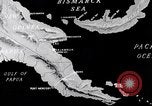
Soldiers pack supplies and parachutes at an Australian Parachute Packing Depot in Papua New Guinea.
March 1943: A map shows Salamaua in Papua New Guinea. An aircraft drops supplies with parachutes over hills. An Australian parachute packing depot. Soldiers pack parachutes on tables in rows. Stacked Australian parachutes to deliver rations, American parachutes used for Ammunition, and 24 foot parachutes for regulation. White parachutes used for medical supplies, blue ones used for rations and red used for ammunition supplies. Aerial view of Goodview, an area of conflict. A soldier radios the requirements to base. Another soldier delivers the plan to the depot. Soldiers pack mortar ammunition. The fuses and sheets are packed together in boxes. Soldiers put boxes into sacks, tie the sacks and attach parachutes. Soldiers pack canned meat: lay straw in big cans, put small cans into those, seal the big cans, secure them with a wiring machine, and attach parachutes. Sacks of rice are put into copper sacks, their mouths tied. Soldiers pack rations including onions, bacon and potatoes for delivery. Supplies are loaded onto trucks and transferred to the aerodrome. (World War II period).
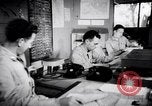
C-47 Skytrains and P-38 Lightning fighters drop supplies with parachutes over Greenview in Papua New Guinea.
March 1943: Australian and American soldiers in Salamaua in Papua New Guinea. Trucks loaded with supplies move to the aerodrome. The Depot officers radio A3 of the 5th Air Force Headquarters, who in turn contact the 54th Troop Carrier Wing for airplanes. Brigadier General Prentiss monitors the mission with Colonel Hampton. Board shows duties of the Troop Carrier Wing. The pilots and crew are briefed for the mission. Soldiers leave in jeeps at dawn for the aerodrome. The pilots are given the time for take off. Supplies are loaded. Planes are ordered off ground. Douglas C-47 Skytrains and P-38 Lightning fighters taxi and take off. Pilot scouts the skies for change in weather and danger. Planes over drop area in Greenview, marked by parachutes from earlier drops on the ground. Soldiers put supplies onto ramps and prepare for the drop. Pilot gives the signal and supplies are dropped. (World War II period).
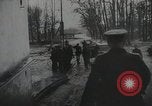
Spanish General is decorated and German and Italian military leaders coordinate defense of Italy during World War 2
Commander of the German 18th Army, Colonel General Georg Lindemann, arrives to personally recognize Spanish Army General Emilio Esteban Infantes, commanding officer of the Spanish "Blue Division" (German 250th Infantry Division) for successfully repelling attack by the Russian 55th Army, in the Battle of Krasny Bor on the Eastern Front in February, 1943. Other officers help General Esteban Infantes to place an Iron Cross decoration around his neck. Scenes of German General Field Marshal Albert Kesselring reviewing Italian and German troops in Italy at an airfield and presenting award to some of the soldiers. In next scene, Benito Mussolini enters a room and then is seated in the first meeting of the leaders of the new Fascist Republican Party, including Alessandro Pavolini and Italian Minister of War Rodolfo Graziani. Next segment covers arrival of German Field Marshal Erwin Rommel to Italy, touring fortifications and inspecting defenses in Italy. He is seen reviewing port lookouts and defense points with German artillery. In once scene he passes an elderly Italian civilian and gives him the Nazi salute, which is returned weakly by the Italian. Next segment covers further expansion of Italian defenses, with the laying of barb wire by troops, including one soldier cutting his pants knee on the barbed wire. Also shows demolition of trees using dynamite. Explosions as trees are blown up. Then shows placement of new artillery guns and positions. German soldier reviewing a map while on phone receiving enemy position information. German soldiers in hills fire artillery at enemy position in a valley.
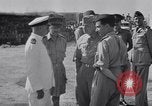
Allies force German forces almost completely out of Tunisia, North Africa, during World War II
Opens with General Dwight D. Eisenhower, Supreme Commander of Allied forces conferring with his deputy for land forces, British Field Marshal Harold Alexander, his deputy for sea forces, British Admiral Andrew Browne Cunningham, and his deputy for air operations, British air marshal Arthur William Tedder, during North African campaign in World War 2 . Map illustrates Allies military plans as analogous to internal combustion engine. General Eisenhower on an airfield consulting with his British Deputy commanders. B-17 bomber in background. Eisenhower salutes the British officers as he walks away. Lieutenant General Carl Spatz, Commander of the North West African Air Force, confers with British air marshal Tedder. Major General Jimmy Doolittle briefs airmen and smiles for camera. Strategic bombers with nose art names Pluto, Yankee Doodle, Jersey Jackass, Alice the Goon, and Fancy Pants. Picture of British Air Vice Marshal, Sir H.P. Lloyd, chief of Coastal air Force. A British Avro Anson aircraft flying air cover over a convoy of Allied ships. Diagram shows how all British and American fighter aircraft and attack bombers were placed under the command of British Air Marshal Cunningham, who is seen stepping from an airplane. British Field Marshal Harold Alexander in command of all ground forces is also seen stepping from an aircraft. Both are seen at a small camp trailer that they shared in the Tunisian mountains, where they work together, at a planning table. Marshal Cunningham is seen briefing air crews in mid March, 1943. B-24 Liberator bombers fly in formation and drop bombs on German Mareth fortifications in Tunis. German anti-aircraft guns create many black flak clouds among bomber formation. View from B-24 aircraft of the bombs exploding on the ground. British Field Marshal Harold Alexander is seen walking with a member of his staff across the sands. Diagram shows planned advance of the British 8th Army. Numerous British heavy guns fire nighttime barrages against the German positions, as British infantry advance during battle. They use scaling ladders and sappers detonate charges. Soldiers carry sticks to line trenches and set up defensive fortifications. Tanks advance. Heavy rain creates problems and some armor bogs down in mud. The next morning British troops are seen in their trenches as smoke drifts across the area. British soldiers moving cautiously under fire. German Field Marshal Rommel looks through binoculars. Additional German armored units entering the area. British gunners firing field artillery and mortars. Map illustrates how 2nd New Zealand Division under Lieutenant-General Bernard C. Freyberg, swings around behind the German line. Formation of British B-26 Marauder aircraft flying over desert. British Vickers Wellington bomber in flight. Bombardier in aircraft pressing a release button and close-up view of open bomb bay door with bombs away view as each bomb is released, followed by huge explosions on ground. British mosquito bomber flying low. Bomb explodes on ground and Mosquito aircraft pulls up and away. Another Mosquito aircraft flying low on a strafing run. Tanks of 2nd New Zealand Division welcomed into El-Hamma, Tunisia, in the Battle of the Mareth line. View of South African army engineers using caterpillar tractor to build roads for Allied forces. Glimpse from rear of three British warships underway in the Mediterranean sea. Front view of a British Queen Elizabeth Class battleship underway. The battleship firing her 15-inch guns. U.S. P-38 fighter planes in formation. Glimpse of pilot in cockpit wearing leather helmet and earphones. Formation of German Junkers Ju-52 aircraft flying low over sea, carrying German troops to reinforce those in Tunisia. View of German soldiers inside the cabin of a Ju-52. Closeup of three Ju-52 transports flying very low over water. Several U.S. P-38 fighter planes attacking the transports. Pilot in one, pressing button to fire his guns. Scenes of aerial dogfight combat between U.S. Army Air Force aircraft and German Luftwaffe aircraft. Gun camera images of P-38s shooting down German transport planes. Map shows American, British, and French forces pressing Eastward against Germans. Views of battle and U.S. Lieutenant General George Patton at the front as his forces move forward during Battle of Guettar. American patrols of light tanks meet up with British patrols from their 8th Army on April 7. Views of the U.S. and British soldiers happy to meet one another and sharing cigarettes. Map shows Allied forces pushing the Germans further. Allied infantry walking into town of Enfilaville. Local families returning to their homes with all their belongings, in carts pulled by donkeys and other animals. In the town, encouraged by British troops, a group of Jewish boys remove Jewish star of David emblems from their jackets that had been used by occupying Germans to identify them as Jewish. British army doctors tending to local women and children.
The Allied Military Government (AMG) begins immediate efforts to cleanup and rebuild Liberated areas of Sicily in World War II.
Allied Military Government efforts to rebuild Sicily after capturing it from Axis forces during World War 2. Italian men needing employnent board an open truck for transport to a job site. Workers standing with American soldiers preparing to work. A huge crowd of men pushing and shoving outside an Allied Military Government (AMG) labor hiring headquarters where they were offered decent wages to begin rebuilding after the war's destruction. Italian men, as well as American soldiers, rebuilding roads in the Alpine region of Italy, where German forces had destroyed them as they withdrew. U.S. Army engineers using a bulldozer, to clear and smooth a road. A large dump truck spreading new gravel for a highway bed. A team of workers manning a cable to pull down a damaged portion of a building. A British Army officer and a Colonial soldier in a turban, set explosive charges to destroy a bomb-damaged building. They detonate the charges and bring down the entire large building. Bulldozers at work on huge piles of rubble. A steam shovel being employed to clear large piles of debris. Men at work in Palermo, to clear entire streets buried in rubble. Men clearing rubble near piles of twisted steel building girders. Rubble being moved by horse-drawn carts and dumped into the sea. Italian masons at work building new homes and refurbishing old ones. In views three months after the original Allied landing in Sicily during July,1943, Palermo is seen well on the way to restoration. School children, including girls with brooms, walking to a place needing cleanup. Views of them cleaning steps and windows. Citizens picking up debris from streets and sidewalks. A man using a hose to clean a street and sidewalk in the city.
CRITICALPAST.COM: About Us | Contact Us | FAQs - How to Order | License Agreement | My Account | My Lightboxes | Shopping Cart | Advanced Search | Featured Collections | Website Terms & Conditions | Privacy Policy ©2026 CriticalPast LLC.
License Agreement |
Terms & Conditions |
Privacy Policy
©2026 CriticalPast LLC.