


 Francais
 Deutsch
 Italiano
Refine Your Search
Tontouta New Caledonia 1943 stock footage and images
- Showing 5011 to 5016 of 10521 results more
more Hide
Hide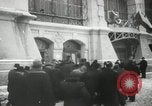
Life under Soviet domination in Eastern Europe following World War II
Legislators entering a hall in Czechoslovakia, in 1948. Inside,an image of the Small Coat of Arms of the Republic of Czechoslovakia (1920) dominates the scene. New scene shows Gustav Husak, acting Prime Minister, delivering an address urging support for the Communist Party. The next sequence shows violent Communist-led demonstrations, as armed trade unionists riot in the Prague streets, attacking the offices of the political opposition. Police attempt to restore order. On February 25, 1948, the communists achieve a Czechoslovak coup d'état. On February 27th, Czech President, Edvard Benes, receives a delegation including communist Premier Klement Gottwald and the 12 new members of the cabinet, at the Presidential Palace. He is seen signing documents accepting the communist cabinet. Change of scene shows Czech Foreign Minister, Jan Masaryk, giving a speech rejecting the change. (He remained in office, but died under suspicious circumstances on On March 10, 1948.) View of Masaryk in his casket. Mourners at his funeral.The Czech Parliament Building with flag at half staff. President Benes seen strolling, using a cane, accompanied by his wife, Hana Benes, in the garden of their summer home, Benesova vila, in Sezimovo Usti. Narrator notes that he refused to sign a new constitution drawn up by the communists. He died of natural causes at his villa on September 3, 1948. Scenes of his funeral and of him in his casket. Views of Benes' state funeral, with mourners lining the streets. View of British Prime Minister Winston Churchill. Narrator describes circumstances using Churchill's term "Iron Curtain." A communist parade in an Eastern European city. A person who was roughed up on the street. View of East German uprising in 1953, being suppressed with Soviet tanks. Uprising in Poland in 1955 being put down by local police and Russian soldiers. Polish musicians playing and examples of Polish political cartoons permitted under relaxed communist rule.
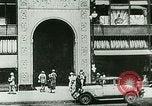
The U.S. National stock market craze during the "Roaring 20's" before the stock market crash.
An office entrance in Tacoma, Washington. Sign at door reads: "A.R. Blair & Co. Importers." A man smokes and reads the Tacoma Daily Ledger newspaper in his office. He reads the page with New York Stock Exchange (NYSE) prices for Thursday, August 30, 1928. A sign '"George R. McCall & Company, Stocks and Bonds, with offices at New York, Buffalo, Chicago & St. Louis." A number of the company's clients sit in chairs and watch as the latest stock prices are posted on display boards. Men are shown on the telephone communicating stock orders to their brokers. Hectic activity is seen on the New York Stock Exchange with floods of orders to buy and sell shares. Stock exchange number boards lit up with numbers. Men are seen in various places hovering over stock exchange ticker tapes running fast out of ticker tape machines. Scene of fireworks in the sky at the end (alluding to collapse of the stock market and the "Crash" on Wall Street that precipitated the Great Depression).
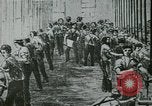
Industrialization of the U.S. and U.S. President Andrew Jackson and statesman Daniel Webster in the America
The history of the United States. Illustration : industrial workers at work in mills in New York. View of other industries with power machinery. New York is made the economic capital. Vehicles on streets. A map showing the east of Mississippi and new states added to the union. Andrew Jackson becomes the U.S. President in 1828. Men of the Congress during a meeting. American statesman Daniel Webster addressing the House of Representatives. Men listening to Daniel Webster.
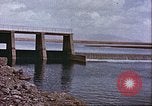
Morrison-Knudsen construction company builds dams and irrigation canals in Afghanistan
Opening scene shows the Boghra diversion dam and associated irrigation canal built by Morrison-Knudsen Construction Company (MK) along the Helmand River in Afghanistan. Three MKA (Morrison-Knudsen-Afghanistan) engineers stand on the bank of the new irrigation canal of this project. Glimpse of a small power plant built on the canal. A man turns a large wheel releasing water from lateral canals into the main canal which would irrigate an experimental farming area. An MKA yellow truck,carrying three Afghans in the back, drives through an ancient gate to the headquarters for this experimental farm at an ancient caravan fortress named Nad-e Ali. Next, an Afghan is seen driving a tractor pulling a set of harrows to till the soil. A field where seed was planted. Scene shifts to later when the seeds have grown and an Afghan farmers are seen harvesting the new grain by hand. The next year, fields of alfalfa are seen from the first year's seeding. Another tractor is seen working at the edge of a field of crop. Afghan farmers use hand cultivators to tend the crops. View of large fields of crops. An Afghan boy stands on the bank of the Boghra canal. View of camels grazing in sparse desert area. Scene shifts to Afghan and MKA officials negotiating another contract. View of brass sign on the Export Import Bank in Washington, DC. Inside, officials of the Bank are seated around a table. (Narrator states the Bank provided a 22 million dollar loan for the new extended construction contract.) View of the Helmand River (and its deep canyon Northwest of Kandahar) and the Arghandab River, where large dams were to be constructed. Dump trucks are next seen commencing work at the Arghandab site, building a work road atop a dike along the side of the river. Camera pans across the broad sweep of the project underway. Construction equipment of all types seen moving along the work road and at work atop the dam. Afghan workers operating power shovels. Earth and stones moving on a conveyor belt. Wooden forms being built and steel reinforcing bars being installed. Afghans clearing areas for drilling operations. Afghan powder men ram charges into areas to be blasted. View of man pushing handle to ignite the charges. Explosion raises smoke, debris and dust. More views of construction equipment in operation Views of the dam at about the 200 foot height.
A river no longer navigable in France due to a bombed out bridge during World War II. The French repair the bridge
Many commercial barges tied up next to one another along banks of a river blocked by a destroyed bridge in France during World War 2. Numerous tug boats also tied up along the river bank. View from one bank of the remains of the bridge completely blocking river traffic. A man rows a small boat from the near shore. Camera pans over the wreckage. Next workers are seen repairing the bridge. Water flows rapidly through an open section of new substructure. A barge loaded with men and steam driven equipment is on the up-river side of the bridge. Black smoke issues from burning coal or oil powering the barge. A single new walkway spans above the bridge opening. Next is a closeup of the work barge with steam rising from it. A different section of the bridge structure is seen next, with a gang of workmen on new bridge decking and others working from below on a barge. Closeup of workers installing the bridge decking. One is cutting excess length of a board, with a hand saw. Several men looking over the edge of the bridge deck at water flowing through spillways underneath it. Closeup of a diver in complete diving gear, including a metal helmet, working at the base of the bridge. Man climbing a ladder from a steel section of bridge. Worker using an Oxy-Acetylene Cutting Torch to remove a damaged section of steel. Tugboats plying the river. Local citizens watching the tugboats from atop a downstream bridge. as boat traffic resumes with the upstream bridge repaired. Closeup of tugboat passing under the bridge. Glimpse of tugboat under a graceful undamaged bridge. Closeup of a bulk carrier powered barge passing a bridge filled with spectators. A clamshell bucket grabbing material from the barge and raising it to load it somewhere.
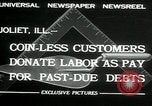
Debtors construct store, paint roofs and eat after work to pay their debts to the Grohar brothers in Joliet, Illinois
The Grohar brothers, grocers, induce workers to build a new store in Joliet, Illinois, during the Great Depression. Unemployed debtors including carpenters,brick layers,plasterers,grocers and other artisans work on building of a new store to pay off their due debts. The new store known as 'the store that friendship built'. A cement trolley on ground. Two men note. Workers paint roof. Workers eat food.
CRITICALPAST.COM: About Us | Contact Us | FAQs - How to Order | License Agreement | My Account | My Lightboxes | Shopping Cart | Advanced Search | Featured Collections | Website Terms & Conditions | Privacy Policy ©2026 CriticalPast LLC.
License Agreement |
Terms & Conditions |
Privacy Policy
©2026 CriticalPast LLC.