


 Francais
 Deutsch
 Italiano

Refine Your Search
US-Gliders- stock footage and images
- Showing 6907 to 6912 of 21999 results more
 Hide

U.S. soldiers relax aboard a landing craft underway in the English Channel during World War II.
U.S. soldiers aboard a ship underway in the English Channel during World War II. A soldier smokes a cigarette. Soldiers sleep aboard a landing craft as they head towards Normandy, France. A soldier opens a ration can aboard the craft. Two soldiers look towards an invasion fleet in a harbor.
A U.S. Army Air Service Martin transport aircraft takes off and in flight in the United States.
An early cargo and transport aircraft of the United States Army Air Service in the United States. A U.S. Army Air Service Martin Transport airplane on a field. Exteriors of the aircraft. Interiors of the airplane with two men seated. They look out from the aircraft. Airplane propellers start to rotate. The motors warm up. The engine starts and the aircraft takes off. The aircraft lands after a flight.
A U.S. Army Air Service DH-4 Honeymoon Express takes off and in flight in the United States.
Early transport aircraft of the United States Army Air Service in the United States. U.S. Army Air Service DH-4 Honeymoon Express on a field as an engine starts and the propellers begin to rotate. A pilot in the cockpit. Passengers in the compartment wave. Specifications of the aircraft. The airplane taxis and takes off. The aircraft in flight. It flies at a speed of 118 miles per hour. The aircraft comes in for a landing and lands on a field.
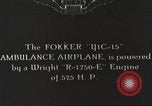
U.S. Army Air service Fokker YIC-15 ambulance plane takes of from a field in the United States.
Early cargo and transport aircraft of United States Army Air Service in the United States. U.S. Army Air Service Fokker YIC-15 Ambulance airplane on a field. Propellers of the aircraft rotate as the engine starts. Men carry a litter patient and place the litter into the plane. Interiors of the aircraft has a cabinet with medicines. Mounting litters and padding on the side to absorb shocks. Aircraft warms up. Aircraft taxis.
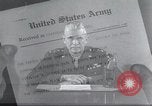
U.S Army Lieutenant General Brehon Somervell urges all Americans to contribute to war effort during World War II.
U.S Army Lieutenant General Brehon Somervell gives radio address to all Americans early during World War 2. He cites the early defeats being suffered by America and its allies in the struggle against the Axis Powers worldwide. He emphasizes the importance of Americans devoting all their efforts to work for the war effort, and exhorts everyone to avoid anything in their civilian life and pursuits that might impede the Nation's war efforts. He states that if things go unchanged, it will be too late to save ourselves and America and civilization. He notes there is no room for any interest groups whose interests and actions might weaken America's war efforts. He appeals to all Americans to back up their fighting men.
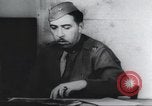
U.S. VIII Bomber Command, 97th Bomb Group, 342nd Bomb Squadron Commander is debriefed by a 97th Bomb Group Intelligence Officer (WW2)
Film opens showing a Captain, Intelligence officer with the U.S 8th Airforce 97th Bombardment Group, debriefing Captain William “Bill” Musselwhite, Commander of the 342nd Bombardment Squadron, about his unit's experience participating in the first Eighth Air Force heavy bomber mission in World War II, attacking the Rouen-Sotteville marshalling yards in France, on August 17, 1942. Referring to a map, he asks Captain Musselwhite where his Squadron dropped their bombs. Musselwhite points out the path of his units aircraft and that his first aircraft overshot the target, but those following dropped "on range," bracketing the target on left and right, with one "stick" of bombs going right down the middle. He mentions one ship straying over the town of Rouen, itself.
CRITICALPAST.COM: About Us | Contact Us | FAQs - How to Order | License Agreement | My Account | My Lightboxes | Shopping Cart | Advanced Search | Featured Collections | Website Terms & Conditions | Privacy Policy ©2026 CriticalPast LLC.
License Agreement |
Terms & Conditions |
Privacy Policy
©2026 CriticalPast LLC.