


 Francais
 Deutsch
 Italiano

Refine Your Search
US-Gliders- stock footage and images
- Showing 6913 to 6918 of 21999 results more
 Hide
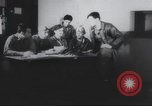
B-17 crew of the U.S. 8th Air Force is debriefed by intelligence officer upon return from a bombing mission.
A U.S. intelligence officer interviews members of a flight crew upon their return from a bombing mission in World War 2. Pilot of the aircraft says that as the B-17 aircraft approached the target over the river, they were hit by Flak in the left wing and tail surface. The Pilot says they dropped their bombs effectively and were attacked by "109s or 190s" (Messerschmitt Bf 109s or Focke-Wulf FW-190s) that dove down on them and swooped up underneath. He refers to his ball turret gunner sitting next to him and says he knocked off one of them. The gunner says he saw the German plane when it came down from the tail, dove under, and started coming up. When asked, the gunner says the German plane was about 900 feet away when it was hit by his machine gun fire. He also noted they were the last ship in the bomb run. Next, after questioning the tail gunner, the intelligence officer asks the Bombardier about his actions. He explains that after releasing his bombs, he began to plot their positions as they exploded on the ground. He notes they got good bursts on the engine sheds, on the concentrations of box cars in the center of the marshalling yards, and on the viaducts leading to the center of the bridge. He notes that all the bombers ahead of them hit some part of the target, with most dropping their bombs right where they were supposed to. (World War II; WW II; World War 2; World War Two)

British Foreign Secretary Eden reviews troops during a visit to U.S. bomber station in England (WW2)
British Foreign Secretary Anthony Eden at an airfield in England during World War II. Anthony Eden reviews troops at the airfield. Lieutenant General Jacob L. Devers and Major General Ira C. Eaker accompany the Secretary. Eden shakes hands with the officers at the U.S. bomber station. Secretary Eden looks on with an aircraft in the background. A man seated in the cockpit with Nazi German swastikas on the door of the plane. Secretary Eden shakes hands with flight crew members lined up at the bomber station. Officers including Colonel Curtis Le May, Colonel Archie Old, Colonel Peterson also present at the air base.
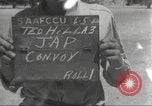
U.S. Army Air Forces operations at Nadzab Airfield Complex, New Guinea, during World War II
The U.S. Army Air Forces Nadzab Airfield Complex, New Guinea, during World War 2. USAAF P-38 aircraft on the flightline. A P-38 on takeoff roll passes the camera. Camera pans across the runway to a line of parked B-25 bombers. A B-24 Liberator bomber of the 90th Bomb Group (Skull and Cross Bombs on its tail) takes off, followed by two P-38s,and another B-24. Closing segment shows several Japanese prisoners of war.
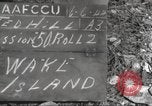
Views of destruction from Japanese air raid on Wakde Island, New Guinea, as U.S. forces occupy it during World War II.
Scenes of destruction from Japanese air raid on Wakde Island, New Guinea during World War II. (Opening slate incorrectly reads Wake Island.) U.S. troops bivouacked in tents near shore. Large supply Ship and several others visible in background.
U.S. Aircraft destroyed on the ground by Japanese air raid in Wakde, New Guinea, during World War II.
Aftermath of Japanese air raid on Wakde Island, New Guinea during World War 2. Numerous destroyed U.S warplanes litter the field. Some are still burning. Most are unrecognizable, but the wrecks appear to include B-25s, B-24s, and P-38s.
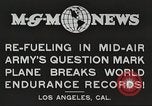
U.S. C-2A being successfully refueled in mid air from a Douglas C-1 aircraft in Los Angeles, California.
U.S. Army Air Corps C-2A aircraft being refueled in mid air during a 11,000 mile long endurance flight in Los Angeles, California. C-2A aircraft in flight with the Douglas C-1 aircraft in flight forward and above it. Tanker plane C-1 lowers its hose to Question Mark aircraft. Crew member on Question Mark catches the hose and drags it inside. C-2A aircraft being refueled in mid air. Another aircraft in flight in the background. C-2A Question Mark aircraft being towed by a tractor on a field as ground crew surround it.
CRITICALPAST.COM: About Us | Contact Us | FAQs - How to Order | License Agreement | My Account | My Lightboxes | Shopping Cart | Advanced Search | Featured Collections | Website Terms & Conditions | Privacy Policy ©2026 CriticalPast LLC.
License Agreement |
Terms & Conditions |
Privacy Policy
©2026 CriticalPast LLC.