


 Francais
 Deutsch
 Italiano
Refine Your Search
US-Gliders- stock footage and images
- Showing 721 to 726 of 21920 results more
more Hide
Hide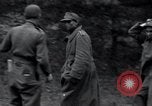
Released U.S. prisoners wave at U.S. soldiers of 117th Infantry Regiment, 30th Infantry Division Grasleben in Germany.
Released American Prisoners of War (POW) kick and throw objects at a German prisoner of war at Grasleben in Germany, near the end of World War 2 in Europe. The released U.S. POWs wave at the American soldiers of 117th Infantry Regiment, 30th Infantry Division passing in trucks and jeeps. They gather around a jeep and converse with soldiers of the 117th Infantry.
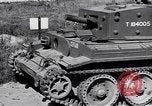
British Centaur and Cromwell tanks, and a U.S. M-4 tank are compared using various tests at Aberdeen Proving Grounds.
Comparison tests being performed between a British Centaur tank, a British Cromwell tank, and U.S. M-4 tank at the Aberdeen Proving Grounds in Aberdeen,Maryland. The three tanks are rolled onto various types of surface such as concrete, mud and sand to compare their maneuvering capabilities.
U.S. 5th, 149th, and 150th Field Artillery use flares,shells, and searchlight, to find enemy trenches, at night, in WWI
Signal rockets are seen in the black night sky, falling over no man's land, to illuminate German trenches, in France during World War I. A bright searchlight and bright artillery explosions illuminate trenches and barbed wire. U.S. 5th, 149th, and 150th Field Artillery fire guns during the day.

U.S. sailors aboard the USS Memphis salute as Lindbergh climbs aboard to return to the U.S.
Aviator Charles Lindbergh leaves Paris after his trans-Atlantic flight. The USS Memphis arrives to receive him. The U.S. flag on the ship. 'Memphis' written on the ship side. Sailors on the deck. A boat approaches the ship. Sailors standing on the smoke stacks and on deck await his arrival. They watch as Lindbergh boards the ship. The sailors salute as he climbs aboard. They greet and congratulate Lindbergh.
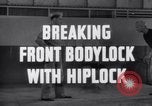
U.S. sailors demonstrate how to break front body lock with hip lock and backward flip during a navy training program in the U.S.
Demonstration of methods of attack and counterattack in a hand to hand combat by two sailors of the U.S. Navy. Two sailors show how to break front body lock with hip lock. One of the sailors attacks another from front. Both the sailors grab each other. The second sailor puts one of his arms at the attacker's elbow, passes his other arm beneath the attacker's other arm, twists and bends causing the attacker to fall. Next they demonstrate Backward Flip- foot to stomach. Both the sailors grab each other's neck. One of them puts his foot on another's stomach. He drops to the ground on his back and hauls the other sailor overhead. Both of them fall to the ground. He twists around still holding the attacker's neck. (World War II period).

U.S. Army's 'Round the World Flight in 1924, using Douglas World Cruiser aircraft
Documentary about the U.S. Army's flight around the world in 1924, employing four Douglas World Cruiser aircraft. A flag of United States. Crowds gather around around. the four Douglas World Cruisers, named Boston, Chicago, New Orleans, and Seattle, as they prepare to depart from Seattle, Washington, on their expedition. One of the aircraft taking off. All the aircraft in flight over Seattle Washington. Major Frederick F. Martin Commander of the flight. An animated map shows the aerial expedition's route and locations of various accidents and incidents that beset them along the way. View of one Douglas World Cruiser in flight, equipped with floats. The expedition was completed by the Cruiser,Chicago, crewed by pilot, Lt. Lowell Smith and Lt. Leslie Arnold; and by the New Orleans, crewed by pilot, Lt. Erik Nelson and Lt. Jack Harding, who are seen being congratulated by expedition Commander, Major Frederick F. Martin upon their completion of the mission in Seattle, on September 28, 1924.
CRITICALPAST.COM: About Us | Contact Us | FAQs - How to Order | License Agreement | My Account | My Lightboxes | Shopping Cart | Advanced Search | Featured Collections | Website Terms & Conditions | Privacy Policy ©2026 CriticalPast LLC.
License Agreement |
Terms & Conditions |
Privacy Policy
©2026 CriticalPast LLC.