


 Francais
 Deutsch
 Italiano
Refine Your Search
US-Gliders- stock footage and images
- Showing 727 to 732 of 21920 results more
more Hide
Hide
U.S. Army Air Corps sets new airborne endurance record using midair refueling
The U.S. Army Air Corps Fokker C-2 named the 'Question Mark' is rolled out and takes off.from Van Nuys, California, on New Years Day 1929 with Capt.Ira Eaker at the controls. Shortly thereafter,it is refueled by a C-1 airplane piloted by 1st Lt. Odas Moon and 2nd Lt. Joseph G. Hopkins., View of the The C-1 above and slightly ahead of the Question Mark, maintaining 20 to 30 feet of vertical separation, with both aircraft stabilized in level flight at 80 mph. The refueling hose is reeled out. View of the Question Mark in flight over the coast of California. At the conclusion of the mission, cut short by engine trouble after 150 hours aloft, the crew, Sgt Hooe, Lt. Elwood Quesada, Lt Halverson, Captain Eaker and Major Spatz are seen standing in front of their airplane, the FokkerC-2, Question Mark.
U.S. Army Air Service Lieutenants John A. Macready and Oakley G Kelly fly non-stop, coast-to- coast across the U.S.
U.S. Army Air Service fliers, Lt. John A. Macready and Lt. Oakley G Kelly, are seen boarding their Fokker T-2 and taking off from Roosevelt Field, Hempstead, Long Island, New York. They are embarking on the first non-stop coast-to-coast flight across the United States. Their airplane seen in flight.
U.S. Navy aircraft attacks on Japanese installations during period of Kamikaze attacks by Japanese against U.S. ships in Pacific
Aerial views and gun camera views of U.S. Navy planes attacking Japanese installations and shipping along coast in the Pacific Ocean in World War II. Explosions and smoke as ground targets are bombed and strafed. Aerial views of smoke rising from coastline.
Two crashed U.S. Navy R5D aircraft near U.S. Navy Air Base in Tsingtao, China
Tsingtao (Qingdao) Shantung Province, China. Camera pans over a hilltop with foliage and several buildings, near the U.S. Navy Air Base at Tsingtao (Qingdao) Shantung Province, China. It focuses on several sailors standing near a completely destroyed Navy R5D (Douglas DC-4) aircraft. The outer wings are missing and its four engines have been removed. While panning the wreckage, the camera picks up part of a tail number reading:" 80395." To the right, another aircraft fuselage is seen. Strips of aluminum are missing from it. It also appears to be a Navy R5D. A view of the cockpit shows the two control yokes missing from their pedestals. (Apparently salvageable parts have been removed from these crashed aircraft by Navy personnel.)
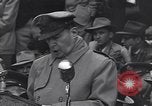
U.S. General of the Army, Douglas MacArthur, criticizes U.S. policy in Korea and at home, calling it a bankruptcy of leadership.
In a outdoor speech before a joint assembly of the Mississippi State Legislature, Douglas MacArthur, General of the Army, talks about freedom, American tradition, and leadership. His remarks are critical of the current U.S. Administration and its failure of spirit, not of military resources, to tackle communism in Korea during the Korean War. He calls it a bankruptcy of leadership in our American tradition, and a glaring failure in Korea. He completes his speech, referring to God, and the religious faith upon which the country was erected. The General is applauded and thanked formally. The Legislators then act to dissolve the joint assembly.
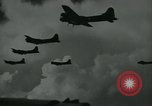
U.S. Army Air Forces demonstrate a glide torpedo for use against water-borne targets in World War II
A demonstration of the Aeronca GT-1 glide torpedo. Six Boeing B-17 Flying Fortress bombers, of the U.S. Army Air Forces, fly in formation. Next, splashes from their guided bombs are shown in water below. A slate appears with illustration and title, "Preset Glide Torpedo Model GT-1." A GT-1 is shown rotating while hung from a chain in a manufacturing area. Another Aeronca GB-1 is on the floor in the background. Four airmen push a GT-1 on a wheeled dolly. They roll it and position it underneath the wing of a B-17. Closeup of them jacking up the dolley to position the GT-1. View of the torpedo secured under the aircraft. Gun camera footage shows a GT-1 on a long glide towards the water, after release from above. View from water surface of the GT-1 approaching the water. At the last moment, its paravane (wing) separates and the torpedo contacts the water. The paravane falls aside into the water. The camera pans over to a makeshift target. The process is repeated with a second GT-1 but it is not seen close to the water. A third demonstration is successful and the wake of the torpedo is tracked from an overflying aircraft.
CRITICALPAST.COM: About Us | Contact Us | FAQs - How to Order | License Agreement | My Account | My Lightboxes | Shopping Cart | Advanced Search | Featured Collections | Website Terms & Conditions | Privacy Policy ©2026 CriticalPast LLC.
License Agreement |
Terms & Conditions |
Privacy Policy
©2026 CriticalPast LLC.