


 Francais
 Deutsch
 Italiano
Refine Your Search
US-Gliders- stock footage and images
- Showing 865 to 870 of 21920 results more
more Hide
Hide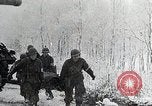
U.S. Army operations in Germany in World War II, including battle of the bulge and difficult snow and winter weather conditions
Medical Corpsmen carry a wounded U.S. soldier on a stretcher across snow covered battlefield, in World War 2. U.S. infantry firing small arms at German enemy on snow covered battlefield.They run across the field and occasionally take cover, lying down in the snow with close-up views of soldiers firing from prone position. U.S. troops on the march single file and running along path in woods in fog and snow. Troops in winter clothing, with snow encrusted, suffer wind and snow as they try to clear roadway using shovels. A tractor with a snow blade sits nearby. Snow covered U.S. troops enter a town. U.S. artillerymen fire 240mm howitzer and 155mm long tom gun, under camouflage nettings. Troops moving single file up a mountain roadway. M4 high speed tractors pulling 155mm guns along a snow covered road, shrinking Nazi progress in the Battle of the Bulge. Troops ride a tank through snow. Some soldiers wear white camouflage coveralls. Two U.S. soldiers ride in jeep over rainy muddy road with snow on roadside. "Ogden, Utah" painted on bottom of windshield. U.S. troops wade through mud and water. German prisoners of war being marched single file through a woods. Jeeps and an ambulance mired down in mud. Formation of U.S. C-47 aircraft flying low and air dropping ammunition and supplies to American forces on the ground. Soldiers rush to an air dropped bundle and distribute its contents.German prisoners of war march along a path. Four carry a wounded comrade on a stretcher. Temporary U.S. field cemetery with white wooden crosses. A temporary field cemetery with German crosses. Group of U.S. soldiers reading letters from home, and then looking up as a group to watch a formation of B-17 bombers leaving contrails at high altitude overhead. View from a B-17 as bombs explode on target below. Views from U.S. fighters strafing and firing rockets at German ground targets.View from bomber of incendiary bombs creating fires at night in Germany. A B-24 Liberator bomber seen from the ground, as it flies through smoke and flak.
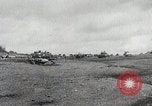
U.S. Army campaign leading to capture of Cologne, Germany, in World War II
U.S. troops huddle together on Sherman tanks late in World War 2 in Europe. U.S. Infantry and tanks moving across open fields. View from cottage window of American infantrymen swarming across a field. U.S. tanks and infantry entering outskirts of Cologne, Germany. One soldier plays a French horn, as he marches into town. Several German civilians walking together. German soldier POWs (prisoners of war) being herded under guard of American Army forces. German civilian refugees walking on a road. Graffiti scrawled on wall reads "Hitler ist Kaput". Numerous trucks filled with German prisoners of war. Civilians watching as U.S. Army M10 tank destroyers move into town towing 155mm long tom guns. Amusing graffiti by U.S. troops reads, "I'll walk Cologne" with arrow pointing (alluding to popular song, "I'll Walk Alone.") U.S. troops loading and firing 155 mm long tom guns. Civilians holding their ears, as they watch. U.S. troops entering center of Cologne, Germany. Towers of Cologne Cathedral visible in background. U.S. infantry firing from behind pile of rubble. Tanks rumble through streets of Cologne. House to house fighting. U.S. Army 3rd Armored Division tanks in streets of Cologne, and soldiers with small arms firing at buildings in clearing operations from building to building. A German soldier emerges from building with hands held up in surrender. Tank firing causes part of a building to collapse. Infantry moving along roadway with Cathedral visible in near background. City buildings of Cologne seen destroyed with rubble everywhere. German Mark V Panther tank is hit by fire from U.S. Army gunner Corporal Clarence Smoyer in a M-26 series Pershing tank (a T26E3) with a 90mm gun, at position at the An den Dominikanern and Marzellenstraße crossroads. German Army soldiers jump from the Panther tank. The Panther Tank is hit again from the American Pershing tank, and goes up in flames and smoke. View from wreckage of the Cologne Cathedral. Bridge across the Rhein (Rhine) River. U.S. forces moving across the bridge. A sign posted on bridge pillar reading: "Cross the Rhine with dry feet, COURTESY OF 9TH ARMD DIV." View from vehicle crossing the bridge. U.S. medics treating casualties in wooded area.
The use of RADAR by Allied forces throughout World War 2
Film made in 1946 recounts use of RADAR in World War 2. Air raid sirens sounding in London, England,1940, during Battle of Britain. Air raid warden helps people to shelters during blitz bombing run by German Luftwaffe aircraft. German He 111 bombers in formation overhead. Woman scoops up child. British gunners man a 3.7 inch antiaircraft gun. Farmer rides horse-drawn plow. RAF airman rings alert bell that reads: "Don't come and tell.Ring this like hell." RAF pilots scramble to their Spitfire fighter planes and take to the air from a British airbase or aerodrome. German He 111 bombers being intercepted.Wreckage of German bombers. Evening views of London. Prime Minister Winston Churchill contributing to a war drive and receiving a pin from a woman. He doffs or tips his hat. Technician using a slide rule. Early British radar antenna tower. A U.S. P-38 aircraft in flight. Animated diagrams explaining how radar works. Radar operators at their screens receiving radar transmissions. U.S. Army soldier operating antiaircraft radar in the field. Antiaircraft gun firing and downing an airplane. Artllerymen decorate gun barrel with symbols for enemy aircraft downed. A U.S. B-29 bomber in flight with bomb bays open. Bombardier with bomb sight having radar and optic options, using radar to sight target. Bombs away view of bombs falling from aircraft through clouds. A U.S. P-61 night fighter aircraft equipped with airborne radar. Hand of pilot of P-61 pressing button to fire on enemy aircraft at night. A C-47 transport aircraft flying in poor visibility makes a ground controlled approach and landing enabled by radar. A U.S. Navy F6F landing with radar help, on an aircraft carrier. A U.S. battleship. Sailors quickly get up from sleeping bunks responding to battle stations at night. Radar antenna rotating on a U.S. warship. Naval guns firing at night. U.S. heavy cruisers bombarding a shoreline. A submarine underway submerged. Navy ship tracking enemy submarine. Destroyer firing depth charges. A PBY Catalina flying over a convoy of ships.
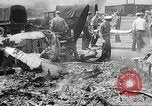
U.S. Navy officers and sailors attend prayer services for dead servicemen in Honolulu, Hawaii after the Pearl Harbor attack.
From a 1943 film blending dramatized scenes and actual archival footage about the conditions soon after the attack on Pearl Harbor in Honolulu, Hawaii in December 1941 by Japanese bombers during World War II. U.S. troops remove the dead bodies of soldiers who died in action. The U.S. flag on the grave of a U.S. soldier. Pictures and parents of U.S. service men of the Navy, the Marine Corps, the Army and Medical Corps who died during Pearl Harbor raid. The family of a U.S. Medical Corps Lieutenant who died during Pearl Harbor raid. Wife of the same lieutenant holds her baby born after the attack. Prayer services for the dead U.S. servicemen. Families of the dead servicemen lay wreaths and flowers around U.S. flags. U.S. Navy officers and sailors at shore attend the memorial services. Ceremony shows line of U.S. Navy sailors laying garlands around each U.S. flag bearing the names of U.S. servicemen who died during Pearl Harbor attack. An Army Chaplain and Navy officers attend the prayer services. Palm trees on the beach.
Vice Admiral Halsey looks at a map aboard a U.S. warship and infantry men advance across jungle swamps on the Solomon Islands.
A naval battle rages off the Solomon Islands during World War II. The Japanese fleet underway in the Pacific Ocean. A U.S. warship fires at Japanese ships. Animated map shows the main objective of the Japanese that is to capture Guadalcanal. A U.S. bomber lands and taxis. A signal officer gives a signal. A pilot in a cockpit. U.S. Navy Admiral Chester William Nimitz seated in a chair discusses the strategy of attack with an officer. U.S. Navy Vice Admiral William Halsey, Jr. looks at a map aboard a U.S. warship. U.S. ships underway in the Pacific Ocean. Animated map shows the positions of ships underway in different directions. A U.S. ship underway. Troops on its deck. U.S. Army General Douglas MacArthur gets off a car in New Guinea. U.S. infantry troops in trucks and jeeps advance along a dirt road. Troops in a jeep wearing gas masks. Troops seated in a truck hold guns. U.S. soldiers stand around an aircraft. A U.S. bomber aircraft in flight. The bomber aircraft taxis and takes off. The troops get off from the aircraft. Infantry men advance through a jungle. Men lay logs to make a bridge. A convoy moves over a bridge carrying supplies. Soldiers load shells in an artillery and fire. The troops advance through a jungle. They fire artillery. Smoke rises due to the firing. Artillery pounds Japanese positions. The infantry advances across jungle swamps.
Condensed highlights of U.S. forces engaging Japanese in Pacific island-hopping campaign (WW2)
Aerial view from high altitude, shows convoy of American warships underway in the Pacific War in 1943 (World War II). Nearest ship seen is an aircraft carrier. Illustrated globe and animated map show a Naval Task Force headed through the Gilbert and Marshall Islands. Three U.S. Navy Douglas Dauntless dive bombers seen flying in formation with an aircraft carrier steaming in the background. Glimpse of more aircraft carriers. Sailors in the powder handling room of the Cruiser USS Chicago (CA-29) carrying cylinders of powder for her 8-inch guns. Sailors, stripped to the waist, in one of her gun turrets, load an 8-inch shell and powder charges into the breech of one of Chicago's guns. Interesting view from below, as they close the breech and step back as the gun fires. Glimpse of Naval guns firing from a U.S. warship. Another view of sailors loading an 8-inch gun on the USS Chicago. (Note: The USS Chicago was lost between Rennel Island and Guadalcanal in the Solomon Islands on 30 January 1943.) A Baltimore Class Cruiser firing its guns. Flashes from naval guns firing from several American warships in close succession. Fire directed at the shore of a Japanese held island. Gun camera footage from a U.S. warplane strafing Japanese aircraft on the ground at an enemy air base. More gun camera footage of strafing and bombing. Closeup of a U.S. Army Air Forces B-26 Liberator bomber in flight, with others in the background. Views from U.S. Aircraft as their bombs strike Japanese targets on the ground below. A U.S. Navy TBF Avenger aircraft flying overhead as viewed from a landing craft. View from inside a landing craft full of U.S. troops heading toward an amphibious landing. Closeup glimpse of Coxswain in landing craft and troops aboard behind him. Amphibious landings being made under fierce friendly and enemy fire. U.S. troops leaving their landing craft under enemy fire. Marines firing small arms, machine guns, and using hand grenades, in Tarawa, Kiribati. Views of fallen Japanese defenders on Tarawa. Closeup of Marine smoking a cigarette. Another is binding shoulder wound of a buddy. American flag raised on one of the few still standing palm trees. American Marines saluting the flag. Bodies of fallen American marines floating at the shore and on the sands of Tarawa. Marines departing Tarawa. Scene shifts to Chinese Kuomintang (KMT) leader Generalissimo Chiang Kai-Shek, seated with President Franklin D. Roosevelt and British Prime Minister Winston Churchill at Cairo, Egypt on 25 November 1943. Leading Allied military leaders sit at a table to hammer out details of postwar plans. American officers present include U.S. Army Chief of Staff George Marshall and Chief of the Army Air Forces, General Henry H. ("Hap") Arnold.
CRITICALPAST.COM: About Us | Contact Us | FAQs - How to Order | License Agreement | My Account | My Lightboxes | Shopping Cart | Advanced Search | Featured Collections | Website Terms & Conditions | Privacy Policy ©2026 CriticalPast LLC.
License Agreement |
Terms & Conditions |
Privacy Policy
©2026 CriticalPast LLC.