


 Francais
 Deutsch
 Italiano
Refine Your Search
US-Gliders- stock footage and images
- Showing 871 to 876 of 21920 results more
more Hide
Hide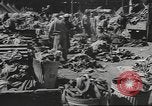
Numerous scenes of U.S. Army Quartermaster salvage operations in Italy during World War II; also brief aircraft crash scene.
U.S. soldiers in the textile repair section of a Quartermaster Salvage Depot, are seen sorting military clothing of all types to be recycled an reissued, or otherwise used as rags for cleaning purposes. Workers from the local populace are hired as paid employees in these salvage operations. A woman removes bundles of used army uniforms from a horse drawn cart and gives them to children who carry them to other women and children who are seen working on various levels of a building, where they mend and otherwise repair and restore the garments. A man works at a sewing machine on the ground floor of the building. But the women and girls seen are all engaged in hand sewing. Scene shifts to a section of the depot yard where tents are being examined, sorted and repaired. Large tents are suspended from a crane to facilitate inspection. The next scene shows interior of a mobile repair shop designed for the Signal Corps, where soldier technicians work on electrical and electronic equipment. A soldier repairs an SCR 536 (better known as handy talky) and an Army Technician fourth grade (T/4) works on an SCR-508 mobile Signal Corps Radio. He tests each tube and connection. A Staff Sergeant removes parts from a BD 72 field switchboard. Outside, several local civilian men employed by the Depot, are physically salvaging useful items, such as brass knuckle joints from metal tubing. Another pulls worn copper wire from an armature. Elswhere in the yard, soldiers and local helpers salvage lead plates from old storage batteries, where they are melted down over a fire and poured into old army helmets, serving as improvised ingot molds. A huge collection of spent artillery shells covers a vast area in the depot. They are loaded aboard barges and brought to ships for transport back to the U.S where they will be repacked and reused. Soldiers collect unserviceable tires for reshipment back to the U.S. Soldiers inspecting a pile of tires. Soldiers inspecting rubber tubes and checking them for leaks. A pile of inflated tire tubes left to sit awhile before being inspected. Outside the infantry too repair shop, soldiers repaint pick mattocks and set them out to dry. Using tools they invented, two soldiers remove wooden handles from shovel blades and from ax handles, in the infantry shovel repair department. Inside the building, soldiers are seen repairing stoves in the stove repair department. One ignites a stove and checks its flame. In a corner of the shop, a worker repairs gasoline lamps. Several are seen illuminated. Soldiers hammer out dents in mess kits and use compressed air and stone molds to take dents out of canteens. One disinfects mess gear by dipping in a lye bath and then in water and repeating that procedure again. He hangs them in the sun to dry. At one spot (where no smoking is written on the wall in Italian) a soldier works repairing 5 gallon (Jerry) gasoline cans using air pressure and water immersion to detect any holes. A jerry can is brazed by a worker using an acetelyn torch and rod. A warplane is seen crashing in flames. Signs advertising salvage as savings, are seen in various places. Salvage trucks and cranes are seen along with glimpses of salvage crews at work. A cartoon sign by a destroyed building shows a GI with ax holding Hitler's head. It reads: "Behead Hitler. Turn in Salvage." Another cartoon sign shows a girl and reads: "You will bet back to me sooner, if you turn in your salvage." A GI whistles in admiration as he passes the sign to pick up two discarded jerry cans. He salutes the sign as he walks away.
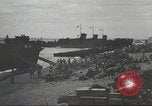
U.S. forces prepare for attack against Japanese forces on Munda, readying supplies, troops, and aircraft.
Planning and moving of U.S. equipment, supplies, aircraft, and soldiers in preparation for attack at Munda Point on New Georgia Islands, Solomon Islands during World War 2. U.S. Marines and infantry massed up on Guadalcanal beach prepare for the invasion of Munda Point. Gasoline barrels are rolled on the beach. Crated food in cargo nets hoisted aboard ships. Equipment is loaded onto ships. U.S. combat aircraft assemble for an aerial offensive. U.S. Army General Douglas MacArthur exits car and talks with another U.S. officer. General MacArthur, U.S. 13th Air Force Lieutenant General Hubert R. Harmon, U.S. Army Air Force General Nathan Twining and U.S. Fleet Admiral William Halsey plan the attack on Munda Point. United States Army Air Force P-40 Warhawk fighters taxi and take off from an airfield. U.S. aircraft including P-40 Warhawk, P-39 Airacobra, U.S. Navy F4F Wildcat, TBF Avenger, B-25 Mitchell and B-24 Liberator aircraft in flight heading to destroy enemy positions on Munda. Japanese aircraft seen taking off and in flight.
Peacetime activities and contributions by the U.S. Army in the United States.
Scenes from Army Day on April 6, 1934. Secretary of War George Henry Dern, in broadcast to the nation about importance of the Army, in peacetime. Brief glimpses of the Yellowstone River lower falls and Old Faithful and Beehive geysers erupting in Yellowstone Park, Wyoming. View amongst log buildings in Reproduction of Army Fort Dearborn, at the 1933 Century of Progress Exposition in Chicago, Illinois. A pioneer wagon; Native American Indians in ceremonial regalia; antique locomotives and trains at the Exposition. Army General Leonard Wood being sworn in as the Governor General of the Philippines. Closeup of General of the Armies, John J. Pershing, America's highest ranking Military officer. Headquarters of Walter Reed Army hospital, in Washington, DC, named for U.S. Army Major Walter Reed, who confirmed that yellow fever is transmitted by mosquito. Acting on this, the U.S. was able to complete the Panama Canal. View of French dredging equipment sitting idle in the water after Yellow Fever prevented them from completing the Panama Canal. Closeup of U.S. Army General William C. Gorgas, who, in 1904, headed the Sanitary Department that controlled mosquitoes and eradicated Yellow Fever, so the Panama Canal could be finished. View of alligator in swamp near the Panama Canal. Photograph of George Washington Goethals, Chief Engineer credited with making the canal happen. Explosives employed in Panama Canal construction. Earth and rocks being loaded into open rail cars. A steamship transiting the Panama Canal. The Washington Monument; U.S. Library of Congress; and the Lincoln Memorial, cited as examples of accomplishments by U.S. Army engineers. The Wilson Dam, under construction by Army engineers, in Muscle Shoals, Alabama and system of levees being built to control the Mississippi River. The raging Mississippi River during 1927 flood. Flood victims being assisted by U.S. Army soldiers, at a tent camp, receiving food and clothing. An Army airplane flying over a forest fire. Army personnel supervising men in the Civilian Conservation Corps or CCC. Mail being loaded aboard an Army airplane, as airmail service is being opened between Washington DC and New York City. President Woodrow Wilson talking with Army pilot Major Reuben H. Fleet. Mail being loaded into the nose of an airplane. U.S. Army Douglas World Cruiser airplanes in flight, returning from their trip around the world in 1924. A pilot sitting in front seat of a Douglas O-38 airplane, pulls a fabric hood over his cockpit to practice "blind flying". View of the aircraft in flight, with instructor pilot in the open rear cockpit. Army aviators taking a camera and a rifle aboard their airplane as they prepare to leave on an aerial mapping flight. Aerial view of skyscrapers of Manhattan Island, New York City. Army Signal Corps personnel working on communications devices. A cable laying ship operating at sea, in support of the U.S. Army's Alaskan cable and telegraph system. Men loading chemicals into hoppers on Army crop dusting airplane. Several views of Army airplanes crop dusting. Glimpse of boll weevil, the target of their efforts. Closeup of Karl Connell, who as a major in the AEF, in World War I, invented a superior gas mask known as the “Connell” or “Victory” mask. A group of miners wearing gas masks enter a smoky mine entrance. The Army invented tear gas, which is shown being used to thwart a bank robbery, in a staged demonstration. Brigadier General Hugh Johnson, appointed by President Franklin Roosevelt, as head of the Great Depression era National Recovery Administration, or NRA, is seen about to give a speech. Narrator cites him as an example of U.S. Army officers who also serve the country in civilian life. Scene shifts to cadets on parade at the United States Military Academy, West Point, New York.
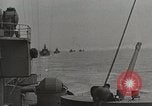
U.S. Naval task force and Amphibious assault operations during World War II in the Pacific
Capital ships of a U.S. Naval Task Force underway in formation, seen from another warship ahead of them. A shell being loaded into the breech of a naval gun, followed by containers of propellant powder. Sailors controlling aiming of guns in triple turret. Closeup from outside, of gun triple guns moving, and then firing to starboard. Glimpse of a battleship firing to port. A Baltimore class heavy cruiser, in camouflage paint, firing forward 8-inch guns to starboard. An Iowa class battleship. A Baltimore class cruiser underway. A Benham class destroyer in camouflage paint. Aerial view of carrier-based Navy Curtiss SB2C Helldiver banking left and diving. Glimpse of bombs falling. Other U.S. Navy warplanes maneuvering. A U.S. Landing ship medium (R) firing rockets. USS LSM-197 and 198 (R) firing rockets. Numerous explosions along the shore of a Japanese held Pacific Island. An Auxiliary Motor Minesweeper underway. Members of a Navy underwater demolition team leaving their boat. Huge underwater explosion raises clouds of water and smoke. A Portland class heavy cruiser firing guns. Shells exploding on shore. More Naval guns firing. A U.S. Battleship firing triple 16 inch guns and double 5-inch guns. U.S. troops climbing down rope nets from an attack transport ship, to board landing craft. The 173 foot Patrol Craft, USS PC-1306 is seen among landing craft. Closeup of U.S. troops in the landing craft and then wading ashore from them. U.S. troops under heavy Japanese fire at Pacific Island beachhead. May hunkered down in sand. Some treat wounded while under fire. Soldiers firing mortars, 75mm pack howitzers., and rifles. More Naval guns firing and Curtiss SB2C Helldiver aircraft flying overhead. Gun camera film of Japanese aircraft being downed by a U.S. carrier based airplane. A U.S. Douglas Dauntless SBD aircraft buzzing over the beachhead. Another gun camera view of a Japanese aircraft being shot down. Landing Ship Tank (LST-1006) arriving at beachhead. An army truck drives her ramp. Various Navy support ships and activities. A U.S. Navy F4F aircraft firing rockets.
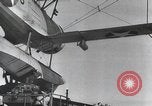
U.S. Navy air and sea forces battle the Japanese fleet during the Battle of Midway in June of 1942, during World War 2
The Japanese Navy and U.S. Navy in combat in the Pacific Ocean during the Battle of Midway in World War II. On June 3rd 1942 : U.S. amphibious aircraft take off from a catapult. A sailor observes through binoculars from a ship deck. A convoy of Japanese ships in the Pacific ocean. A pilot in the cockpit of the U.S. Navy aircraft in flight. A man beside the control panel. The Pacific Fleet Admiral Chester William Nimitz on a ship. The United States sailors work on the ship deck. The sailors inside a cabin on the ship. Men walk out of the cabin to the deck. The men load a bomb in bomb bay of an aircraft. The ammunition on the deck. The aircraft takes off from the carrier deck. U.S. Navy ships attacked by Japanese aircraft. Smoke rising from an aircraft carrier in the Pacific ocean. U.S. ships fire at Japanese planes. A Japanese plane crashes into the ocean. A parked U.S. plane bounces to side of aircraft carrier after explosions and turbulence and nearly falls off edge. Dramatic close view of a Japanese aircraft hit while closing in on a U.S. Navy carrier. A wing tears off and the Japanese plane crashes into the ocean right beside the U.S. Navy carrier. Gun camera footage of U.S. Navy aircraft attacking the Japanese naval fleet. Japanese ships burning and smoking. Views of disabled Japanese ships off the Midway atoll. U.S. soldiers on deck of ship after the battle.
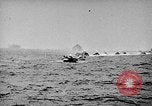
Japan Kamikazes attack U.S. Navy Task Force 58, in battle of Okinawa in World War II
Role of U.S. Navy Task Force 58 in Okinawa, Japan during the Battle of Okinawa in World War 2. Film begins showing amphibious assault by U.S. forces of Navy Task Force 58, against Okinawa, on Easter Sunday, April 1, 1945. Higgins Boats from U.S. transport ships race through the water and discharge troops on the land, with no signs of Japanese resistance. Some of the boats' markings show they came from the U.S transport ship USS Barnett (APA-5). Sailor aboard a transport ship uses ax to cut a line and release a power boat from its davits. The boat drops into the water with a huge splash. View of lines of U.S soldiers and marines wading through shallow water toward mud flats on the land. Closeups of Troops with landing craft behind them. advance overland with no signs of Japanese resistance. Troops sitting on a landing vehicle tracked (LVT) parked in sand. U.S. infantry begin moving inland accompanied by armor and military trucks and other vehicles. The area is very quiet, with no sign of enemy activity. Views of Army and Marine Corps infantry walking beside an M4 Sherman tank. Views of soldiers using binoculars in effort to detect any signs of the enemy. Crews in combat gear, at battle stations aboard Navy ships waiting patiently for enemy action. It came suddenly in the form of Kamikaze attacks on April 6, 1945, when the Navy's radar picket ships were attacked followed by general attacks against U.S. Capital ships. A kamikaze is seen striking an Essex-class aircraft carrier amidst ship, setting off explosions on the ship. Anti-aircraft gunners on various ships are seen firing at the Japanese planes. Another ship is struck by a Kamikaze. Douglas Dauntless and F4F aircraft being launched from carriers. The Battleship, USS Maryland (BB-46), is struck by a kamikaze that knocks out some of her gun emplacements, but she continues her mission in spite of the damage. A kamikaze aircraft is seen attacking the USS Yorktown (CV-10). It is hit by anti-aircraft fire and just misses the ship, splashing into the water nearby. Air is filled by black smoke puffs, from anti-aircraft fire as Japanese aircraft maneuver overhead. One is struck and falls burning to crash in the water, just off the flight deck of a carrier. Gun camera clip showing a multi-engine Japanese aircraft being shot down from behind, by a U.S. aircraft. Closeup of a Japanese Kawasaki Ki-61 aircraft in flight, peeling off to attack. More gun camera footage of a Japanese multi-engine aircraft being shot down from behind. A Kamikaze airplane diving down under anti-aircraft fire and crashing into the sea. Gunners firing Bofors anti-aircraft guns from gun emplacements beside the flight deck of an aircraft carrier. Skies filled with black flak clouds. On 11 April, a low-flying kamikaze Zero, although fired upon, is seen crashing on the battleship, USS Missouri USS (BB-63). It strikes her starboard side, just below her main deck level. The starboard wing of the plane was thrown far forward, starting a gasoline fire at 5 in (127 mm) Gun Mount No. 3. At the same time, another kamikaze crashes into the sea in the foreground. An aircraft carrier's gunners fire anti-aircraft Bofors guns at a Kamikaze plane that swoops over her flight deck and crashes, exploding, into the sea just off the flight deck. A low flying Kamikaze aircraft crashes into the sea off the bow of an escort carrier, underway. Heavy black smoke rises from the airplane blowing up. A huge explosion with a white cloud of smoke is seen above the battleship USS Missouri.
CRITICALPAST.COM: About Us | Contact Us | FAQs - How to Order | License Agreement | My Account | My Lightboxes | Shopping Cart | Advanced Search | Featured Collections | Website Terms & Conditions | Privacy Policy ©2026 CriticalPast LLC.
License Agreement |
Terms & Conditions |
Privacy Policy
©2026 CriticalPast LLC.