


 Francais
 Deutsch
 Italiano
Refine Your Search
US-Gliders- stock footage and images
- Showing 985 to 990 of 21920 results more
more Hide
Hide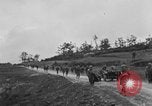
U.S. 24th Army Corps advance and 382nd Infantry, 96th Division battling at Table Top Ridge in Okinawa.
U.S. troops in Okinawa. U.S. 24th Army Corps in Southern Okinawa Front. Troops move along road. Troops along pathway in fields. U.S. artillery shells enemy positions on hills. American plane overhead makes bombing run. U.S. 382nd Infantry Regiment fighting at Table Top Ridge. Artillery fires enemy positions on side of hill. Japanese fortifications on hillside are shelled by artillery. Medics carrying wounded across field. Wounded man transferred on weasel. U.S. 381st Infantry Regiment supported by tanks fighting in Kakzu Ridge. Tanks fire at enemy positions on hills in the background. U.S. troops rushing toward deep fortified cave on hillside. Japanese coming out of cave. Flamethrower firing flames on hillside Japanese caves. Troops of 382nd Infantry, 96th Division advance up hill and place bombs in Japanese caves clearing pillboxes. Explosion in cave. (World War II; WWII;World War 2; WW2)
Antiaircraft gun on tower, manned by U.S. Army troops during World War II, near Avril, France. USAAC aircraft operating nearby.
A steel girder flak tower in woods by Avril, France, near airfield used by U.S. Army Air Force , in World War 2. Barrel of 90mm gun seen moving at the top of the tower. A U.S. Army Sergeant standing on the tower with earphones and binoculars. Formation of U.S. fighter planes seen in background, as they start to break for landing at a nearby airfield. U.S. gunners handle packs of 90mm ammunition. A P-38 aircraft seen high above. U.S. B-26 passing overhead and another P-38 in the sky. A C-47 taking off from nearby airfield, and another P-38 overhead.
Basic principles of torsion bar suspension used on army track vehicles are explained in the United States.
Explanation of the basic principles of torsion bar suspension. The vehicle suspension uses a torsion bar as the main weight bearing spring. United States tank destroyer 3-inch Gun Motor Carriage (GMC) M10 and 76 mm Gun Motor Carriage M-18 tank destroyer move along an uneven terrain. M-10 uses spring type suspension and M-18 uses torsion bar suspension. A man uses a model to describe the principles of torsion bar suspension used on army track vehicles. He uses a plain piece and a simple model for demonstration of principles. The bar's torsion resistance is demonstrated. Torsion bar and suspension bar are explained by the model.
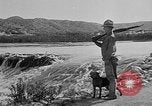
Scenes during Mexican revolution, in 1913, along the U.S. Mexican border
U.S. soldier with shouldered rifle stands guard beside the Rio Grande river, separating the United States from Mexico, in 1913. A dog stands next to him. The river is rushing in the background. View of extensive stakes and barbed wire lining the U.S.Mexico border. U.S. soldiers perform changing of the guard at a checkpoint on the U.S. side of the border between the U.S. and Mexico. Two new American sentries replace those being relieved. Signs on the fence identify the respective country boundaries. Mexican refugees (mostly women and children) flee the revolutionary combat taking place in Mexico. U.S. soldiers monitor as they cross into the United States, and direct some passing inside a trench manned by American soldiers along the border. Scene shifts to an official looking building guarded by U.S. soldiers. Several Mexican men, including Pancho Villa leave the building, accompanied by two or more Americans. (One American, wearing glasses , and carrying a cane. is dressed in a white suit, and wears a bow tie and Edwardian style summer straw hat. Next, Pancho Villa is seen with a number of his soldiers. A group of Mexican men relaxing at a shaded table near rustic structures. Large cacti frame the foreground, where a girl is walking toward them. Closeup of the men gathered around the table.
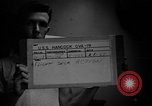
U.S. A-1H Skyraider makes a recovery and lands on the deck USS Hancock CV-19 after Vietnam Carrier Air Strike in South China Sea.
The U.S. aircrafts lands after the Vietnam Carrier Air Strike in South China Sea on the deck of USS Hancock CV-19, Pacific Ocean. U.S. A-1H Skyraider makes a recovery. Plane taxies forward, aircraft folds its wings. U.S. A-1H Skyraider lands. U.S. A-1H Skyraider on a fly back taking a wave off. U.S. A-1H Skyraider on the deck after landing. Damage to the side of U.S. A-1H Skyraider. A hole in its fuselage.
The invasion of the U.S. troops on the Marshall Islands and destruction of Japanese garrisons during World War II.
U.S. troops' invasion on the Marshall Islands and destruction of Japanese garrisons during World War II. An animated map depicts the location of Marshall Islands in the South East Asia. U.S. Navy ships proceed in order to take the island from their enemies. The animated map depicts the tactics of U.S. Navy. The soldiers attack the Kwajalein Island. Roi and Namur in the north are attacked by the U.S. Marines. The U.S. fighter aircraft. Soldiers in small boats approach towards the Marshall Islands. Aerial bombarding on the island by the U.S. fighter aircraft. The American soldiers take their positions on the island's coast. Soldiers with their weapons. An officer examines the bomb explosion through binoculars. The remains of a destroyed Japanese aircraft. American soldiers capture the Japanese base headquarter. The dead Japanese soldiers. The arrival of more American troops on the island.
CRITICALPAST.COM: About Us | Contact Us | FAQs - How to Order | License Agreement | My Account | My Lightboxes | Shopping Cart | Advanced Search | Featured Collections | Website Terms & Conditions | Privacy Policy ©2026 CriticalPast LLC.
License Agreement |
Terms & Conditions |
Privacy Policy
©2026 CriticalPast LLC.