


 Francais
 Deutsch
 Italiano
Refine Your Search
US-Gliders- stock footage and images
- Showing 991 to 996 of 21920 results more
more Hide
Hide
U.S. 25th Infantry Division and South Korean troops battle North Korean troops near Taejon, Korea during the Korean War.
U.S. troops battle North Koreans in Taejon, Korea during the Korean War. U.S. 25th Infantry Division troops fire howitzers, bazookas and other artillery weapons at North Korean positions. U.S. tanks fire at enemy positions. Smoke rises from enemy positions on hills. A U.S. aircraft bombs enemy positions. U.S. troops cover a bridge with rifle and machine gun fire to help the last units to cross a river near Yongdon. Men in a jeep fire guns as it goes across a bridge. United Nations flag flies from a pole at U.S. 24th Division Regimental Command Post in Chinju. North Korean prisoners are rounded up at the command post as South Korean troops move up to aid the defense. Trucks tow camouflage artillery guns up a hill. 25th Division infantrymen advance and recover their vehicles.
Various U.S. Navy aircraft land aboard USS Coral Sea while underway in the South China Sea during Vietnam War.
USS Coral Sea underway in the Gulf of Tonkin during Vietnam War. USS Coral Sea, an aircraft carrier underway in the Gulf of Tonkin. U.S. Navy A-4E aircraft comes in for landing aboard USS Coral Sea. A-1J aircraft in a landing pattern as it is being recovered aboard. U.S. Navy A-1H aircraft takes a wave off over the deck of the aircraft carrier. U.S. Navy RF-8A aircraft comes in for landing and lands on the deck. U.S. Navy A-1J and C-2A also come in and land one by one. Two U.S. Navy F-4B aircraft land on the deck of the carrier. Aerial view of a destroyer escort underway at sea. A destroyer underway at sea. U.S. Navy KA-3B flies over the wake of USS Coral Sea. Another KA-3B aircraft comes in and lands at the deck.
U.S. Commandant-General of 5th Division Major General Albert E. Brown decorates Russian officers at Protivin, Czechoslovakia (WW2)
U.S. Army exchange decorations with Russian Army in Protivin in World War II. Paintings of former U.S. President Franklin D. Roosevelt, Russian Commader-in-Chief Joseph Stalin, and U.S. President Harry S. Truman. A sign reads 'Long Live the American Army'. Russian Commandant-General of 107th Infantry Division General Bogdonov stands after decoration of U.S. officers. Czechoslovakian woman presents flowers to Russian and U.S. officers. U.S. Commandant-General of 5th Division Major General Albert E. Brown decorates Russian officers.
Guns of U.S. cruiser ships fire salvo at Japanese positions on an island in the Pacific Theater during World War II.
U.S. ships in action in Pacific Theater during World War II. U.S. battleships and cruisers head for enemy islands in the Pacific Ocean. Man blows a bugle aboard a ship. Men at a large instrument panel aboard the ship. U.S. fighter takes off to intercept Japanese bombers. U.S. lighter cruiser's guns fire salvos. Cruiser fire guns at shore batteries. Flak bursts in sky. U.S. ships fire towards the island at night. Man looks through periscope aboard a ship. Cruiser under heavy attack. Sailor sorts away shell cases on the deck of ship. Men on deck of ship after capturing an island. U.S. flag flies on bridge of the ship.
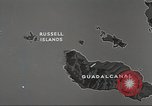
U.S. amphibious force invade Rendova Island, Solomon Islands during World War II.
Amphibious forces of the United States capture Rendova Island, Solomon Islands during World War II. An animated map links up Guadalcanal with Rendova and Vanguna depicting the voyage of U.S. amphibious forces. U.S. troops disembark from ships onto landing crafts off the coast of Rendova. Armed troopers loaded on landing craft head for Rendova beach. The troops unload after securing Rendova beachhead. Tanks followed by heavy artillery unload from a ship. Japanese dive bombers and medium bombers in flight over Rendova. Japanese aircraft drop bombs over the beachhead. U.S. fighters in flight to intercept the enemy bombers. U.S. antiaircraft batteries fire at the Japanese aircraft. Flak bursts in the sky. Japanese aircraft being attacked. A Japanese bomber crashes in water. Aftermath of battle shows abandoned equipment, dead and wounded U.S. soldiers on the beachhead. Burning beachhead of Rendova. U.S. ships unload equipment on the captured island of Rendova.
U.S. military training film demonstrates skills taught to soldiers,and how to conduct various combat operations
Film based on advantages and procedures of using U.S. Army training films to instruct troops during World War 2. Animated film depicts aircraft identification methods in World War 2 to distinguish between aircraft of friend and foe in flight. U.S. aircraft on flight line. Propeller of aircraft. Engine of aircraft. Instructor teaches men about electricity functions which demonstrates operations of a spark plug, radio vacuum tubes, telegraph fuse, and recoil mechanisms. Shows how signal communications are maintained by use of wire on field. U.S. troops drive army jeeps, tanks, and trucks. Soldier repairs a tank. Correct posture of a cavalry soldier while riding a horse. Barrage balloon in sky above a U.S. ship in harbor. Soldiers work on a balloon fiber and on folding a balloon. Demonstration to build a bridge and how to destroy it with demolition blast. Soldiers fire various artillery guns. Demonstration about rifle squadron maneuvers in combat. Animation depicts how Quatermaster Corps get supplies to field of action.
CRITICALPAST.COM: About Us | Contact Us | FAQs - How to Order | License Agreement | My Account | My Lightboxes | Shopping Cart | Advanced Search | Featured Collections | Website Terms & Conditions | Privacy Policy ©2026 CriticalPast LLC.
License Agreement |
Terms & Conditions |
Privacy Policy
©2026 CriticalPast LLC.