


 Francais
 Deutsch
 Italiano
Refine Your Search
US-Gliders- stock footage and images
- Showing 1015 to 1020 of 21920 results more
more Hide
Hide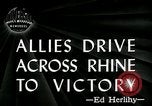
Tanks and troops of U.S. First Army enter Cologne, Germany,during World War II.
U.S. First Army troops advance in Cologne, Germany during World War II. View of Cologne Cathedral still standing. Sherman tanks tow away street cars used to block roads. M-26 Pershing tanks roll through streets of Cologne. City almost destroyed by bombing. U.S. Soldiers walk through streets and fire machine guns from behind piles of rubble. Heaps of debris on streets. A German car is struck by a collapsing building. U.S. troops shoot at German soldier walking across street. Sherman tank firing from a park square. Close range view of a German Panzer tank, filmed by combat cameraman Jim Bates, as it is is hit by fire from an US Army M-26 Pershing tank (gunner Corporal Clarence Smoyer) and the German crew jumps out. The tank goes up in flames. Wounded German soldier lying on ground. Two American officers shake hands, standing on an abandoned German Panther (Panzer) tank, in front of the Great Dome Cathedral, which was deliberately spared by U.S. bombers. Many German prisoners of war. Hohenzollern Bridge, destroyed by retreating German forces. A road sign reads: "Welcome to Koln, courtesy of the Spearhead Division." German residents stream back into the wrecked city. An older German civilian man sits on his luggage next to a damaged train track. Damaged street car on rubble-filled street. Views of the Cologne Cathedral, standing in the midst of destroyed city.
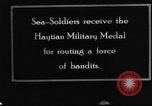
President Sudre Dartiguenave awards Haitian Military medals to U.S. Marines for routing bandits in Haiti, West Indies.
U.S. Marines receive honors in Haiti, West Indies. Four U.S. Marines stand at attention in a field adjoining the National Palace, in Port-au-Prince, Haiti. U.S. naval officers in summer white uniforms are present. President of Haiti, Sudre Dartiguenave, pins Haitian Military medals on the Marines for their performance in routing a force of bandits. Next, Haitian Gendarmerie, officered by U.S. Marine Non-Commissioned Officers, march past in review. The President and U.S. naval officers stand near the National Palace to review the Gendarmerie. They salute as the troops march past. In the far background, can be seen the Cathedral of Our Lady of the Assumption (Cathédrale Notre-Dame de L'Assomption). Next, in complete change of scene, U.S. Marines are seen leaving a campsite of white tents, as they head out on a patrol, carrying their rifles and transporting supplies, on a burro. Final change of scene shows two marines examining boots being made at an outdoor shoemaker. The proprieter, a man, works at a sewing machine. He has many women helpers who sit on the ground and do handwork on footware. A Haitian customer examines a boot.
Boxers fight in a ring. A U.S. Army Master Sergeant speaks about fire power and research. He points at models of missiles
The "Big Picture" public film by the U.S. Army. In it Master Sergeant Queen speaks about the use of fire power by the U.S. Army in defense of the United States. Boxers fight in a ring. Spectators cheer for the boxers. One boxer is knocked down and counted out. Then scene shirfts to U.S. Army Master Sergeant Queen speaking about the defensive fire power of the U.S. Army being like a "knock out punch.". He points to models of missiles on his desk, including models of a U.S. Hermes A-3 Missile and what appear to be a Cruise missile and an air defense missile.
U.S. soldiers loaded on tanks advance and fire artillery on a battlefield in the Korean Peninsula during the Korean War.
U.S. Army advances in the Korean Peninsula in the year 1952 during the Korean War. U.S. soldiers loaded on tanks advance towards battlefield. U.S. tanks firing artillery and troops firing heavy machine guns from truck. Army sergeant talks over a telephone. Tank burning. African American soldier using sighting device to plan artillery position and aim. Soldiers load shells and fire artillery. Numerous U.S. artillery firings from variety of weapons. A smoke column rises from explosions. U.S. officers observe from command post. A vast quantity of expended shell casings litter a field. Dead soldiers on the ground. North Korean Prisoners of war walk through streets.
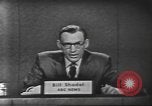
During an election debate in the US, Kennedy and Richard Nixon talk about a hypothetical invasion by the Chinese Communists.
The third Kennedy-Nixon Presidential Debate in the United States. Charles Van Fremd from CBS News asks Republican candidate U.S. Vice President Richard M. Nixon that if he were the president would he launch a war if the Chinese Communists began an invasion of Quemoy (Kinmen) and Matsu Islands and if he would authorize the use of nuclear weapons if regular conventional forces failed to halt the invasion. Nixon answers and states that it is irresponsible for a presidential candidate to indicate the course of action and the weapons he would use in the event of such an attack. He states that he would not say in advance how the U.S. would respond. He states that the Chinese Communists do not want just Quemoy and Matsu or Formosa (Republic of China or Taiwan), but the world. He concludes that defense of the free world territories and not surrender will lead to the path of peace. Democratic candidate Senator John F. Kennedy talks about a treaty to defend Formosa (Taiwan) and the Pescadores Island. He states that the U.S. would meet its commitment to Formosa. He disagrees with Nixon's suggestion that the United States should go to war if Quemoy (Kinmen) and Matsu islands are attacked as the treaty does not include these two islands. He concludes and says that the U.S. would defend if Formosa (Taiwan) or the Pescadores Island is under attack.

French General Marie Emile Antoine Bethouart presents French awards to U.S. officers in Bad Tolz, Germany after World War II.
French awards given to U.S. Generals at U.S. 3rd Army headquarters in Bad Tolz, Germany soon after World War II. U.S. General Lucian Truscott and French General Marie Emile Antoine Bethouart inspect French troops of the 27th Alpine Infantry Division and U.S. 3rd Army, 503rd Military Police Battalion, Company A. General Bethouart speaks before microphone. General Bethouart awards the Legion of Honor and Croix-de-Guerre to Commanding-General of U.S. 79th Infantry Division Brigadier General A. F. Kingman and Commanding-General of U.S. 102nd Infantry Division Major General Frank A Keating.
CRITICALPAST.COM: About Us | Contact Us | FAQs - How to Order | License Agreement | My Account | My Lightboxes | Shopping Cart | Advanced Search | Featured Collections | Website Terms & Conditions | Privacy Policy ©2026 CriticalPast LLC.
License Agreement |
Terms & Conditions |
Privacy Policy
©2026 CriticalPast LLC.