


 Francais
 Deutsch
 Italiano
Refine Your Search
US-Gliders- stock footage and images
- Showing 1063 to 1068 of 21920 results more
more Hide
Hide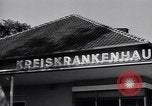
US Army soldiers in Germany after World War 2 and participation in German culture
Sign on German hospital building reads 'Kreiskrankenhaus' (Town Hospital). United States Army blood donors in the German hospital. Nurse in hospital examining room greets soldiers. American soldiers play with homeless or orphaned German children. A German Porsche car in a car race with obstacles, attended by Americans and Germans. A Center for German youth in Stuttgart sponsored by U.S. Seventh Army and VII Corps. Army Soldiers supervise German youths in handicrafts; table tennis (ping pong); baseball, with players wearing "Phillies" uniforms; miniature car racing (Soap Box Derby). American Major General visits Boy Scout encampment. (General wears 11th Airborne patch on his uniform.) Scout leader wears Tyrolean hat. Boy Scouts cooking and eating food. Rural Town of Kirnbach, Germany, invites U.S. Army soldiers as guests. U.S. Army soldiers including an African American soldier exiting a bus on arrival in town. Musicians in band playing at a gathering. Views of groups of German citizens, including children and elderly, men and women, in the town. The U.S. soldiers share in various local cultural activities and dine with local people. View of plate of food and glasses of beer. View of poster promotion Berlin Philharmonic Orchestra concert in February 1949 under the baton of Paul Hindemith. U.S. Army musicians join in rehearsal of an orchestra (possibly the Berlin Philharmonic Orchestra?), with an unidentified conductor (possibly a young Herbert von Karajan?), playing instruments and rehearsing a Mozart composition.
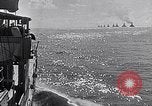
U.S. Navy fleet exercise and war game during 1925.
Line of U.S. battleships, including 1917 class (New Mexico class) such as the USS Idaho, USS Mississippi, USS New Mexico. Image of U.S. Capitol in Washington seen. U.S. Navy sailors parading in Washington, DC. Crowd gathered at Washington monument. Sailors on signal bridge of a U.S. warship, hoisting signals. Ships in distance. U.S. Navy sailors, aboard a destroyer, launching depth charges which explode and produce upsurge of water, behind the vessel. Sailors hurrying to their battle stations.
U.S. amphibious assaults on Saipan and Luzon during World War II
June 14, 1944. Naval guns of U.S. battleships and other warships bombard the island of Saipan, in the Marianas, in World War 2. U.S. aircraft fly low over the shore attacking Japanese military positions. A U.S. tank and marines moving on the beachhead. October 19, 1944, landing craft, manned by U.S Coast Guardsmen, from the Coast Guard operated Attack Transport USS Calloway (APA-35) are seen among others maneuvering in the water as they begin the assault on Luzon, the Philippines. U.S. troops wading ashore on Luzon.
Training Movie about U.S. Navy air crewmen and gunners of TBF Avenger aircraft.
U.S. Navy Training film' Air Crewmen of the Navy'. A U.S. Navy pilot named Lieutenant Grant Evans, played by Hollywood actor Robert Stack, enters a building. 'KTWM' written on the building. He is interviewed. Both men sit across the table. He talks about air crew of the U.S. Navy. He describes his work. A Navy Grumman TBF Avenger aircraft is inspected. The Navy pilot meets his crew members. Other planes in the background. The men talk to each other. The air crew climbs the plane and takes off. The pilot reaches the 'Naval Air Gunners School'. The gunners are trained. U.S. Navy Captain presents U.S. Navy aircrew wings to the trainees. Planes in flight. Planes land on flight deck.

United States Army soldiers use sound deception to deceive the German in Film 'Sonic Deception'.
Film 'Sonic Deception' shows the use of sounds to deceive the enemy (sometimes described as the "Ghost Army" in World War 2). Dramatization shows United States troops crossing river in small boats and arriving on beach. They establish beachhead on river bank and defeat German troops located there, having arrived by suprise. Film recounts through actors how a German spy at a German army corps headquarters informs about the presence of United States tanks and trucks. Film demonstrates how sound recordings were used by U.S. soldiers to create false impression of troop activities including bridge building and tank and vehicle movements, in order to serve as a decoy and mislead Germany enemy forces about U.S. Army activities. Dramatization shows German officials consulting and looking at maps. German soldier looks through binoculars and informs officials through phone. Tanks cross a bridge and artillery on field. Actual scenes of front gate of Army Experimental Center station headquarters at Pine Camp in Great Bend, New York (upper New York State). U.S. Army soldiers are shown recording via microphone the sounds of actual bridge construction at the center. The microphone routes to a recording truck where a turntable for pressing recordings is running, creating a phonograph recording of the bridge building decoy sounds. Recording of other sounds is shown, including sound of a bulldozer at work, sounds of men unloading trucks, and sounds of tanks crossing a bridge. Soldier is seen selecting a phonograph record from the Army Experimental Station Library.
Damaged U.S. Army Support Group truck seen after ambush by elements of Korean Peoples' Army in the Korean DMZ
Following an attack by elements of the North Korean Peoples'Army, a U.S. Army 3/4 ton truck with canvas cover sits on dirt road. Its left front and rear tires are flattened. Several papers are scattered on the driver's seat. View from across the road. Two military policemen (MPs), assigned to the Joint Security Area, examine the truck. Front view of truck shows numerous bullet holes in the windshield. A tee shirt hangs on the radio antenna. Bumper contains identification reading : "UNC-USASS.JSA-16." Another vehicle drives around and behind the truck. MP comes from behind the truck and leans his weapon against its left rear fender. (Note: this U.S. Army Support Group truck was ambushed South of the Joint Security Area on April 14, 1968. During the encounter, two U.S. soldiers and two Koreans, augmenting the U.S. Army, were killed in action and two U.S. soldiers were wounded in action. )
CRITICALPAST.COM: About Us | Contact Us | FAQs - How to Order | License Agreement | My Account | My Lightboxes | Shopping Cart | Advanced Search | Featured Collections | Website Terms & Conditions | Privacy Policy ©2026 CriticalPast LLC.
License Agreement |
Terms & Conditions |
Privacy Policy
©2026 CriticalPast LLC.