


 Francais
 Deutsch
 Italiano
Refine Your Search
US-Gliders- stock footage and images
- Showing 11191 to 11196 of 21913 results more
more Hide
Hide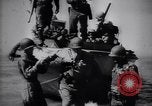
Early life of General George S Patton, and Patton in Africa during World War II.
'The Big Picture' episode narrated by Ronald Reagan depicts the life of U.S. General George S Patton, Jr. Opening scene shows General George S. Patton, Jr. stepping from a landing craft in France, during World War 2. He stands by the side of a road and waves, as elements of his 3rd Army pass in tanks. Patton in a jeep moving with his troops. General Patton pointing with a baton, in North Africa. View of a world globe being circled by a satellite. A baby picture of Patton (called "Georgie"). Patton seen as a boy, fencing, as a cadet at the Virginia Military Institute, and as a cadet at the U.S. Military Academy, West Point. A smiling Patton at West Point. Members of the first football team for soldiers established by Patton. Renault tanks of the 1st Tank Battalion moving with AEF soldiers in World War I. Tank commander George Patton standing in front of a Renault tank. Group picture of American soldiers and tanks, at the Tank School, in Fort Meade, Maryland, after World War I. Closeup of Dwight D. Eisenhower and George S. Patton, in the group. Patton and his wife, Beatrice Banning Ayer, in Old West costumes, for a party, where he displays a pistol in his belt, and in costumes for another party, where they dress as a knight and his lady on horseback. American recruits and draftees being issued uniforms in World War 2. Lieutenant General George S. Patton, Jr. commanding forces for the invasion of North Africa, in November, 1942. U.S. Navy warships fire their guns in advance of an amphibious landing. Landing craft heading toward shore. U.S. troops coming ashore at Casablanca, French Morocco. General Patton accompanied by French officers. Glimpse of U.S. President Franklin D. Roosevelt and British Prime Minister Winston Churchill at their conference in Casablanca in 1943. Patton riding in an armored car with three-star flag displayed. Artillery firing in battle of Tunisia. Lt. Gen. Patton and others observing operations. British General, Sir Harold Alexander, steps from a light airplane to meet with General Patton in North Africa. They converse. General Patton in March 1943 with binoculars observing battle, with Major General Terry Allen on his right, and Brigadier General Theodore Roosevelt Jr. to the right of Allen. They are viewing from a ridge by the village of El Guettar, as allies engage German troops and armor from the 10th Panzer Division. M3 Lee tanks moving in the desert. Knocked out tanks of the German 10th Panzer Division, including German Panzer IV tanks, in the aftermath of the Battle of El Guettar. General Patton coming aboard an American warship, and then standing with an Italian officer and a U.S. Major General. Allied naval bombardment at night. Patton observing though binoculars. Allied warships bombarding Sicily. Allied amphibious forces heading ashore in landing craft. Troops moving ashore. Closeup of troops in a landing craft. Glimpse of Patton in a landing craft. Troops walking across floating dock from a landing ship. U.S. flag flying in sand at beachhead. Landing ships in background. General Patton stepping ashore from small boat, and conversing onshore with a Brigadier General and some troops.
The Cuban Missile Crisis. The Limited Nuclear Test Ban Treaty.
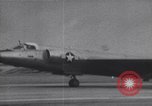
October, 1962, U.S. Air Force U-2 reconnaissance aircraft, tail number 56-6707, of the Strategic Air Command (SAC) 4080th Strategic Reconnaissance Wing, lands at Laughlin Air Force Base, Texas. View of Photographic evidence, brought back by the U-2, showing Soviet missiles being set up in Cuba. President John F. kennedy broadcasts to the nation about the crisis on October 22, 1962, announcing measures being taken by the USA to address the situation. A B-58 Hustler bomber landing. Airmen removing camera from nose of a reconnaissance aircraft. Air Force Sergeant, photo interpreter, reading wet film in a base laboratory. U.S. Naval officers and sailors in Command Center viewing large wall map of the world. U.S. Air Force SAC B-52 bombers taking off. View of United Nations Headquarters building in New York City. On October 25, 1962, U.S. Ambassador to the UN, Adlai Stevenson, confronts Soviet Ambassador Valerian Alexandrovich Zorin about missiles in Cuba.He looks at Zorin, and says,"Don't wait for the translation, yes, or no." Zorin smiles as the room fills with laughter. He then responds. View of a Soviet ship bound for Cuba being monitored by a U.S. aircraft overhead. Pilot in cockpit of the aircraft. View from U.S. aircraft flying low past a Soviet ship. Crew in cockpit of the aircraft. Soviet ships turning away. Helicopter flying over sandy beach area of Hyannis Port, Massachusetts. The helicopter parked and Undersecretary of State, Averell Harriman, steps from the helicopter and is later seen with President Kennedy, and Secretary of State, Dean Rusk, at the President's Weekend White House. Harriman reports on the successful negotiation of a limited nuclear test ban treaty. Glimpse of Moscow. U.S. Secretary of State, Dean Rusk, Soviet Foreign Minister,Andrei Gromyko, and British Foreign secretary, Alexander Douglas-Home, are seen signing the document for their respective nations, August 5, 1963.
The Battle of Iwo Jima in World War II
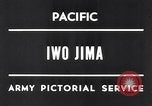
Scenes filmed by Navy and Marine combat photographers, of the Battle for Iwo Jima, in February and March, 1944, during World War 2. View from a boat offshore, of Mount Suribachi, on the Island of Iwo Jima. Warships of the U.S. 5th Fleet attack with naval gunfire, as landing craft manuever near shore. U.S. Marines aboard Landing Vehicles Tracked (LVTs) head for the beach, with the heavy cruiser, USS Baltimore (CA-68) in the background. U.S. Carrier-based Grumman TBF Avenger aircraft drops bombs on Mount Suribachi. Landing craft arriving at a fairly level area of beach. U.S. marines moving cautiously on the beachhead. The USS Baltimore and a Fletcher class destroyer offshore in background. Marines hunkered down with smoke rising near them, and then moving forward again, through the black sands. Closeup of a marine with flame thrower. Several U.S. Chance Vought F4U Corsair aircraft fly overhead, dropping bombs on the mountain. Marines continue to move forward, under constant fire from Japanese small arms. A heavy landing craft Infantry, LCI(H) moves toward shore in background. A DUKW ("Duck") coming ashore. Marines using a crane to offload a 105mm howitzer from a landing craft. As they raise the gun, the landing craft moves away and marines Hook the howitzer to a DUKW to help move it. Next, marines are seen setting up two 105s on the beachhead and firing them. Marines with more artillery pieces stacked on the beachhead. A gunboat, LCI (G), firing from close to the shore behind them. Marines digging in sand that the narrator calls the floor of an active volcano. Smoking sulphur gases are seen rising behind them. The USS Baltimore firing her guns from close to shore. Machine gun tracer rounds crossing the beachhead, as Naval gunfire resumes from offshore. Marines crawling and then occasionally sprinting forward across the sand dunes. (One carries a stretcher.) Four marines carrying one wounded back to the beachhead, on a stretcher. Two marines carry another between them. Marines scrambling over brush and rough ground. View from hillside of marines climbing up from below, as shell bursts only a few yards away. Scene shifts to later in the battle for Iwo Jima. A catapillar tractor is parked near bodies of Japanese soldiers strewn across the landscape. (Narrator notes that more than 14 thousand such dead had been counted by March 6, 1944.) Finally, the iconic moving images of U.S. marines raising the American flag over Mount Suribachi.

The United States Army presence in Europe and America during the Cold War era.
Opening scene shows Headquarters, United States Army, Europe (USAREUR) at Campbell Barracks, Heidelberg, Germany. A line of U.S. 7th Army M48 Patton tanks contributing to NATO defenses. One backs out of position. A line of M113 Armored personnel carriers proceeding along a dirt field. A tank destroyer followed by M113 APC. M113s of a U.S. Armored Brigade drive in Berlin, affirming allied rights in the city. Bridge in Italy displays logo of U.S. Army Southern European Task Force (SETAF). A Sergeant Missile Battalion of SETAF provides nuclear capable support to NATO. One of its Sergeant missiles is seen maneuvering on its mobile launch platform. Two Italian soldiers are seen being trained in missile operations. A motorized tractor pulls several wheeled containers of military supplies stockpiled at one of NATO's European storage facilities. More supplies are seen being moved outside a warehouse. Army personnel using keyboards and computer tape drives to keep track of war materiel. Yards full of military hardware, including lines of jeeps, provide backup for military operations. A sign at the Headquarters United States Southern Command in Quarry Heights, Panama. A ship is seen moving through the Miraflores locks of the Panama Canal. U.S. and allied soldiers are seen working with ropes to traverse a river, during Jungle Warfare training. Soldiers seen moving through jungle underbrush during training at the Southern Command School of the Americas. Scene shifts to U.S. Army, Alaska at Fort Richardson, near Anchorage. A U.S. M113 APC is seen driving and firing its weapon on a snowy field. Its stops and soldiers in white arctic gear step from a rear hatch to take up positions. A Piasecki H-21 Army helicopter is seen flying low above the terrain. It is equipped with landing gear skis. Rear view of tank moving in snow.
Allied forces and German Army in Battle of the Bulge
German counter attack in Battle of the Bulge, in world War 2. U.S. Army Sherman tank crews load artillery shells and fire from wooded positions. U.S. artillery crews load shells and fire heavy guns under camouflage nets. Scene changes to German forces: German infantry advancing past knocked out U.S. artillery piece and Sherman tank. A Jagdpanzer IV tank destroyer rolls by behind the soldiers and the wreckage of tanks from recent battle. German Panzer V "Panther" tank advances, with several soldiers riding on top, followed by a Jagdpanzer IV tank destroyer with a few German soldiers in and on top of it. Grille Ausf. M self-propelled artillery gun fires. German infantry and trucks with German soldiers enter a village. British RAF Hawker Typhoon aircraft dive and fire rockets at German ground targets. U.S. forces fire artillery and regroup in a forest. U.S. troops move through water and mud in a town. U.S. Army soldiers carry wounded on stretchers. British troops escort German prisoners of war in a town. U.S. Army trucks move through deep water flooding the main street of a small town. An American soldier places his foot on edge of a bin and water pours out of his boot. American soldiers take a chow break to eat.
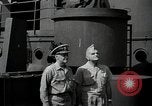
Career of Chester W. Nimitz. Scenes from navy battle for Philippines in World War II.
Admiral Nimitz and Admiral Halsey in conversation, aboard a U.S. ship. Scenes of U.S. battle at sea, against Japanese forces during Philippine campaign of World War II. U.S. assault troops boarding landing boats. Japanese aircraft carriers launching Kamikaze aircraft. U.S. navy ships defending with antiaircraft fire. Carrier crew fighting fire after being struck by Kamikaze. U.S. aircraft crash landing on carrier deck. Japanese Kamikazes successfully striking U.S. aircraft carriers. Clip shows many incoming Kamikaze aircraft with many being hit and landing in ocean, and other striking US Navy ship targets.
CRITICALPAST.COM: About Us | Contact Us | FAQs - How to Order | License Agreement | My Account | My Lightboxes | Shopping Cart | Advanced Search | Featured Collections | Website Terms & Conditions | Privacy Policy ©2026 CriticalPast LLC.
License Agreement |
Terms & Conditions |
Privacy Policy
©2026 CriticalPast LLC.