


 Francais
 Deutsch
 Italiano
Refine Your Search
US-Gliders- stock footage and images
- Showing 11197 to 11202 of 21913 results more
more Hide
Hide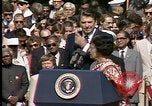
Indian Prime Minister, Indira Gandhi visits as being officially welcomed at a ceremony at White House in the United States.
Prime Minister of India, Indira Gandhi visits United States for better understanding and friendship between the two countries. Prime Minister Gandhi delivers a speech about friendship and understanding in Washington D.C. U.S. President Ronald Wilson Reagan welcomes the Prime Minister Gandhi and gives speech about better understanding between two countries. Animated chart shows that Prime Minister Gandhi starts her visit from New York on 27 July. Prime Minister Gandhi arrives at New York to improve Indian-American relations. She presents a gift "Sculpture of Surya" to United Nations symbolizing a sense of law, virtues and ritual behavior. Photographers take photos. Prime Minister Gandhi delivers a speech that 'May Surya light and strengthen your way'. United Nations Secretary General thanks for wishes and gift given by her. Prime Minister Gandhi arrives at Washington. She disembarks from the plane and being greeted by U.S. ambassador. U.S. President Reagan and Indian Prime Minister Gandhi meet. Official welcome ceremony on morning after her arrival at the White House in Washington D.C. U.S. President Reagan and Mrs Reagan come out the White House. A car arrives at the White House. Miniature flag of India and United States on car. Indian Prime Minister Gandhi emerges from the car. U.S. President Reagan and Mrs Reagan greet her. Mrs. Gandhi being greeted by U.S. officials and dignitaries. Troops stand in attention and National anthem of India being played. Flags of India and United States on White House grounds. U.S. people stand on White House grounds as they show respect towards national anthem of India.
Y-12 atomic production facility; Trinity Shot atomic text explosion in the United States; Truman speaks about atomic secrets.
Atomic bomb production and its use in the United States. Doctor Ernest O. Lawrence experiments with the cyclotron at the University of California, Berkeley. View of the exterior and interior of the cyclotron. An animated diagram shows the results of the splitting of the uranium atom. Diagram shows a nucleus, electrons and protons. Atomic structures of Helium, Lithium and Uranium. A diagram of the creation of barium and krypton, and the release of atomic energy. Aerial and ground views of Y-12 atomic energy testing, uranium enrichment, and manufacturing plant at Oak Ridge, Tennessee created during Manhattan Project. Workers walking on the grounds of the the plant. The Trinity Shot first atomic explosion is shown near Los Alamos, New Mexico on July 16, 1945. Flash of explosion and a cloud of smoke rises as seen from U.S. Army cameras 6 miles away. Two other views of the explosion are seen from other camera positions while narrator explains the effects. U.S. President Harry S. Truman speaks of the need to keep the secrets of the atomic bomb among the U.S., the U.K, and Canada, alone, until they find successful techniques to control the bomb and protect the world from total destruction. He indicates that he will work the the U.S. Congress in the effort and make the power a force for world peace. Truman asks that God guide the U.S. in how to use the technology in His ways and for His purposes. (World War II period).
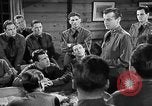
An officer explains different types of platoon formations and its usage and advantages (WW2)
The advantages of the different Platoon formations during World War II. The U.S. Army Sergeants stand around a desk. A Rifle Squad officer talks about the formal formations of the Platoon. He first explains the Platoon Column Formation which is useful at night and during low visibility. Secondly he speaks about the Platoon in Line of Squad Column in which the center is the Base Squad and is useful only when the location of the enemy squad is known. A Sergeant asks a questions and the officer answers. Next is the Platoon in Squad Column formation with center squad back this formation is most useful and widely used. It provides Rifle Squad support and allow use of covered approach terrain further movement in Platoon Column. A Sergeant asks question about the number of squad to be used in the formation. The officer answers. Another sergeant questions him about maintaining contact with security measure. The officer explains this answer with the help of a example.
Charles de Gaulle visits Arlington National Cemetery and addresses people of New York City in the United States.
Charles de Gaulle visits the United States. An aircraft lands at Washington National Airport in Washington DC. People at the airport. The leader of the Free French Forces General Charles de Gaulle disembarks from the aircraft. He is greeted by dignitaries. U.S. Army General George Marshall, U.S. Army Air Forces General Henry Arnold and U.S. Navy Admiral Ernest King salute as the French National Anthem is sung. De Gulle also salutes and shakes hands with these and other dignitaries. He gets in a car and leaves for the White House. At the White House he is greeted by U.S. President Franklin Roosevelt, his daughter, U.S. Secretary of State Cordell Hull, U.S. Secretary of the Interior Harold Ickes and U.S. Secretary of Navy James Forrestal. He visits Arlington National Cemetery to pay tribute at the Grave of Unknown Soldier. In Manhattan people line the streets and cheer as De Gaulle's car moves towards the New York City Hall. He addresses the people of the New York City from the top of the RCA Building. (World War II period).
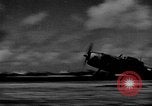
United States soldiers in combat with Japanese forces in towns and in city of Manila, Philippines (WW2)
Street fighting in Asia during World War II (Pacific Theater). Republic P-47 Thunderbolt fighter takes off from field. P-47 fighters dive bombing Japanese-occupied towns as American infantry squads advance in battle-scarred town. The U.S. soldiers employ rifles, bazookas, rifle grenades, hand grenades, and flame throwers (which destroy wood and other lightly constructed buildings). Americans advance under fire from Japanese snipers and return fire. United States soldiers use flamethrowers on wooden houses. A dead Japanese sniper in rubble of building. A Japanese soldier running to surrender, carrying a white flag. A staged exercise in a Burmese village, to demonstrate proper techniques for combating occupying enemy in such a setting. Huts and building in village. Soldier signals other soldiers. Two persons acting as Japanese soldiers inside a building. American soldiers wade through water. Acting Japanese soldier walks to the river side with an empty bucket. American soldier attacks the acting Japanese soldier from behind. Views of various Japanese cities, like Tokyo, Yokohama and Nagoya. Traffic with pedestrians on road. Smoke arising from U.S. artillery shelling of Manila. U.S. Army artillery battery firing field pieces at targets in Manila. Smoke in the streets during the 1945 Battle of Manila. U.S. Soldiers advance through burning Filipino buildings. They advance in groups. U.S. soldiers firing in streets and helping wounded soldier to cross street in front of the import-export business Levy & Blum Inc (345 Echague, Quiapo, Manila, Philippines). They take cover behind rubble. Soldiers engage in street fighting against the Japanese in front of boarded store in Ongpin street, Binondo (Manila Chinatown district). Troops pass by a wrecked building. U.S. soldiers gathered around a chart. They fire gun from hole in wall. Soldiers check houses for booby-traps. Soldier at window of building. Tanks and troops advance. Smoke screen in street. Soldier talks into radio. Captured Japanese march under guard.
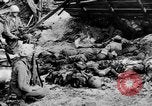
Scenes of the horror of World War II, in the Pacific and Europe. Dead, dying, and wounded casualties of war
From "He Has Seen War", scenes of badly disfigured dead bodies of Japanese and American soldiers killed on islands in the Pacific, during World War 2. Corpses of U.S. Marines on a beach. Soldiers dig out dead bodies from mud. Body of U.S. soldier, in mud, being fingerprinted for identification. American dead lying in a field, each with a white covering. Bodies kept under a white cover on a ship. A cemetery of dead soldiers. American dead, each draped in an American flag, being buried at sea. Exhausted and wounded soldiers walk out of a Landing Craft Vehicle. Group of tired U.S. Army soldiers look at camera with blank, exhausted, saddened faces. Sad and depressed war struck civilians. U.S. soldier lifts body of little girl from under rubble and debris. U.S. Army soldier seated beside a grieving civilian family. A dead boy lies between them. They sadly cover his body. Wounded U.S. soldier on stretcher cries out in pain. Soldiers walking in long lines to or from battle. Faces of war-hardened U.S. Soldiers and Marines. Narrator describes the nature of what these soldiers have seen and that they will be changed by their experiences.
CRITICALPAST.COM: About Us | Contact Us | FAQs - How to Order | License Agreement | My Account | My Lightboxes | Shopping Cart | Advanced Search | Featured Collections | Website Terms & Conditions | Privacy Policy ©2026 CriticalPast LLC.
License Agreement |
Terms & Conditions |
Privacy Policy
©2026 CriticalPast LLC.