


 Francais
 Deutsch
 Italiano
Refine Your Search
US-Gliders- stock footage and images
- Showing 11287 to 11292 of 21913 results more
more Hide
Hide
Saga of the Allied invasion of Normandy in World War II, with emphasis on role of African American soldiers
Opening scene shows U.S. soldiers firing rifles as they advance in the hedge rows (Bocage) of Normandy after the D-Day invasion in World War 2. Lightning is seen as a storm begins. Various invasion ships and boats are seen being pummeled by wind and waves. Some ships are seen tilted against the shore and damage to beachhead installations is evident all across the shore the wake of the storm. Landing craft of various sizes are left where they had been driven by the storm onto the shore. Twisted steel and damaged boats are seen everywhere. Views of U.S. infantry advancing into the interior of Normandy, under fire. A Sherman tank camouflaged with foliage, moves past demolished building. Troops marching single file along the sides of a rural road. At TC: 00: 57, the film continues with enactments of German officers in conference. At TC: 01:06, the actual Normandy beachhead is seen again with troops and war materiel being delivered without port facilities. Amphibious 2 and a half ton trucks (DUKWs) are seen making their way from transport ships to the shore. View of cargoes being lowered from a transport ship to a DUKW. Views of crew on the ship's deck, including an African American operating the cargo hoist. Closeup of cargo net with supplies dropping into a DUKW. Closeup two soldiers (one an African American) riding in a DUKW. Trucks and cranes on the beach. A soldier operates a crane placing ammunition into a truck. Crew member on a transport ship passes Jerry cans of fuel to a soldier in a DUKW. An M36 tank destroyer (90 mm Gun Motor Carriage, M36) filled with soldier, drives from ashore from an LST. Numerous trucks gathered on the beachhead. Closeups of two soldiers at the front. Closeup of M36 tank destroyer moving toward the camera. Aerial overview of a beachhead. Soldiers with shovels fill holes in a roadway as trucks pass. A destroyed railroad yard. A destroyed airfield. A destroyed harbor. Destroyed rail line and communications lines at Valognes, in Normandy, France. African American soldiers using special equipment to string communications lines onto telephone poles. Closeups of them in vehicles designed for that purpose. Closeups of wires being unspooled. American soldiers connecting wires atop a pole. A group of African American soldiers working on telephone lines. Others are seen using mine detectors. An African American soldier operating a mobile crane. African American soldiers installing pierced steel plank (Marsden matting) on an airfield. A team of African American soldiers placing rails in place for a railroad. Others working on pipeline. One uses an acetylene torch to weld a pipe. Fuel gushing from a hose refueling an armored vehicle. The destroyed port of Cherbourg occupied by American troops. View a week later of the harbor in full operation. Cranes unloading a locomotive at the port. View of port operations on July 4, 1944. A German aircraft overhead and bombs exploding. More views of work being done on the port. Stockpiles of supplies at the port. A Sherman tank moving with infantry. Troops moving along sides of a road. An M36 tank destroyer is welcomed by local civilians as it moves through their town. A 75 mm Howitzer Motor Carriage M8 moves through a town 25 miles from Paris. American infantry marching through a town. Heavy army trucks carry supplies. Sign posted for the "Red Ball Express." Columns of trucks carrying supplies from the port of Cherbourg to the front. Mines exploding nearby as the trucks move at night. Closeup of an African American soldier driving one of the trucks.

'The Big Picture' focusing on the United States Army 24th Division's first 50 days in Korea
Narrated feature on the Korean War and the arrival and initial reactions of 24th Division Army troops during the first 50 days of war. Soldiers boarding landing craft and landing on beaches. Tending wounded soldiers. Advancing on foot. U.S. Air Force supply land landing and soldiers unloading boxes from it. Troops assembling with gear. Soldier holding box containing food rations. U.S. Soldiers in line crossing bridges and into towns as Korean citizens look on. South Korean soldiers marching through villages, looking weary from war. Villagers carrying belongings and leaving a town. U.S. soldiers march through an empty town with all shops and homes closed. U.S. soldiers digging gun placements for artillery and machine guns. Soldiers cooking. One stirs pot with knife. Battle scenes with U.S. soldiers firing artillery, rifles, machine guns. Wounded on stretchers.
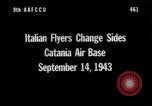
Kingdom of Italy aircraft and crews surrender to Americans at Catania Air Base in Sicily, Italy, during World War II.
Italian aircraft and crews surrender to Americans at Catania Air Base, in Sicily, during World War 2, under terms of the Armistice of Cassibile , signed on September 3, 1943 and publicly announced on September 8th by U.S. General Dwight D. Eisenhower, on Radio Algiers. Under its terms, the Kingdom of Italy ceased hostilities against the Allies and Kingdom forces were to surrender to the Allies. An Italian SIAI-Marchetti SM79 ("Sparviero") Torpedo-Bomber is seen in flight over water, as viewed from another airplane. It carries the number 1NS-20. View of Catania Air Base, with U.S. B-25 Mitchel bomber, of the 340th Bombardment Group, landing, in background. The Italian SM79 is seen taxiing to the ramp, after landing at the Base. A Italian crew man opens the door and an officer exits using the aircraft ladder. He is followed by Giulio Cesare Graziani, torpedo bomber ace and winner of the Italian Gold Medal of Military Valor. (He is framed at 1:12.) Another officer also exits and the three shake hands with U.S. 9th Army Air Force officers on the ground. Commander of the 340th Bomb Group Lt Col Adolph "Tik" Tokaz appears in frame 1:05. The Italian officers present some documents and discuss them with the U.S. officers. The officers from both countries gather around the Italian seal, of the kingdom of Italy, on the tail of the plane and discuss it. The officers turn to watch another Italian SM79 land, taxi in, and park. Italian fliers exit this airplane and walk across the ramp to join the others, with whom they exchange salutes, and shake hands.

Withdrawal of NATO forces from France; scenes of Americans stationed in France
A U.S. Military Policeman (MP) directs traffic at the U.S. Army Communications Zone Europe Headquarters in France. Aerial views of the North Atlantic Treaty Organization (NATO) military force base. A map shows locations of NATO bases in France. An aircraft flies overhead. Officials communicate over the wireless and telephone in the Chateauroux Air Base control tower. U.S. military airplanes parked on an air strip. U.S. Air Force trucks. Narrator discusses impact on French economy and social issue related to departure of so many Americans from France. French men employed at the base walk as a group heading to or from work at the base. American soldiers with their French wives and families. Soldier with wife and son walking on street with Eglise Saint-Andre church in background. A soldier and his wife in a shopping center as a sales woman helps the couple look at silverware. Closeup view of a LP vinyl record playing on a phonograph record player turntable. An American soldier by the microphone at a Armed Forces Radio network military broadcasting installation. View of the DJ and the control room in the radio broadcasting studio. French people gathered on the streets to witness a marching band on parade from Chateauroux American High School in Châteauroux, France. Flag corps dancers and marching band members playing musical instruments are seen in the parade. View from ground looking upward as an American flag is lowered from a flagpole. View of a triangle folder American flag being held by a U.S. Army Military Police man, as he carries it away.
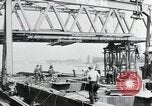
Construction of a bridge on the Rhine River and men working on it in Wiesbaden, Germany
Germany ten years after World War II. Construction of a bridge on the Rhine River in Wiesbaden, Germany.Men heat rivets. An air hammer is used in riveting. A worker rakes a red hot rivet from the fire with a pair of tongs. He places it on the ground to clean it. Men place a large girder into position using a crane. A man uses an acetylene torch for cutting. A man uses a drill. A forge is used to heat the rivets. A worker changes an automatic wrench. Piers to which the bridge will be connected. Men work around.

World War 2 film promoting public investment in War Bonds and stamps to aid the war effort and temper inflation
World War 2 era film that also includes some World War 1 scenes. Show girls or chorus girls in follies-like show, costumed as U.S. silver dollars and marching to tune and lyrics alluding to dramatic increase of currency in circulation, over the years. Animation with stacks of coins shows increase in national income from $46 billion,in 1933, to $71 billion, in 1939, and $142 billion in 1943. Back to the "follies dollars," a boy asks why, and then scenes of the Japanese attack on Pearl Harbor,are shown, with U.S. battleships being sunk. Wartime arms plants are shown. An M2A3 Light Tank rolls off a production line. Ships being constructed in a shipyard. B-24 Liberator bombers being built in a factory. Artillery shells being produced. Defense workers receiving their pay. The "follies dollars" group themselves to illustrate the fractions of income devoted to taxes and savings. But other spending is curtailed by wartime shortages. A woman talking with clerk in a drug store. U.S. Army troops crossing a pontoon bridge in open trucks, towing 75mm M1A1 howitzers. Infantry on the march. Animation showing industrial production devoted to war materiel and lots of dollars chasing few civilian goods. A grocery clerk offers to sell a woman customer butter for more than the established price, and she agrees. The "follies" performers then introduce the idea of an "inflationary dollar," and some history of past U.S. inflations. Animated examples of price inflation are shown. Glimpses of World War I scenes are seen, circa 1917 -1918, including: a 12-inch railway gun firing; a huge explosion from shell bursting near the camera; various scenes of United States infantry soldiers and French soldiers in battle action, running to bomb craters for cover and emerging from trenches to go up "over the top" into no-mans land during combat. Meanwhile, singing narration refers to the home front inflation due to competition for limited civilian goods. Map shows Europe and singing narration cites rising prices for food in occupied France and other countries suffering ravages of World War II. Montage of scenes showing needy civilians obtaining food in those countries. Animation shows increases, by 1944, in cost of U.S. civilian goods since the Pearl Harbor attack. "Follies" character called "Double-duty dollar," appears explaining he serves the war and curtails inflation on the home front by being saved through investments in War Bonds and stamps.
CRITICALPAST.COM: About Us | Contact Us | FAQs - How to Order | License Agreement | My Account | My Lightboxes | Shopping Cart | Advanced Search | Featured Collections | Website Terms & Conditions | Privacy Policy ©2026 CriticalPast LLC.
License Agreement |
Terms & Conditions |
Privacy Policy
©2026 CriticalPast LLC.