


 Francais
 Deutsch
 Italiano
Refine Your Search
US-Gliders- stock footage and images
- Showing 11365 to 11370 of 21913 results more
more Hide
Hide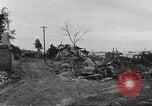
United States Marines distribute clothes to Korean civilians during the Korean War.
U.S. Marines in Korea during the Korean War. Debris and rubble in a coastal town of North Korea. Korean refugees evacuate. A U.S. soldier directs the refugees. U.S. Marines talk to Korean children and distribute clothes. A captured North Korean soldier smokes a cigarette with a U.S. soldier. U.S. Marines make Korean children wear new clothes.
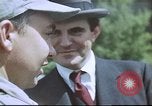
Lt. Gen. Jacob Devers and Maj.Gen. Ira Eaker escort British civilian official in visit to an airfield in England.
U.S. Lieutenant General Jacob L. Devers, Commander of U.S. Army Forces in Europe, and Major General Ira Eaker, Commander of the U.S. 8th Air Force, escort a British official visiting an air base in the UK. The official speaks momentarily with U.S. ground crewman. Then a U.S. Lieutenant Colonel escorts him in a walk around a B-17, named "Delta Rebel" while the Generals and others stand nearby.(Captain Robert K Morgan, Pilot of the "Memphis Belle" is a member of the visiting party.) The British Official has an extended dialog with escorting officer. All members of the visiting party begin climbing aboard a C-45 aircraft. Change of scene show the party walking from the C-45 past an honor guard. General Devers greets several Air Corps officers standing in a line. He is followed by the British official, with his Lt. Col. escort. Generals Devers and Eaker speak with the Lt. Col. escort and then General Eaker walks with the official to a waiting car (appears to be a 1938 Packard sedan). The official enters the car and drives away, followed by American staff car and another vehicle.

Malta Conference scenes and then views of Yalta Conference with Big 3 Roosevelt, Churchill, and Stalin in Crimea Russia.
Malta Conference meeting of American and British Allied leaders on island of Malta in the Mediterranean Sea, beginning January 30, 1945. C-54 aircraft lands on airfield in Malta, with U.S. staff officers aboard. Leaders exit plane starting with U.S. Navy Admiral Ernest J King, greeted by U.S. Ambassador to Soviet Union Averell Harriman. U.S. Army General George Marshall exits with Lieutenant General Brehon Somervell, and they are greeted by British Army Field Marshal Wilson and Mr. Harriman. Exterior of Montgomery House on Malta as dignitaries enter the conference. General Marshall and then Admiral King enter Montgomery House. Dignitaries seated at long table meet during conference at Montgomery House. Camera shows various attendees including British Field Marshal Alexander and Field Marshal Sir Alan Brooke. Also Admiral Sir Andrew Cunningham, Marshal Charles Portal and Marshal H. Wilson. British Prime Minister Winston Churchill on British ship salutes arrival of President Roosevelt on U.S. Navy ship arriving for Crimea Yalta Conference. Yalta mountains and Black Sea views. Workmen unload communication equipment from ship and deliver it by truck convoy. Exterior of the Livadia Palace site of the Yalta Conference. Signal Corps wire the building and Army Navy message center and telephone exchange is shown. Stettinius, Anthony Eden, and other leaders arrive by aircraft and are greeted by Chairman of Council of People's Commissars Vyacheslav Molotov. British Prime Minister Churchill and American President Roosevelt arrive and meet Molotov and other Russian dignitaries. Russian honor guard stands in formation. Big Three of President Roosevelt, Soviet Union Premier Joseph Stalin and British Prime Minister Churchill at the palace. Dignitaries seated around conference table to discuss plans for occupation of Germany. They sign a statement. Big 3 dignitaries seated on a bench outside the palace pose for photos with officials. (World War II period).
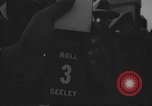
Dignitaries and officials seated in a stadium to watch the Army Navy football game in the United States.
The Army Navy football game in the United States. Flags fluttering on flag poles in the background. People crowd in a stadium. The teams run out on the ground. U.S. President Harry Truman in the stands. U.S. Army Major General Bryant E. Moore shakes hands with the President. The wife of the President seated nearby. U.S. Army General Omar N. Bradley and a British General seated. U.S. Secretary of Army Gordan Gray chats with a woman in the stands. U.S. Secretary of Navy Francis P. Matthews and an admiral seated in the stands. Cadets march and the crowd watches them. The cadets cheer. The game in progress. President Truman and British Army Field Marshal Bernard L. Montgomery seated in the stands. The crowd walks away on the ground.
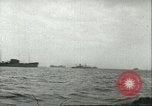
Cutters and airships of the USCG patrol around a convoy and sink a German submarine in the Atlantic Ocean.
Antisubmarine activities of the United States Coast Guard ( USCG ) in the Atlantic Ocean during World War II. Cutters and airships of the USCG and U.S. Navy patrol around a convoy underway. U.S. Navy airship in the air. The U.S. Navy, the USCG and the U.S. Merchant Marine work together. An officer watches enemy action through binoculars. The U.S. flag flying from a flag mast. A man watches through binoculars and other men prepare for a counter attack. Man operates signal light to relay information. Depth charges readied and guns are fired from the ships. They sink a German submarine after it torpedoes a merchant ship. Merchant seamen come aboard a cutter from a life raft.
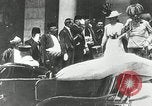
America mobilizes for World War I and confronts demobilization afterwards
Opening scene shows Austrian Archduke Franz Ferdinand and his wife, Sophie, Duchess of Hohenberg. Newspaper swirls into the image, with headline announcing their assassinations. Glimpse of railways guns firing. View of a ship's bow as it sinks beneath the ocean, is covered by newspaper headline announcing the sinking of the RMS Lusitania, by a German submarine. U.S. President Woodrow Wilson at his desk. Newspaper headline reads: "U.S. Declares War !!" U.S. soldiers marching in Washington, DC, with U.S. Capitol building in background. Newspaper announces: "Yanks are Coming!" American General John Pershing on horseback leading a contingent of the American Expeditionary Forces (AEF). American troops going "over the top" (charging out of their trenches) in France during World War 1. Troops firing French 75 artillery pieces at point blank range. A formation of Allied Airco (de Havilland) DH9 aircraft in flight. Bombs bursting near trenches on the front lines. Renault FT-17 tanks accompanying American infantry on the Western Front. Persons playing roles as employees in the Department of Labor when they served as the War Labor Administration in World War 1. Women in the War Labor Administration working with long paper rolls of personnel records. Women in various war effort endeavors including airplane and arms manufacturing. Men working in a wartime steel plant. Marchers and a band demonstrating for the rights of workers to organize. People celebrating the at the end of World War 1, by gathering in the streets, throwing tickertape, dancing in the streets and waving effigies of the Kaiser. Stern view of the U.S. Army Transport Ship, President Grant filled with American soldiers returning from France at the end of the war. Lettering on stern reads, "U.S.A.T. President Grant" (The ship, AP-29, was originally the German ocean liner Konig Wilhelm II, and seized from Germany on 6 April 1917.) Views of United States soldiers returning home, disembarking, and assembling on a wharf home on American soil. Department of Labor persons assisting returning soldiers and prospective employers. Views of workers on farms, and in factories.
CRITICALPAST.COM: About Us | Contact Us | FAQs - How to Order | License Agreement | My Account | My Lightboxes | Shopping Cart | Advanced Search | Featured Collections | Website Terms & Conditions | Privacy Policy ©2026 CriticalPast LLC.
License Agreement |
Terms & Conditions |
Privacy Policy
©2026 CriticalPast LLC.