


 Francais
 Deutsch
 Italiano
Refine Your Search
US-Gliders- stock footage and images
- Showing 11395 to 11400 of 21913 results more
more Hide
Hide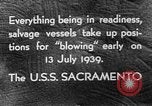
Men work with dials during salvaging activities for USS Squalus off the coast of Isles of Shoals near Portsmouth,New Hampshire.
Salvaging activities for the U.S. Navy submarine Squalus (SS-192) off the coast of Isles of Shoals near Portsmouth,New Hampshire. USS Sacramento (PG-19) underway off the coast of Isles of Shoals. Small district craft LHT Hibiscus and the U.S. Navy fleet tug boat Wandank (AT-26) underway to rescue U.S. Navy submarine Squalus. Air hose is attach to U.S. Navy submarine Sculpin (SS-191). Many buoys floats on water support the tails of pontoon slings. Air hoses men work with dials. Pontoons are blown dry. Stern of pontoon surfaces up and cause gushing of water. Men secure pontoon. Bow of U.S. Navy submarine Squalus (SS-192) is raised to surface. Pontoon and sling slip off and bow settles back into water. Diagrammatic representation of the slipping off the sling and bow of pontoon.
American armor and infantry in Germany, near end of World War II, in Europe
German soldiers (prisoners of war) walk with hands on their heads, past U.S. M18 Tank Destroyers of 771st Tank Destroyer Battalion, attached to the 84th Infantry Division, a month before the end of World War 2, in Europe. An M4 Sherman tank makes way slowly through mud in a forested area of Lubbeck (Lübbecke) Germany. Scene shifts to a knocked out U.S. tank. A U.S. Army Lieutenant points to holes blown in the tank ( most likely by German panzerfausts). View looking into the tank reveals a dead U.S. crewman. Group of German soldier prisoners moves quickly along side of a dirt road, under guard by U.S. soldiers from the 334th Infantry Regiment. Another group of POWs moves on sidewalk past a cottage.

German civilian Matthias Gierens is hung until death for murdering a downed American flier in Germany in World War 2.
German civilian Matthias Gierens, a 37 year old railroad worker, is hanged in Rheinbach Germany for the August 15, 1944 murder of a downed American flyer, who was later identified as U.S. Army Air Forces 2nd Lieutenant Lester E. Reuss, from Forsythe, Montana. Reuss was the navigator on U.S. Army B-17 bomber #42-31183 which was downed by German aircraft after it attacked the Airdrome at Wiesbaden, Germany. Gierens and three other German civilian men, Peter Kohn, Peter Back, and Matthias Krein, were convicted on June 2, 1945 in Ahrweiler, Germany, for the murder of the American airman after his parachute landing near Priest, Germany. The trial was the first Allied trial in Germany of civilians charged with a war crime. Military police are seen escorting Gierens toward the gallows in a prison yard in Rheinbach. A German Catholic priest performs the rites. U.S military officer reads charges as Gierens is readied for execution (the officer is possibly Lt. Col J.V. Roddy, of San Francisco, who was in charge of the hanging). Trap door opens and Gierens is hung. The U.S. Army executioners were Master Sgt. John C. Woods, a former Texas State executioner, and Staff Sgt. Thomas Robinson, of Bronx, New York. Witnesses present included seven U.S. Lieutenant Colonels and one British officer, a number of Military Police, news correspondents, and photographers.
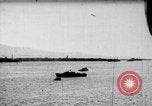
The Japanese attack on Pearl Harbor, December 7, 1941
Attack on Pearl Harbor, Hawaii by the Japanese Navy on December 7, 1941, as filmed from the deck of U.S. Navy Hospital Ship, USS Solace (AH-5). Ships docked at Pearl Harbor. Several small launches speed across the calm harbor. Suddenly a bomb bursts in the water, behind one of the launches. Several U.S. SBD Dauntless and F4F aircraft, from the USS Enterprise, fly over the deck of the Hospital Ship, with their landing gear down (to land at Ford Island). U.S. Navy ship USS Nevada (BB-36) leaves the harbor at high speed, throwing up a bow wave. Japanese aircraft bomb U.S. Navy ship USS Arizona (BB-39) docked. The ship explodes and sinks. A large smoke column rises from the explosion. (This image has been reversed. From the perspective of the USS Solace, the Arizona should be pointing to the right, not to the left.) Anti aircraft firing from U.S. Navy ships fills air with black Flak puffs. Various ships burn. (World War II period).
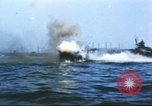
Color scenes of WWII including Pearl Harbor, D-Day, and Pacific campaign.
Montage of scenes dealing with Japanese attack on Pearl Harbor in World War 2. Bombs exploding and ships on fire; Japanese airplane diving from formation; a jeep driving past a burning airplane; hangars burning; Sailors firing anti-aircraft guns from an American ship; A New Orleans class American Cruiser firing her 8-inch guns; A South Dakota Class battleship firing her 16-inch guns; Group of American M3 Stuart light tanks in a field; U.S. Aviation Cadets marching between rows of Boeing Stearman Model 75 training biplanes; American soldiers marching in huge formations; Paratroopers in training jumps from towers; U.S. soldiers climbing down netting on side of troop transport ships to board small landing ships in the Pacific.; Marines in a landing craft carrying a large American flag; Landing craft in an amphious assault; Troops coming ashore from a Higgins boat, during training; An amphibious invasion task force at dusk; Troops wading ashore during the invasion of France in World War II, with barrage balloons aloft and support ships offshore. Staged scene of soldier on transport ship using flash light to read letter from home. Capital warships firing heavy guns and soldiers descending rope nets to enter landing craft. Soldiers landing on shore from Higgins Boats during training, and then on the shores of Normandy during the D-day invasion. American tank crew on an M26 Pershing tank. Major General George Patton with 1st Armored Division patch on his uniform sleeve. General George Marshall. General Dwight D. Eisenhower decorating an officer. Lieutenant General Henry (Hap) Arnold. Paratroopers jumping en masse from C-47 transport planes. German forces retreating in trucks along a road. Japanese General Yoshijirō Umezu, Chief of the Army General Staff, signing Surrender document aboard the USS Missouri, ending World War II, in the pacific. Glimpse of troop ship arriving in a U.S. harbor. View of U.S. military cemetery. Scene shifts to John Charles Daly, speaking in front of wall with names of Medal of Honor recipients, in the Hall of Heroes at the Pentagon, Arlington, Virginia, in 1968.
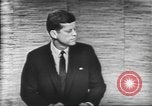
During a presidential election debate in Washington DC, Kennedy comments that its proper to express regrets to nations.
The second Kennedy-Nixon Presidential Debate in Washington DC, United States . Edward P. Morgan of ABC News asks Democratic candidate Senator John F Kennedy about sending apologies or regrets to General Secretary of the Communist Party of the Soviet Union Nikita S Khrushchev over the U-2 reconnaissance aircraft incident. Kennedy answers that if it could save the summit conference it would have been proper to express regrets. He speaks that the U-2 flights were proper from the point of view of protecting their security. But they were not in accordance with the international law. He speaks about the regrets expressed to Castro, to Southern Russia and to Eastern Germany under the Eisenhower Administration during the past years. He mentions the regrets expressed by the Soviet Union and the Chinese Communists to the U.S. over incidents. He states about they should have a stronger military force and should increase their strength all over the world. Republican candidate U.S. Vice President Richard M. Nixon presents his views and states that Senator Kennedy is wrong in thinking that Khrushchev might have continued with the summit conference if the U.S. had expressed regrets. He disagrees with Kennedy's analogies that the U.S. is a strong country and can express regrets for any wrong doings. He also disagrees in expressing regrets to anybody for doing things which has the support of the Congress and which is right from point of view to protect the security of the U.S. (This 4 part debate is sometimes called the Great Debate)
CRITICALPAST.COM: About Us | Contact Us | FAQs - How to Order | License Agreement | My Account | My Lightboxes | Shopping Cart | Advanced Search | Featured Collections | Website Terms & Conditions | Privacy Policy ©2026 CriticalPast LLC.
License Agreement |
Terms & Conditions |
Privacy Policy
©2026 CriticalPast LLC.