


 Francais
 Deutsch
 Italiano
Refine Your Search
US-Gliders- stock footage and images
- Showing 11407 to 11412 of 21913 results more
more Hide
Hide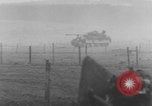
German forces counterattack Allied forces in battle of Ardennes during World War II.
At start of film, a German 10.5cm self propelled tank destroyer is seen covered with foliage moving in a field during German counterattack (Battle of the Ardennes, also known as the Battle of the Bulge) in World War 2. Closeup of a soldier standing in a Panzer III tank. White smoke rising across the entire background in a scene. A tank destroyer entering a village. Infantry running nearby. German infantry hunkering down in a field near a house. Soldiers crawling on hands and knees as they engage in fighting from house to house. Suddenly they rise up and run toward the front of the house, behind a passing German tank. German soldiers firing rifles from inside a round open turret in an armored vehicle equipped several installed machine guns. German soldiers lying low in a field as a tank burns behind them. A soldier fires a panzerfaust anti tank weapon. A huge explosion raises dense white and black smoke. German infantry run from a trench as another large explosion occurs. A German tank destroyer moves slowly past buildings, followed by a half track armored personnel carrier covered with foliage camouflage. Infantry walking behind armored vehicles. Soldiers running past rubble in house to house fighting. They jump through a destroyed brick wall. American soldiers being taken as prisoners as they step from a building and walk with their hands over their heads. A group of American soldiers surrendering with a white flag. U.S. Army soldier prisoners of war in formation on a cobblestone street. A destroyed tank upside down. A knocked out American tank with "America First" stenciled on its side. German soldiers look at hole in its side. One puts his hand in it. Soldiers surronding a captured U.S. jeep. One, with a bloodied face, uses a field phone. SS-Oberst-Gruppenführer Josef "Sepp" Dietrich, the 4 Star Commander of the German 6th Panzer Army is seen stepping from his staff car. He watches as German infantry walk past him. Closeup of Josef Dietrich. Line of infantry continuing to move as they pass him. Infantry moving along wifh armored vehicles and trucks. A soldier looks up at the sky as a German V-1 Buzz Bomb passes overhead. An American rifle stuck in the ground at a field next to a Browning M1917 machine gun. German soldiers look over the field where dead American soldiers lie amidst destroyed equipment and weapons. A burning U.S. tank. Several captured U.S. M3 Stuart tanks lined up in a field.
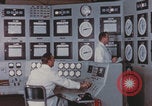
Scientists study and change fuel elements in core reactor of the Sodium Reactor Experiment nuclear power plant
Scientists working in control room of Sodium Reactor Experiment nuclear power plant at the Santa Susana Field Laboratory in Southern California. Fuel elements made from special uranium alloys, thorium uranium, and high temperature ceramic fuels. A scientist in white protective suit rides and operates bridge train. Fuel elements are removed from the core by the shielded fuel handling cast. The operator positions the cast in the general area over the used fuel element to be withdrawn. An indexing mechanism guides the cast to a preset position. Pneumatic mechanism forces an LED radiation shield down onto the surface of the loading face. Animation depicts a pickup device within the cast is lowered to engage the shielding plug of the used fuel element, with the shielding plug hanger rod and radioactive fuel element as one complete unit. Revolving fuel support plate at the top of the cast rotates to position new fuel element over empty fuel channel. The new fuel element is lowered into the core and shielding mechanisms are raised. The used fuel element is taken to underground cleaning cells where it is washed in a water bath. The fuel element is transferred into a storage cell after cleaning to permit reprocessing. Scientists use the hot cells for disassembly and study of experimental fuel elements. A scientist uses robotic arms to handle irradiated material in another room.
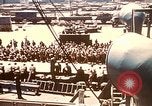
German prisoners of war board the moored USS Thomas Stone at Algiers, Algeria (WW2)
German prisoners of war gathered near the U.S. Navy Attack Transport ship, USS Thomas Stone, AT-59, at the port of Algiers in World War 2. (The US Thomas Stone was repurposed, after damage, as a floating barracks or processing vessel, especially for handling German and Italian POWs captured.) The German POWs climb a ramp to board the ship. View of them on the ship's deck. U.S. officer and sailor watch as the prisoners board. View of the wharf where lines of German prisoners are boarding. An African American U.S. Navy cook, in chef's white outfit, gives a small card to one of the boarding prisoners. Various views of German prisoners boarding. Scene shifts to view from a small moving boat as it moves out in the harbor.
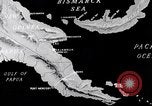
Soldiers pack supplies and parachutes at an Australian Parachute Packing Depot in Papua New Guinea.
March 1943: A map shows Salamaua in Papua New Guinea. An aircraft drops supplies with parachutes over hills. An Australian parachute packing depot. Soldiers pack parachutes on tables in rows. Stacked Australian parachutes to deliver rations, American parachutes used for Ammunition, and 24 foot parachutes for regulation. White parachutes used for medical supplies, blue ones used for rations and red used for ammunition supplies. Aerial view of Goodview, an area of conflict. A soldier radios the requirements to base. Another soldier delivers the plan to the depot. Soldiers pack mortar ammunition. The fuses and sheets are packed together in boxes. Soldiers put boxes into sacks, tie the sacks and attach parachutes. Soldiers pack canned meat: lay straw in big cans, put small cans into those, seal the big cans, secure them with a wiring machine, and attach parachutes. Sacks of rice are put into copper sacks, their mouths tied. Soldiers pack rations including onions, bacon and potatoes for delivery. Supplies are loaded onto trucks and transferred to the aerodrome. (World War II period).
Former American war correspondents get aerial views of Paris from a helicopter during a tour.
Group of former U.S. war correspondents in Paris, France to mark the 25th anniversary of Allied invasion of Europe in World War II. A view of railway tracks as seen from a moving train. American correspondents outside the U.S. Embassy in Paris. The group is joined by R. Sargent Shriver, then American Ambassador to France. The Eiffel Tower in Paris, viewed from a moving bus. Correspondents at a U.S. military helicopter pad in Paris. A helicopter lifts off. Aerial views of a city as seen from the helicopter. View of the Seine river and buildings of Paris below. Correspondents get off a U.S. Army CH-47 Chinook helicopter. Another smaller helicopter, the blades rotate.
City officials mark Independence Day in colorful ceremony at Philadelphia, Pennsylvania.
Philadelphia City officials mark July 4th Indepdence Day in colorful ceremony at Philadelphia, Pennsylvania. View of Independence Hall and Public Library in Philadelphia. American flags flutter on building. City and US Navy officials and women pose for photographs. Display of stacked rifles with U.S. Navy sailors in the background in Independence Square. Bronze statue of Commodore John Barry visible. US Navy Vice Admiral Harris Laning stands with Philadelphia Mayor J. Hampton Moore. Between them is a young man, Edward Weiner, a graduate of Central High School, to whom was given the annual honor of reading the Declaration of Independence. US Navy sailors march during the ceremony.
CRITICALPAST.COM: About Us | Contact Us | FAQs - How to Order | License Agreement | My Account | My Lightboxes | Shopping Cart | Advanced Search | Featured Collections | Website Terms & Conditions | Privacy Policy ©2026 CriticalPast LLC.
License Agreement |
Terms & Conditions |
Privacy Policy
©2026 CriticalPast LLC.