


 Francais
 Deutsch
 Italiano
Refine Your Search
US-Gliders- stock footage and images
- Showing 11449 to 11454 of 21913 results more
more Hide
Hide
Montage of Wright brothers and their airplanes in France and at Ft. Myer, Arlington, Virginia.
As a contrast to the early pioneering airplanes, passengers are seen seated inside cabin of a "modern" airplane (Douglas DC-4E). View of the DC-4E in flight. A view of Orville Wright. Wilbur Wright gesturing as he talks with officials in France about an aerial course to be flown. Wilbur Wright placing wheels under a Wright Flyer before it is moved across a muddy field in France. A team of men pull a rope raising a catapult weight in a tower. The weight falls, catapulting the Wright Flyer airplane into the air. Soldiers remove a Wright Flyer airplane from a storage building onto the parade grounds at Ft. Myer, Virginia. The airplane is seen in flight with Orville Wright alone, at the controls, On July 30, 1909, soldiers are seen moving a Wright Flyer from its shed for its final acceptance test. President William Howard Taft, U.S. Army Major George Owen Squier, U.S. Army Major Charles E. Saltzman and Wilbur Wright are among those standing with the President, as the Wright Flyer is moved toward the parade ground. Views of the monorail and weight and catapult used for launching an airplane. Men turn the two propellers on a Wright Flyer, as Wilbur Wright stands at the rear of the aircraft engine and makes an adjustment. . On September 9, 1908. U.S. Army Lt. Frank P. Lanham, seen in uniform, seated on a Wright Flyer, is joined by Orville Wright. Wilbur. They take off and set a new airborne endurance record, and Lt. Lanham becomes the first Military officer to fly in an airplane. On July 30th, as part of the final acceptance test, Orville Wright takes Army Lt. Benjamin D. Foulois on a cross country flight to Alexandria, Virginia, and back again. They are seen aboard the Wright Flyer, and then high in the air on their way to Alexandria.
President Kennedy receives Indian Prime Minister Jawaharlal Nehru and Ms. Indira Gandhi at Newport and in Washington.
U.S. President John F Kennedy receives Indian Prime Minister Jawaharlal Nehru and his daughter Ms. Indira Gandhi at Newport airport, Rhode Island. American ambassador to India John Galbraith, Indian students from Brown University and the press are also present. Military honor guard holding flags stands with airport terminal in background. Scene changes to Washington DC. Daytime view of exterior of U.S. Capitol building under a bright blue sky. Wide view of Washington Monument and reflecting pool. Scene in a park with yellow and orange colored autumn leaves on trees and ground, and adults and children walking in the park, wearing typical early 1960s fashions. Wide view of tidal basin and Jefferson Memorial in the distance. Arrival of President and Mrs. Kennedy accompany the visiting Prime Minister and his daughter on Air Force One aircraft as it arrives in Washington DC. Military honor guard holds flags and military band members play music, including the U.S. Army Herald Trumpets fanfare ensemble. The arriving officials are received by Vice President and Mrs. Lyndon B Johnson, Secretary of State and Mrs. Dean Rusk, and other dignitaries. President Kennedy speaks at a podium with microphone and welcomes the Prime Minister on his third visit to the U.S. Prime Minister Nehru then speaks and expresses gratitude for the welcome and for the friendship expressed by the President. View of Air Force helicopter taking off to fly the guests and the President to the White House after the ceremony.
The role of USAF bombers, submarines and Intercontinental Ballistic Missiles in maintaining world peace during Cold War.
The role of USAF bombers, submarines and Intercontinental Ballistic Missiles (ICBM) in maintaining world peace especially in the Mediterranean, Vietnam and Berlin during the Cold War. View of formation of United States Air Force Boeing B-52 Stratofortress bomber aircraft flying overhead in a blue sky. View from low flying aircraft of a U.S. Navy Polaris submarine cruising in ocean waters. A USAF Intercontinental Ballistic Missile being raised slowly upward from a silo into a launch-ready position. View from ground of large number of American paratrooper soldiers dropping from sky and landing on a field, including wide views and close-up views of parachutes and paratroopers landing. A U.S. Army paratrooper organizes his parachute and equipment immediately after landing. Aerial view of U.S. Navy warships cruising in the Mediterranean Sea. View from inside a U.S. Army helicopter in flight in Vietnam. Soldiers observe terrain out open door. Sign "You are leaving the American Sector" seen at Checkpoint Charlie of the Berlin Wall separating West Berlin and East Berlin. American and Soviet soldiers seen on each side of the checkpoint. An American tank parked at the checkpoint. (Vietnam War period).
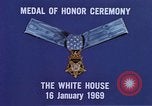
President Lyndon B Johnson at Medal of Honor Ceremony at the White House, Washington DC.
President Lyndon B Johnson arrives at East Room in White House, Washington DC. President Johnson addresses. Lieutenant Colonel Joe M Jackson, U.S. Air Force, Major Stephen W Pless, U.S. Marine Corps, Lieutenant Clyde C Lassen, U.S. Navy; and Staff Sergeant Drew D Dix, U.S. Army. Relatives of medal winners seated. Medals on the board. People clap.

A wartime war flag is woven and stitched for President Roosevelt in Philadelphia, Pennsylvania during World War 2.
Scenes of U.S. flag and White House. U.S. Presidential flag on a ship. President Franklin D Roosevelt on the ship. Presidential motorcade on its way. U.S. Capitol far in the background. Women hold Presidential flag. A woman designs Presidential flag. Women weaving and stitching the flag. Scene of Eagle on the flag. President Roosevelt sitting on a chair. Scene of U.S. Presidential seal.
Atoms for Peace. UN approves formation of IAEA. Nuclear scientists gather in Geneva Switzerland
UN General Assembly seen meeting in 1954 as it approves an International Atomic Energy Agency (IAEA). U.S. Ambassador Henry Cabot Lodge II, and French ambassador, Henri Hoppenot, speaking. Finn Moe, of Norway, speaking. View of the city of Kjeller, Norway. Flags of Norway and the Netherlands at joint atomic laboratory. Scientists with various pieces of scientific equipment inside the facility. Indian ambassador, Krishna Menon, speaking at the United Nations. Atomic laboratory and a Government Teachers' Training College, in India. Indian scientists in a laboratory. Indian lecturer speaks to students. Brazil's Professor Ernesto Leme speaks at the UN. The city of Sao Paulo, Brazil. The University of Sao Paulo. Rio de Janeiro, Brazil. The Center for Physical Research. Clock tower of Brazil Central Station in Rio. Sutan Sjahrir,of Indonesia at the United Nations. An animated map shows nations interested in atomic energy. The UN Headquarters building on the East River in New York. A person looking through a microscope. Foreign scientists attending indoctrination courses at the U.S. Argonne National Laboratory. Diplomats sign agreement between the U.S. and Philippines on July 27, 1955, for the Philippines to lease uranium for a research nuclear reactor, and to receive technical assistance. Views of Geneva Switzerland in August 1955, including street views with pedestrians, and tram or streetcar on city streets. Exterior of Palace of Nations, then interior view with atomic science conference in progress. Indian nuclear physicist, Homi Jehangir Bhabha, presiding over conference of scientists and university representatives from 73 nations, including, inter alia, John Cockcroft, of Great Britain; Otto Hahn, of Germany; Willard Libby, of the U.S.A.; Vladimir Vexler of the Soviet Union; and Niels Bohr of Denmark. Views of exhibit hall at the conference, and displayed models of nuclear reactors, uranium ore refining exhibits, and accelerators. U.S. President Dwight Eisenhower views swimming pool reactor, while visiting the exhibit hall. Site work and construction underway in Meyrin, Geneva, Switzerland for a research laboratory for the European Organization for Nuclear Research (CERN - Conseil Européen pour la Recherche Nucléaire). Sitework seen for a facility of Euratom in Europe (European Atomic Energy Community). View of early sitework in Manila for an Asian nuclear center in the Philippines under the Colombo plan, for training personnel in nuclear science and technology.
CRITICALPAST.COM: About Us | Contact Us | FAQs - How to Order | License Agreement | My Account | My Lightboxes | Shopping Cart | Advanced Search | Featured Collections | Website Terms & Conditions | Privacy Policy ©2026 CriticalPast LLC.
License Agreement |
Terms & Conditions |
Privacy Policy
©2026 CriticalPast LLC.