


 Francais
 Deutsch
 Italiano
Refine Your Search
US-Gliders- stock footage and images
- Showing 11485 to 11490 of 21913 results more
more Hide
Hide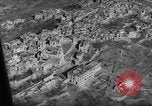
Scenes from the Battle of Monte Cassino, Italy, during World War II.
The Battle of Monte Cassino, Italy. Aerial view of San Vittore to the west. U.S. troops walk along a mountain road, as an Italian woman, holding a small child, watches from the roadside. Views of the town and Abbey of Monte Cassino, from mountainside outlook. Aerial view of Abbey on mountaintop. M7 Priest SP firing 105mm howitzer from camouflaged position. U.S. troops escorting Italian prisoners of war (POWs). American soldier carries several artillery shells up a hill. Several Sherman tanks of the 756th Tank Battalion are parked in a quarry below him. (The quarry is on the Cassino - Caira Rd north of Cassino.} Group of Italian civilians walk past a line of Sherman tanks parked along the empty riverbed of the Rapido River. U.S. soldier observes the Abbey of Monte Cassino through binoculars. Two American soldiers climb aboard an M4 Sherman tank mired down in the mud.(It has been identified as tank number C-14 belonging to the 3rd Platoon of C Company, 756th Tank Battalion.) Their Jeep is parked beside it. U.S. soldiers dug in along a roadside. One soldier plays solitaire with cards. Two soldiers place several propaganda leaflets into artillery shells.
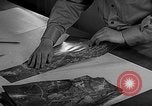
The film mosaic of T-3A camera is assembled together and interpreted in United States.
A U.S. Army training film about interpreting a camera film with aerial views. A print of T-3A camera film is developed. The mosaic prints are mounted by adhesive or staples. Completed mosaic is matched for contrast control networking. It is contrasted with U.S. geographical survey sheets and road maps. These are used to mark known places. Then these prints are pasted together. These pictures are send to an interpreter officer who translates the desired information. He uses stereoscope to find new enemy gun position, camouflage or other informations. (World War II period).

High Line Method and Burtoning Method of replenishing cargo from one ship to another described in the United States.
A U.S. Navy training film about replenishing in sea. The film is titled 'Fueling and Replenishing at Sea'. Two ship in sea transfer ammunition, cargo, fuel and personnels from one to another. Provision ships and cargo ships in the sea. Boom head cranes and winches at ship. Two types of transfer methods are described using pointers High Line Method and Burtoning Method. To transfer high load wire winches are used. An operator at wire handing winch. Forward loading area at ship described. Type of hooks, their functioning on both the delivery ship and the receiving ship is explained. Work of winch-men on both ships discussed. Horizontal lift of provisions. Use of slings in transfer demonstrated. A cargo is unloaded on a ship and sailors move it on a conveyor belt. Ammunitions handled with extra care during transfer. The distance between two ships is maintained at 70 feet. Sailors talk on communication line between both ships. High Line Method of transfer described in detail. Arrangements of haul line described.

United States Navy 3rd fleet carriers shell Japanese oil reserves in the South China sea.
U.S. Navy carrier planes hit oil fields in the China Sea. A storm in the China Sea. U.S. Navy 3rd fleet carriers on a ship. A diagram shows an arrow on the South China Sea. The fleet moves forward towards Japanese bases. U.S. airplanes bomb Japanese targets. Carrier planes return back to the ship. A plane crash lands on the ship. The pilot of ship is hurt and stuck in the cockpit. The crew runs toward the plane and gets him down. A diagram shows an arrow from the South China sea to IndoChina, Saigon. A tanker is torpedoed by U.S. planes. Bombing on Saigon. An oil reserve on fire. (World War II period).
Views of Japan and its militarism from 1937 through 1943 . Construction of B-29 bombers in the United States
Volcanic eruption and creation of island of Japan. Glimpse of map of Japan. Gardens and rivers. Two men demonstrate samurai sword techniques. Japanese soldiers advance through smoke carrying rising sun flag. Chinese suffering under Japanese military occupation. Two executed with rifles. Japanese soldiers waving weapons and red ball flags. A DC-3 aircraft flying over a Japanese Pagoda. Vies of Old Japan. Farmers at work. One manually turning a water pump with his feet. A man using a pole to propel a boat. Modern methods adopted in Japan for terraced farming. Japanese building railroads. Japanese modern locomotive on South Manchurian Railway. in 1934. A Japanese twin engine bomber taking off. The Japanese ocean liner, Asama Maru, in the 1930s. Glimpse of numerous ships in Tokyo harbor. Western style architecture in modern Tokyo buildings. Neon lights on the Grand Palace Hotel and other establishments in Tokyo. Industrial smoke stacks. Women at work in a silk factory. Finished product stamped "Made in Japan."Steel ingots being made in a Japanese steel mill using scrap iron imported from the U.S.A. Chinese victims of 2nd Sino-Japanese War. Japanese troops on parade. Dead American Marines on shore of Tarawa Atoll in the Pacific in World War 2, killed in battle. Japanese high ranking officers reviewing troops on parade. Japanese warships underway. Troops parading beneath the Imperial Palace in Tokyo. American B-25 bombers on flight deck of the USS Hornet, headed to bomb Tokyo.A crew of Doolittle's Raiders standing by their plane. B-25 taking off from the Hornet. Formation of B-25s in flight. View from bomber of smoke rising from bombing of Tokyo below. Brigadier General Jimmie Doolittle pledging to repeat bombing of Tokyo. Supply train entering a Boeing Company defense plant. United States war production workers being scrutinized as they enter the facility and punching in at a time clock. Poster in the plant picturing a B-29 bomber aircraft on a message in German describing it as an instrument for a "Destruction Battle against the Luftwaffe." Bold letters, above, in English read: "They're Promised-Let's Deliver 'em!" And, below, the words: "B-29, Super Bombers." Slabs of aluminum sheets fill a factory room. Overhead traveling cranes move them. Workers in airplane manufacturing and assembly plant use heat and brakes to shape the aluminum sheets. Multiple views of the aluminum being machined and stamped to specifications. Wings being fabricated. Relatively unskilled labor using jigs to perform the work. Woman war worker operating an overhead crane moving a wing in the plant. Views of plane parts moving across the ceiling via cranes. Women workers driving rivets into wings. Men and women employees working inside fuel fuel compartments of wings. A floor full of engine nacelles. A floor full of 2200 HP radial engines. A skeleton nose section being fabricated. Midsections and bomb bays being assembled. Workers crawling through the airframe during aircraft assembly. A woman working on a connecting tunnel. Sub-assemblies made by contractors arriving at the plant. More views of Boeing employees including young, old, men, and women, at work in the plant.

Modified C-135 aircraft of the Strategic Air Command (SAC) serve as "Combat Lightning" aircraft in Vietnam War
Opening scene shows two U.S. Air Force F-105 Thunderchief aircraft taking off in pre-dawn from Vietnam on a bombing mission, in 1966, during the Vietnam War. Next, the F-105s are seen diving and dropping bombs that explode into fire and smoke on the ground. Closeup of a Strategic Air Command (SAC) KC-135 aircraft in flight. It has been modified to serve as as a "Combat Lightning" aircraft that serves as a communication link between the Tactical Air Reporting Center at Monkey Mountain, near Danang, Vietnam and ground radar, airborne radar and any U.S. aircraft operating over North Vietnam. KC-135 "Combat Lightning" crew members are seated in a briefing room at the U-Tapao Royal Thai Navy Airfield, in Thailand. A briefing officer explains their mission, using charts and a map labeled SECRET Noforn (no foreign access) showing Vietnam and the Gulf of Tonkin. The briefer points to an area in the Gulf, and sketches a figure eight, showing where and how the KC-135 should maneuver in a holding pattern during its mission. Crew members rise and leave at the end of the briefing. View of a Strategic Air Command EC-135L that arrived on May 29, 1967, along with another, to support 24 hour "Combat Lightning" operations. Ground crewman directs the EC-135L as it taxis out and then takes off, past a C-130 aircraft holding short of the active runway. (Narrator notes that by the end of July, 1967, there were four "Combat Lightning" C-135 aircraft operating at U-Tapao airfield.) View from above of EC-135L aircraft in flight above clouds, en route to its assigned location over the Gulf of Tonkin. View of radio operator inside the aircraft, who is in radio contact with U-Tapao and the aircraft they are going to relieve. View of map showing their destination figure-eight holding pattern. Radio operator establishes the same contacts used by the aircraft they are relieving, to assure continuity of communications. Remainder of the film contains extended views of the radio operator at his station and of the EC-135 aircraft in flight. Near the end, the crew's Armaments and Electronics Technician is seen pulling a piece of malfunctioning electronic gear from a rack and replacing it with a spare, stored nearby.
CRITICALPAST.COM: About Us | Contact Us | FAQs - How to Order | License Agreement | My Account | My Lightboxes | Shopping Cart | Advanced Search | Featured Collections | Website Terms & Conditions | Privacy Policy ©2026 CriticalPast LLC.
License Agreement |
Terms & Conditions |
Privacy Policy
©2026 CriticalPast LLC.