


 Francais
 Deutsch
 Italiano
Refine Your Search
US-Gliders- stock footage and images
- Showing 11605 to 11610 of 21913 results more
more Hide
Hide
United States Jim Holt demonstrates shelter building and cooking techniques in Tropical rain forests in the Philippines.
Demonstration of the survival techniques in Tropical rain forests in the Philippines. Captain of the United States Air Force, Jim Holt demonstrates shelter building and cooking techniques: Jim chooses a campsite above the high water mark. He builds a shelter using wooden sticks. He makes a sleeping platform using leaves. He rests for a while. He prepares for building a fire. For that he digs a hole,place woods and dried palm leaves and lit fire using water proof match stick. Aquatic plant seaweed is used for cooking. He places leaves,cover them with mud and places the crabs in it. He cuts the cooked food and eats it.
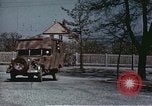
Scenes in and around Auerbach and Tannenbergsthal in Germany, immediately after the end of World War II in Europe.
German soldiers, in and around Auerbach and Tannenbergsthal, Saxony, moving to home bases in Germany immediately after end of World War Two in Europe. German trucks loaded with troops and a bus loaded with German soldiers turn a corner and move on road. German bus moves on tree lined street. German soldiers and trucks in a grassy field. Trees and hills in the background. German and American soldiers converse. German officers surrender pistols and a rifle to a U.S. Army officer. German soldiers ride in horse drawn carts on a street in a village. They ride along rugged road. German officer talks with U.S. Army officer. German truck on a village street and a country road. German soldier walks on a road. He stops to read a road sign. German open staff car moves on street in village. German soldiers ride in two horse drawn carts. Other German soldiers walk beside carts. Two German officers talk with a U.S. Army officer. German soldiers ride on top of bus. U.S. Army officer talks with a group of German officers.
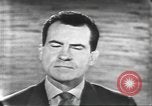
Nixon and Kennedy comment on the Cold War and Communist prestige during a presidential election debate in Washington DC.
The second Kennedy-Nixon Presidential Debate in Washington DC, United States. Edward P. Morgan of ABC News asks Republican candidate U.S. Vice President Richard M. Nixon to comment on whether the United States was doing well in the Cold War. Nixon states that they were not doing as well as they should have in the Cold War because of the presence of the Communists on the international scene. He says that the Communist prestige in the world is lower than the American prestige. He comments on cost cuttings on programs like mutual security and defense by the Democratic Congresses. Democratic candidate Senator John F Kennedy disagrees with Nixon's statement that the Congress has not provided funds for national defense. He also disagrees on the question of U.S. position in the United Nations. He mentions that various reports of Congressional committees indicate that the relative strength of the U.S. compared to that of the Soviet Union and the Chinese Communists together has deteriorated in the past years. Alvin Spivak of United Press International asks Kennedy how the losing prestige can be regained, and programs accomplished without damaging economy. Kennedy talks about the breaking off of the sugar quota with Cuba, passing of an authorization, and the development of the Inter-American Bank. He states that the U.S. has looked at the needs of Latin America. He states that instead of concentrating aid on surplus military equipment in Laos, the aid should have been concentrated in long-term loans. He concludes that Americans should identify themselves not only with the anti-Communist fight but also with the fight against poverty and hunger. Nixon presents his views and states that along with the necessity for economic assistance, the need for technical assistance should also be developed. Americans should not only think in terms of fighting Communism but also in terms of the interests of these countries. He concludes and mentions American ideals of independence, right of freedom and right of progress.
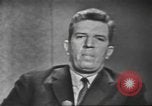
Kennedy and Nixon comment on the Indochina War, Quemoy and Matsu islands, and U-2 flights during their third debate.
Nixon and Kennedy debate questions regarding relations with Communists during the third Kennedy-Nixon Presidential Debate in the United States. Douglass Cater of Reporter magazine asks Republican candidate U.S. Vice President Richard M Nixon to comment whether there was a valid criticism of his statement of foreign policy. Nixon answers and states that the criticism is not valid. Regarding Indochina, he says that the U.S. would not have tolerated Indochina falling under Communist domination. And as a result of that the civil war there ended. He states that he supports the President's position and thinks that the President was correct in ordering the U-2 flights. Referring to Quemoy and Matsu he states that he objects to the constant reference to surrendering these islands. Democratic candidate Senator John F Kennedy disagrees with Nixon's statement on Indochina and states that reason Indochina was preserved was the Geneva Conference. On the question of the U-2 reconnaissance aircraft flights he states that he has never criticized them and never suggested stopping of espionage. On the question of keeping the Communists in doubt about the U.S. defending Quemoy and Matsu he states that the U.S. should meet its commitments to Formosa (Taiwan) and the Pescadores. He concludes by saying that he disagrees with Nixon as Nixon is extending the administration's commitment.
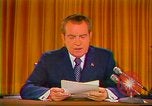
President Nixon speaks about reduction in defense budget while addressing the nation from the White House in Washington DC.
Television broadcast of U.S. President Richard Nixon's speech from the White House in Washington DC, United States on withdrawal of the remaining U.S. troops from Vietnam on 29th March 1973 during the Vietnam War. President Nixon speaks about progress that the U.S. has made towards peace and the end of the Vietnam War. He says that the United States should not reduce its defense budget. He speaks about negotiations with the Soviet Union regarding elimination of nuclear arms. He says that cutting down defense budget before the negotiations would increase the danger of war and there should be mutual reduction in defense. President Nixon says that the U.S. should maintain its strength.
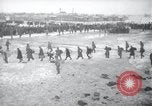
Russian prisoners are taken to train from camp in Plattling, Germany for their return to Russia soon after World War II.
Camp for Russian prisoners in Plattling, Germany soon after World War II. Russian prisoners being placed in line by a U.S. soldiers. Prisoners walk along a field and being lined up. Prisoners carry their meager possessions. Line of U.S. trucks. Russian and U.S. soldiers on guard. Line of Russian prisoners being marched to trucks for return to Russia. Prisoners getting into a truck guarded by rifle carrying U.S. soldiers. Truck pulls off. Trucks drive up to a train. Prisoners being searched for knives or weapons of any kind. Historical record accompanying the footage indicates that these Russian prisoners were former Russian soldiers, captured by the Germans, and that some of them then joined and fought for Germany.
CRITICALPAST.COM: About Us | Contact Us | FAQs - How to Order | License Agreement | My Account | My Lightboxes | Shopping Cart | Advanced Search | Featured Collections | Website Terms & Conditions | Privacy Policy ©2026 CriticalPast LLC.
License Agreement |
Terms & Conditions |
Privacy Policy
©2026 CriticalPast LLC.