


 Francais
 Deutsch
 Italiano
Refine Your Search
US-Gliders- stock footage and images
- Showing 11653 to 11658 of 21917 results more
more Hide
Hide
President Harry S. Truman arrives at Kansas City's Fairfax Airport and proceeds to a homecoming at Truman house in Independence
Preparations for the homecoming of U.S. President Harry S. Truman to the Kansas City area for the first time since becoming President of the United States. View from Fairfax Airport in Kansas City, Kansas. Cameras mounted on car as cameramen record the arrival of President Truman. Customized U.S. Army Air Force C-54 Skymaster aircraft nicknamed "Sacred Cow" lands and taxis. (This VC-54C was built for Franklin Roosevelt, but he only flew on it for one trip before his death. The name "Sacred Cow" was a precursor to the name "Air Force One." The trip by Truman in this video clip was the first domestic airplane trip by a U.S. President in history. Prior trips by Franklin Roosevelt had all been international travel.) People gathered in a large number to welcome the President. President Truman and others in his party get off the aircraft. Arrival of President Truman at the Truman home in Independence, Missouri (his summer White House). Roger T. Sermon, Mayor of Independence greets the President's car as it arrives. Secret Service stand by near car and President while Truman greets well-wishers. Gathering in the back yard of the Truman home with members of the Independence Chamber of Commerce. From left to right: Cedric Siegfried, Al Huff, Richard Harbin, President Truman, George Hare, Dixon Kepley, Paul Snyder, Petey Childers. Photographers click pictures.
Generals Omar Bradley and J. Lawton Collins attend ceremony at Utah Beach Memorial on 25th anniversary of D-Day
A U.S. delegation visits Normandy, France, 25 years after the Allied invasion of France during World War II. Soldiers and Honor Guard lined up. Military band plays. A cameraman records as a correspondent speaks. Children carrying American flags lined up along a path. Military officers seated in chairs. Civilians stand behind barricades. French officers at the ceremony. A helicopter in flight. A French Breton woman wearing a traditional hat of the Concarneau region. American officials including General Omar Bradley and his wife, along with General J. Lawton Collins. U.S. Ambassador to France Robert Sargent Shriver is also seen. Close views of General Bradley and General Collins seated side by side. British and American flags raised at the ceremony. A sign on a memorial reads 'In memory of our dead 1st Engineer Special Brigade'. A French flag raised. British, American, French and Canadian flags near the memorial at Utah Beach in Normandy. Military Honor guards standing at attention. Two U.S. Army soldiers in a small tank vehicle near the officials. The turret revolves. General Collins assists a soldier in lighting a flame torch. The soldier gets onto the tank. General Collins places flowers at the memorial.
Submarines of the Japanese fleet, being sunk during Operation Road's End, after World War II
Operation Road's End. Japanese submarines being sunk after World War II. A U.S. Navy Martin PBM Mariner flying boat circles over several Imperial Japanese submarines as they are being scuttled and/or sunk by gunfire on April 1, 1946, off the Goto Islands, of Japan. Smoke drifts over the water from charges ignited aboard a sub. One of the submarines explodes raising a surge of water and huge black cloud. Clear view of a U.S. Baltimore class Cruiser with two scout planes aboard. Sailors watch from the U.S. Destroyer, USS Everett F. Larson (DD-830) as a submarine slips below the surface. Another submarine explodes and sinks. Gunfire from the Larson strikes another submarine. Smoke from the Larson's guns drifts in front of the camera. Closeup of the Larson's forward 5-inch guns, turned to starboard, firing.
Army training film explains proper position of hand on telegraph key when sending Morse code messages
Army Master Sergeant, in training film about telegraphy. He illustrates proper position of telegraphers hand on telegraph key, with the help of a large dummy hand. Index and middle finger hold the button. Thumb on side with ring and little finger curled inside. Movements made with fingers keeping thumb steady. Third step being practice given on screen. A Sergeant listens to the recorded tape and uses RD-60 code recorder. Screen displays a good and bad example of using hand key. That soldier sits in a jeep and demonstrates use of a field telegraph key strapped to his leg. He transmits invitation to a woman, to dine with him. She imitates his Morse code message on a piano.. She agrees to join him for dinner. The soldier sends the letter "V" (for victory) repeatedly over the telegraph. Film ends with the couple dining in a restaurant.
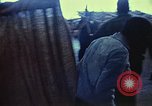
Sammy Davis Jr. performs for sailors on the USS Hancock, during USO tour in the Vietnam War
Opening scene shows Sammy Davis Jr. singing the song, "You're Nobody 'Till Somebody Loves You." while he moves about the stage arranging items for his USO show aboard the U.S. Aircraft Carrier, USS Hancock (CVA-19)during the Vietnam War. A U.S. Marine stands guard at stairs leading to a stage, that is set up on the hangar deck of the ship. Recorded orchestral music is heard accompanying him in background. Closeups of Davis on stage. Audience participates by clapping rhythmically as Davis sings. He uses a black hat as a prop in his performance. At one point, he sings alternately with the audience responding. The ship is anchored somewhere in protected waters, with land visible in near background.
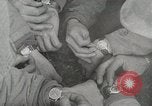
Scenes from the Battle of San Pietro, Italy, during World War II
Elements of the U.S. 36th Infantry Division engaging in the Battle of San Pietro, during World War 2. Opening scene shows U.S. infantrymen of the 141st Infantry Regiment synchronizing their watches on H-Hour, D-Day, the 15th of December, 1943. Next they move forward 400 yards from their positions and are immediately pinned down by heavy artillery fire from German defenders. Soldiers of the 2nd and 3rd Battalions of the 143rd Infantry Regiment advance 100 yards and hunker down at barbed wire barrier close to German defense line. They also come under heavy German artillery fire. American Sherman tanks enter the Town of San Pietro to find and destroy the German artillery interfering with the American advances. Views of U.S. tanks on the move. Narrator states that 16 tanks were dispatched along the road to San Pietro. Three reached the outskirts. German gunfire destroys two of these. Smoke rising from a struck tank. Views of pieces of destroyed tanks. Destroyed and abandoned American tanks. American infantrymen carrying a wounded on a litter past a knocked out Sherman tank. View of one (of four) tanks returning to the Regimental Bivouac area. Parachute flares illuminate the battlefield at night, where small American units succeed in penetrating German defenses, but are forced to move back again due to flanking German artillery and machine gun fire. Closeups of several wounded American infantry being moved on stretchers.
CRITICALPAST.COM: About Us | Contact Us | FAQs - How to Order | License Agreement | My Account | My Lightboxes | Shopping Cart | Advanced Search | Featured Collections | Website Terms & Conditions | Privacy Policy ©2026 CriticalPast LLC.
License Agreement |
Terms & Conditions |
Privacy Policy
©2026 CriticalPast LLC.