


 Francais
 Deutsch
 Italiano
Refine Your Search
US-Gliders- stock footage and images
- Showing 11647 to 11652 of 21913 results more
more Hide
Hide
Army Signal Corps receive and send messages via various methods in World War II; Pentagon signal center operations.
The role and contribution of the U.S. Army Signal Corps in combat during World War 2. Submarine cables laid down by the Signal Corps. Soldiers operate field army communication equipment for communication within and between units. Soldiers talk over the radio in a military jeep. American soldiers employ communication equipment seated at a table in a camp. A U.S. Army Signal Officer goes through documents. An officer receives a message in Washington DC. The message is relayed from the State Department to the Signal Center in the Pentagon building. Exterior views of the Pentagon building circa 1943 or 1944. Inside the Army Communications Signal Center in the Pentagon, technicians work using various communication equipment. They receive messages punched on tape as the tapes emerge from machines. Workers encoding and decoding secret and confidential messages that run the war. Workers at the 'Traffic Control, Army Command and Administrative System'. Paper messages seen gliding across a track near the ceiling above a signboard. A man inserts and removes cables from switchboard slots. The plans are then passed on in code through a maze of antennas all over the world. An animated map depicts the sending of these messages by radio multi-channels, radio teletypes, and manual radios to the front lines. A vast network of Army communication system from Washington DC to the rest of the world to carry a message around the world in three and a half minutes.
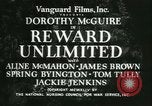
The need for cadet nurses and young girls to volunteer for military nursing service during World War II.
A film titled 'Reward Unlimited' starring Dorothy McGuire dramatizes the need for cadet nurses during World War II. Dramatization depicts why a girl called Peggy decides to become a nurse, and how she is trained. Peggy discusses marriage and future plans with her Lieutenant boyfriend. She decides to get a war job. She meets a woman who was a nurse and who gives her information about the U.S. Cadet Nurse Corps, Congress scholarships for nursing schools and duration of the courses. Peggy discusses her decision to join a nursing school with her parent. After she convinces her parents that nurses are needed, she enters training. She undergoes theoretical and practical training with many other girls in a hospital. Nursing students in classroom setting with teacher or professor at blackboard providing class instruction. Nurses receiving practical clinical instruction. Nurses using microscopes and taking notes, nurses attending patients in a hospital ward. Nurse cadet taking care of an infant baby. Nurse in surgery theater handing instruments to a doctor during operation on a patient. The graduation ceremony from the Army Nursing School. Peggy checks on a little boy called Jimmy. A government message urging young girls to volunteer for military nursing service with information about the U.S. Cadet Nurse Corps.
French Resistance Maquis members distribute and examine weapons in Chateaudun, France in World War 2.
The French Resistance Maquis (underground guerilla fighters) in Chateaudun, France. Men and women masquisards arm themselves near a French farmhouse. The weapons include English machine guns, U.S. Browning Automatic Rifles and captured German weapons and ammunition, dropped by the U.S. Air Force for the French underground. The members seated by a road. One loads cartridges into a magazine. The masquisards prepare the weapons. They discuss the plans and strategize. The fighters examine the weapons. A member demonstrates the use of a gun.
German occupation of Paris in June 1940 and the city's liberation by Allies in 1944. Also Includes some D-Day scenes.
The occupation and liberation of Paris during World War II. Germany occupies Paris in June 1940. A Nazi flag on the Eiffel Tower. Adolf Hitler with Nazi officers. Germans unfurl the Nazi flag on the Alsace-Lorraine Memorial. Hitler and his officers driven through the Place de la Concorde and past the Arc de Triomphe. Parisians close their shops. A man removes a Vichy poster and scribbles on a wall. Parisians listen to U.S. General Dwight Eisenhower's broadcast from London on June 6, 1944: The Allied task forces advance towards France on D-Day. Naval guns shell Normandy. Allied troops land on the beachhead and advance inland. Some fall to German gunfire. Headquarters of the Paris Underground. Members of the French Forces of the Interior (FFI) discuss, plan, document, prepare grenades, check guns, and wear badges of freedom with the FFI symbol. The French underground barricade streets. Men, women and children build barricades using various material. They inspect their guns and take their positions behind sand bag barricades on sidewalks. FFI soldiers honored. Burning vehicles on the roads. Street fighting between the FFI and the Germans. Corpses on the street. FFI men holding flags. Medics carry a wounded on stretcher. German tanks roam the streets. Wrecked vehicles and war equipment. FFI soldiers fire at German tanks. German snipers fire while French forces equipped by the U.S. are liberating the city. Explosions on the street. Civilians take cover. FFI fighters inspect a German soldier's corpse. They take German prisoners. French troops and military vehicles close in on Paris. Civilians watch and cheer as they enter the city. Barriers built by the FFI are pulled aside to let the troops pass. French forces in American tanks pass the Eiffel Tower. Explosions and machine gun fire during the street fighting. French soldiers fire at Germans hiding in buildings. Several German prisoners. German officers and soldiers surrender. Parisians watch as they are herded to prisons. Prisoners clean street.
Soldiers, correspondents and civilians pay their respects at a British and American cemetery in Villacoublay, Paris.
U.S. correspondents visit British and American cemetery in Villacoublay towards the end of World War II. Graves of U.S. Army Air Forces and British Royal Air Force fliers buried with honor by the French. The graves inside the high stone walls of the cemetery. Plain white crosses, flowers, and bushes planted over the graves. Allied officers, soldiers, U.S. correspondents and civilians pay their respects.
Casket containing the first American Unknown Soldier is viewed in France and carried through Châlons-en-Champagne and LeHavre.
Ceremonies attending the burial of the unknown and unidentified American soldier after World War I in France. France honors the Unknown U.S. Hero before the body is transported to America for burial at the Tomb of the Unknown soldier at Arlington National Cemetery. The ceremony marks the selection of the Unknown Soldier to be taken to the United States for burial. French citizens pay final homage to the body of the American lying in state at the Hôtel de Ville in Châlons-en-Champagne (City Hall in Châlons-en-Champagne, France). French men, women, and children wait in line and then file through to pay last respects. A banner on the road honors the American Hero. French soldiers stand by the large crowd of mourners outside the City Hall. People emerge from the Hall and more inside the Hall. View of the coffin with the simple offering of white roses to indicate that this would be the body sent back to the U.S. to represent all of his Unknown Soldier brothers. United States and French soldiers around the coffin. Close-up view of U.S. Army Sergeant Edward F Younger, who fought in all the American offensives and who had the honor of selecting the body from among four identical coffins on October 24, 1921, at the City Hall in Chalons-en-Champagne, France. A car arrives. French and American Generals emerge and greet the waiting officials. General Allen with a French General near the coffin. Allen pays tribute to the Unknown Soldier. The Generals and officers salute as the coffin is taken out of the City Hall and laid in a caisson. Marching troops lead the procession. The casket is brought to Le Havre where French citizens turn out in respectful tribute. Soldiers carry the casket past railway carriages followed by military officers and government officials. A large crowd on the streets watches the procession. The horse drawn caisson moves through people gathered on either side.
CRITICALPAST.COM: About Us | Contact Us | FAQs - How to Order | License Agreement | My Account | My Lightboxes | Shopping Cart | Advanced Search | Featured Collections | Website Terms & Conditions | Privacy Policy ©2026 CriticalPast LLC.
License Agreement |
Terms & Conditions |
Privacy Policy
©2026 CriticalPast LLC.