


 Francais
 Deutsch
 Italiano
Refine Your Search
US-Gliders- stock footage and images
- Showing 12043 to 12048 of 21917 results more
more Hide
Hide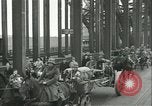
German and Japanese forces capture towns; Allied workers make ammunitions in factories (WW2)
German forces during remilitarization of the Rhineland: German Army supply wagons and German soldiers cross Hohenzollern Bridge in Cologne, Germany, to reoccupy Cologne and the Rhineland on March 7, 1936. Change of scene to Japan in late 1930s. Emperor Hirohito of Japan inspects troops on his white horse, Shirayuki. Japanese soldiers bow in front of the Imperial Palace in Tokyo. Japanese men holding banners. Japanese soldiers and cavalry advance. Japanese soldiers stand in formation and march on a street. Japanese Navy officers view a map or chart and discuss their plans and strategies for attack. Japanese soldiers fire artillery and other weapons in battle. Japanese war production worker in munitions plant making shells. Change of scene to American workers in war production factories in the United States making shells, bullets, and various munitions during World War 2. Elevated view of large American tank factory floor with many Army tanks being assembled. War production workers building Army trucks and new trucks being driven off of assembly line. Rows of U.S. Army tanks and artillery on the ground. U.S. Army soldiers board a troop transport ship. A submarine is spotted by a sailor. A hand presses a button to launch torpedoes to attack a ship. View through periscope as torpedo moves just below water surface toward target. View in open water of torpedo moving through water. Torpedo strikes a ship and explosion rocks ship. Formation of torpedo aircraft and dive bombers in flight over an area. Ships on fire with black clouds of smoke rising above. British navy sailors firing anti aircraft guns from a British ship. Sailors and officers aboard ships watch enemy airplanes through binoculars. U.S. Navy sailor manning a machine gun aboard ship watches the skies overhead.
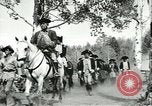
American forces prepare for war; ASF Lieutenant General Brehon B. Somervell addresses officials (WW2)
Continental Army cavalry riding horses and soldiers marching in an American Revolutionary War reenactment. Continental Army soldiers carrying the wounded on their backs under heavy rain. United States Army soldiers marching in New York City during World War II. Views of enormous numbers of U.S. Army soldiers marching in formation. Large columns of U.S. Army soldiers seen approaching camera position and from above. A soldier with an Army Service Forces (ASF) patch marching. Close up of the Army Service Forces (ASF) patch. Commanding General of the ASF Lieutenant General Brehon B. Somervell smiling. A notice detailing the War Department Reorganization effective March 9, 1942. Army Ground Forces commander Lieutenant General Lesley J. McNair. Army Air Forces Commander General Henry H. Arnold. General Somervell and Army Chief of Staff George C. Marshall. Soldiers advance towards a battlefront. Wounded are evacuated from the area. The soldiers stand in formation. Officials seated at a desk. General Somervell addresses them and speaks on the value of war material. A dead German soldier in tank. Dead bodies of Japanese soldiers scattered on the beach in the Pacific. Tires and scraps for use by the army. A newspaper advertisement reads “Your scrap will save some brave boy’s life!”. Ceiling prices listed in grocery store during wartime. Japanese planes bombing Malaya and Singapore. Burned houses after Japanese bombardment in Asia. A burning house in China. An oil tanker explodes and burns after being bombed at sea. Tanks advance towards the front. Generalissimo Chiang Kai-Shek and wife Soong Mei-Ling (Madame Chiang). An airplane in flight, bombarding a target area. Prisoners of war standing. Dead bodies lying on the ground. Destroyed area after an enemy attack. The soldiers and the tanks advance towards the battlefront. Barrage balloons in flight overhead. Allied flags on display such as the Soviet Union and England.
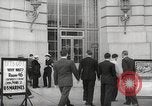
Men gather in a large number to enlist in the the United States Navy, in San Francisco, California, during World War 2
Recruitment of new Navy personnel in a Navy Department building in San Francisco, California. Men gather outside the building. They enter and leave the building. Sign boards outside the building read: "Let's Go Why Wait" and "Arise Americans" encouraging men to enlist in the U.S. Navy and U.S. Marine Corps. A board outside the entrance of the building reads: 'US Navy recruiting'. Military representative seated at a desk inside the building. New recruits gather inside the building and wait in a queue to give their applications to be recruited for posts.
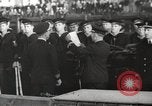
United States sailors and officers transferring old submarines to British Navy and Polish Navy early in World War 2.
US Navy ceremony handing over older submarines, early in World War 2 to the British Navy and Polish Navy, in New London, Connecticut. U.S. Navy officer reads a document as sailor stand and watch. U.S. Navy officers and sailors leave submarine and walk onto dock. British sailors take possession of the submarine. British officers conduct review of sailors on the submarine. Polish flag raised on another submarine as personnel salute. A sailor raises a ribbon flag on the conning tower. A Polish Navy sailor holds the flag of Poland on the submarine deck. An officer near a deck gun.
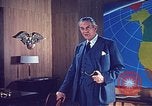
North American Air Defense System (NORAD) being exercised
Actor Raymond Massey in an office discussing importance of American military readiness. Street scenes in Manhattan, New York City. View from buiding overlooking Times Square in Mahattan, with Astor Hotel at left. Camera pans up (northward). Shift to North American Air Defense (NORAD) command center in Colorado Springs, Colorado, where U.S. Air Force men and women mark aircraft positions on plexiglass status board. During this exercise,NORAD Commander,General Laurence S. Kuter,USAF,with NORAD Deputy Commander, Canadian Air Marshal Roy Slemon, at his side, picks up phone to alert defense forces. View of DEW line radar site where men monitoring radar screens pick up returns from two incoming bombers. A NORAD radar picket ship at sea and sailor inside detecting incoming bombers on his radar screen. An airborne Lockheed EC121 Radar picket aircraft and crew member inside detecting targets on his radar screen. Views of personnel at various NORAD centers sending and receiving detailed information about the detected aircraft. Canadian and U.S. officers communicating on "red telephone." General Kuter and Air Marshal Slemon, consulting in NORAD headquarters command center. A Navy Captain on the "red phone." Klaxon horn alerts Royal Canadian Air Force intercepter crew who scramble to their aircraft. Canadian Avro CF-100 Canuck interceptors taking off. General Kuter and Air Marshal Slemon engaged in the NORAD command center. Unidentified 4-star Air Force General using "red phone." SAC bombers on airborne alert. Air Force officer alerts interceptor squadron. Pilots scramble and run to their F-102 aircraft. F-102, tail number 53-107 taxiing from hangar. Pilots quickly entering their aircraft and being secured in cockpits. F-102s taxiing at high speed.BOMARC missile readied. Civil defense officials issue air raid alert.
The demonstration of the principles of the steam power in the United States.
A film titled: 'The Magic of Steam' depicts the working of the steam turbines in the United States. A woman seated in her room turns the light on. Men work inside a factory. Electric poles in an area. Wires connected from one electric pole to the other. A pie chart depicts the power used for the production of electricity. 65 percent of steam and 30 percent of water being used for the purpose. Men work inside a factory. They work on steam turbine. A man demonstrates the working of a steam turbine using the steam. A man places a tea kettle to heat. Steam arising out of the kettle as the water boils. A paddle wheel is placed near the kettle from which the steam comes out. The wheels start revolving due to the steam. A lid is placed on the kettle. The high pressure of steam lets the wheels to revolve faster and pushes the kettle in the opposite direction. The lid is then removed from the kettle. Another example to demonstrate the concept of steam is that of the fire hoses. Firemen try to control the fire in a building with the help of fire hoses. Men work near a steam turbine in a factory. (World War II period).
CRITICALPAST.COM: About Us | Contact Us | FAQs - How to Order | License Agreement | My Account | My Lightboxes | Shopping Cart | Advanced Search | Featured Collections | Website Terms & Conditions | Privacy Policy ©2026 CriticalPast LLC.
License Agreement |
Terms & Conditions |
Privacy Policy
©2026 CriticalPast LLC.