


 Francais
 Deutsch
 Italiano
Refine Your Search
US-Gliders- stock footage and images
- Showing 12175 to 12180 of 21917 results more
more Hide
Hide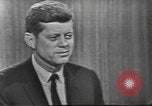
Senator Kennedy gives his closing statement during the fourth presidential election debate held in New York, United States.
The fourth presidential election debate held between Democratic nominee Senator John F. Kennedy and Republican nominee U.S. Vice President Richard Nixon in New York, United States on 21st October 1960. ABC news correspondent Quincy Howe asks Senator Kennedy to give his closing statement. Senator Kennedy says if he loses the election he would continue in the Senate to try and build a stronger country. He says that the year is of importance for the United States. He speaks about the present situation of the U.S. in regard to education, science, and diplomatic relations. He says that the Republican party has stood still really for twenty-five years and opposed all of the programs of President Roosevelt and others. He further says that the U.S. should get a party which believes in going ahead so that the country can reestablish its position in the world with strong defense, economic development, justice for people and should particularly to try to reestablish the atmosphere which existed in Latin America at the time of Franklin Roosevelt.
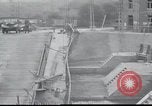
French families flee During Battle of France in World War II.
Invasion of France by Germany during World War II. German Army trucks pass over a bridge near damaged canals and locks on a river. Large pieces of rubble line the side of the bridge. Families evacuate from the town during German occupation, using horse-drawn wagons, and bicycles to carry their belongings. A car being used as a powerless conveyance, with men pushing it. Inside a mother and baby can be seen. The car is filled inside and out with bedding and other articles strapped to the roof. Catholic nuns leaving along with numerous French people walking and using bicycles to help carry belongings. A mother with two girls, pushing a baby cart holding belongings. A team of four horses pulling a large wagon loaded with people and belongings. A woman in the wagon is crying. Evacuees pause at side of road, as woman drinks from a bottle.
Allied leaders attend the Cairo Conference and the Tehran Conference in the Middle East during World War II.
Allied leaders at conferences in the Middle East during World War II. Aerial views of pyramids in Cairo, Egypt. U.S. President Franklin Roosevelt, British Prime Minister Winston Churchill, Chinese Premier Chiang Kai-Shek and his wife Madame Chiang Kai-shek seated during the Cairo Conference. Allied officers stand behind the seated leaders. Soviet Premier Joseph Stalin, President Franklin Roosevelt and Prime Minister Winston Churchill at the Tehran Conference in Tehran, Iran. Churchill's daughter Sarah, an officer in the Women's Auxiliary Air Force, is introduced to Premier Stalin by President Roosevelt. British Foreign Secretary Anthony Eden, U.S. Ambassador to the Soviet Union William Averell Harriman and Soviet Foreign Minister Vyacheslav Molotov stand behind the Big Three with other officials. During a ceremony, Winston Churchill presents the Sword of Stalingrad to Premier Stalin which he accepts on behalf of Russian people. U.S. Army Chief of Staff General George Marshall present.
German General Field Marshal Rundstedt speaks to Major General Milburn in Weilheim, Germany after his capture.
German General Field Marshal Gerd von Rundstedt in Weilheim, Germany after his capture by the U.S. Army towards the end of World War II in Europe. General Field Marshal Rundstedt speaks with Commander of U.S. XXI Corps Major General Frank W. Milburn. General Field Marshal Rundstedt steps from a car and enters a building. Interiors of a room shows General Field Marshal Rundstedt smoking. He walks out of the building followed by U.S. officials.
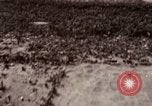
Aerial views of bomb-damaged buildings and marshaling yards in Worms, Germany during World War II.
Bomb damage in Worms, Germany during World War II. Aerial views from a U.S. Army Air Force aircraft making a low pass shows refugees in a prison camp. Bomb damaged marshaling yards and bombed-out buildings in Worms. Aerial view of a pontoon bridge with U.S. military vehicles moving across it. Several views of destroyed and bomb damaged bridges in Frankfurt am Main. A steam locomotive and train moves across one span, still intact. A formation of U.S. Army Air Force B-26 Marauder bombers in flight.
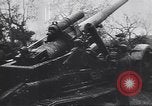
German artillery fires propaganda leaflets in the European Theater during World War II.
Dramatization about German artillery firing propaganda leaflets in the European Theater during World War II. German artillery fires propaganda leaflets towards U.S. soldiers. Two soldiers look at leaflets being fired at them, one of them is an African American soldier. Writing on the leaflet reads, 'What will you get out of this war? Surrender ! Come over to us. Colored soldiers will be well treated in a German camp.' U.S. soldiers continue their attack. German officers surrender at Allied headquarters in France towards the end of World War II.
CRITICALPAST.COM: About Us | Contact Us | FAQs - How to Order | License Agreement | My Account | My Lightboxes | Shopping Cart | Advanced Search | Featured Collections | Website Terms & Conditions | Privacy Policy ©2026 CriticalPast LLC.
License Agreement |
Terms & Conditions |
Privacy Policy
©2026 CriticalPast LLC.