


 Francais
 Deutsch
 Italiano
Refine Your Search
US-Gliders- stock footage and images
- Showing 12955 to 12960 of 21917 results more
more Hide
Hide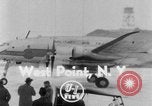
General Eisenhower returns to West Point, New York and meets his wife and grand children.
U.S. Army General Eisenhower returns to West Point, New York. A U.S. military aircraft transporter on the ground. General Dwight D. Eisenhower arrives at West Point to rest and prepare his report for the Congress. He disembarks from the aircraft after a tour of the Atlantic Pact nations in Europe. His wife and grand children meet him. He holds his grandchildren onto his lap.

UN forces stage their own show and provide a barrage of laughs for their buddies during a lull in fighting in Korea.
UN forces relax during a lull in Korea during the Korean War. U.S. Army Commander of the UN forces General MacArthur on the front with his men. An aerial view of a mountain terrain and the 38th parallel. Shirtless North Korean prisoners are marched under guard, with their arms over their heads. Damaged tanks, artillery and other equipment. During the lull in the fighting, UN forces rest and Army soldiers stage their own show and entertain their buddies. U.S. Army soldier acts in a skit and dances with another soldier dressed like a woman, and other soldiers watch the show and laugh at them.

Britain's Prime Minister Winston Churchill is greeted by President Truman and speaks at Bolling Field in Washington DC
Britain's Prime Minister Winston Churchill arrives in United States. He arrives on the 'Queen Mary' ship in New York harbor. Officials and other dignitaries greet him at the Army base in Brooklyn. Then he boards the President's airplane "Independence" at Floyd Bennett field to go to Washington DC. U.S. President Truman greets him at Bolling Field. U.S. Capitol and Washington Monument both visible in background. Churchill addresses the people at the airfield and talks about the harmony and close bonds between the two countries. Truman comments briefly also with words of agreement.
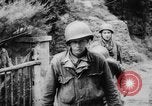
German soldiers guard and march United States Prisoners of War captured in France during World War 2.
German soldiers on the move near Caen after the Normandy invasion, France. They guard and march a group of U.S. Prisoners of War captured during and after Normandy invasion operations. German soldiers walk beside the U.S. forces. Prisoners of war sit. Trees in the background. Close views of some of the prisoner soldiers resting and marching. Some prisoners are held up by fellow soldiers helping them to walk.

American workers and OSS in World War 2 work to estimate the loss of German military manpower in battle.
Film outlines process of U.S. military and War Department to estimate the German military manpower losses from 1939-1943 during World War II. Scenes of German military forces in battle. German tank on the battlefront smashes down a tree and German soldiers follow, running behind it. Dead bodies of soldiers lay on the battlefield. Airplane falling from sky to ground after being hit. German Soldiers fire rifles during battle. German soldiers carry wounded on litters and German medical staff treat the wounded soldiers. A wounded soldier on a hospital bed. Nurse leans over hospital bed and talks to a wounded soldier. A study made to find out the number of soldiers returning to their jobs after being injured. A man reads a magazine which reads: 'Estimate of non battle causalities'. German soldiers march through Arc de Triomphe in Paris during occupation of Paris by Nazi Germany. Headline of a newspaper reads: 'Germans silent on Russian gain'. Brief scene of Soviet leader Stalin speaking at a microphone. Cavalry soldiers, likely Soviet, crossing a battlefield. Scenes of World War I German troops being reviewed by officers. Civilian or OSS men lean over a German map and discuss among themselves. They study the map. Scene of men and women at a German news stand buying German newspapers in order to obtain obituary information. OSS personnel translate casualty reports from German newspapers to help estimate deaths of German soldiers and determine force strength. An operations room with American staff analyzing German newspapers. View of a Boeing 314 Clipper Flying Boat aicraft taking off from water. The reports from World War I and II, allied forces, chart, graphs and NARS computers used to estimate German Army's manpower loss. African American women workers operate keypunch machines recording battle casualty statistics which yield punch cards for further data analysis. Punch cards being created and being loaded in sorting and reading machines bearing brand "International" (for International Business Machines or IBM). A document entitled "analysis of obituaries." Man in an office studying a map and a document. A woman helps him as she enters numbers into a Remington Rand adding machine. They estimate the officers killed in war and the number of the killed enlisted men, in order to estimate the total battle loss. They compare the data of soldiers missing, killed, wounded, and unfit for duty from 1939 to 1943.
Wounded but recovering Army Air Force soldiers work at a bomb factory in Denver, Colorado in World War 2.
Ambulances in front of a military hospital. A nurse working with wounded soldiers in a hospital ward. View of wounded but now recovered U.S. Army Air Force soldiers punching a time clock to work at a bomb factory in Denver, Colorado. View of the qquipment yard outside the Colorado Building Supply Company or "COBUSCO". The soldiers and airmen serve as war production workers for 6 hours a day while their recovery continues. Workers work on bomb shell assembly in the arms factory. Some use welding equipment. View of completed bombs on assembly lines. Stacks of completed bombs being inspected before shipment.
CRITICALPAST.COM: About Us | Contact Us | FAQs - How to Order | License Agreement | My Account | My Lightboxes | Shopping Cart | Advanced Search | Featured Collections | Website Terms & Conditions | Privacy Policy ©2026 CriticalPast LLC.
License Agreement |
Terms & Conditions |
Privacy Policy
©2026 CriticalPast LLC.