


 Francais
 Deutsch
 Italiano
Refine Your Search
US-Gliders- stock footage and images
- Showing 12967 to 12972 of 21917 results more
more Hide
Hide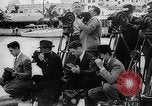
President Roosevelt, James Roosevelt and Harold Ickes aboard yacht Potomac in Washington DC.
Dignitaries on yacht Potomac in Washington DC. Cameramen prepare their cameras to record the event. Flags flutter on the ship mast. An airplane in flight over the ship. Sailors stand on the deck. U.S. President Roosevelt, his son Brigadier General James Roosevelt and U.S. Secretary of the Interiors Harold Ickes aboard the ship. They talk amongst themselves.
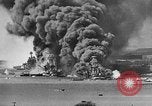
Japan attacks the United States of America at Pearl Harbor, Hawaii. President Roosevelt declares war against Empire of Japan (WW2)
Smoke billowing from U.S. warships bombed by Japanese warplanes in Pearl Harbor, Hawaii, on December 7, 1941. Japanese planes attack Pearl Harbor during World War II. Scenes at other U.S. military installations with aircraft burning in hangars and injured being carried on stretchers. Voice of President Franklin D. Roosevelt declaring war against Empire of Japan.
Harry S Truman assumes office of President of the United States following death of Franklin D. Roosevelt during World War 2
Harry S Truman appointed President of the United States. The U.S. Capitol building in view. Trees in the foreground. President talks on the phone. Harry Truman attends the 1944 Democratic convention with his daughter, Margaret Truman. People gather holding boards and placards of Truman in hand. A board reads: 'Truman for Vice President'. Franklin Roosevelt seated in a car during his fourth inauguration parade, on January 20, 1945, with motorcade proceeding on Constitution Avenue in Washington DC, and then driving up to the White House. Past events show President Franklin Roosevelt talking to Vice president Truman. Flag at half staff on the U.S. Capitol following death of President Roosevelt. Truman addressing a joint session of the Congress. General Marshall, Admiral King, Secretary of War Stimson all arriving at the White House to meet with President Truman. Also seen are James Byrnes and Truman receiving Lord Halifax, Anthony Eden, Secretary of State Stettinius in the White House. Truman speaks to joint session of congress on April 16, 1945 and expresses desire to continue the efforts and direction set by Franklin Roosevelt, saying, "With great humility I call upon all Americans to help me keep our nation united in defense of those ideals which have been so eloquently proclaimed by Franklin Roosevelt...." He also states, "So that there can be no possible misunderstanding, both Germany and Japan can be certain, beyond any shadow of a doubt, that America will continue to fight for Freedom until no vestige of resistance remains. Our demand has been, and it remains, unconditional surrender. We will face the problems of peace with the same courage that we have faced and mastered the problems of war. In the memory of those who have made the supreme sacrifice; in the memory of our fallen president, we shall not fail."

President Franklin Roosevelt address people, during Presidential campaign, at a convention hall in Philadelphia.
U.S. President Franklin Roosevelt in Philadelphia, Pennsylvania. A large crowd gathers at a convention hall to hail the President. The President addresses the people from a podium. The crowd cheers and applauds. President Roosevelt states that the U.S. does not have any secret agreements with any other nations. He speaks about the neutrality policy of America and non involvement of America in any foreign war. Roosevelt states, "To Republicans and Democrats, to every man, woman and child in the nation I say this: Your President and your Secretary of State are following the road to peace. We are arming ourselves not for any foreign war. We are arming ourselves not for any purpose of conquest or intervention in foreign disputes. I repeat again that I stand on the Platform of our Party: 'We will not participate in foreign wars and we will not send our army, naval or air forces to fight in foreign lands outside of the Americas except in case of attack.'
The United States Naval fleet is termed as the best fleet in the world on the Navy Day.
The United States Naval fleet on Navy Day. U.S. fleet is termed the best in the world. U.S. battleships, cruisers, destroyers and submarines underway at a sea. Planes take off from an aircraft carrier. An aerial view of the ships. Men work with equipment on a ship. Soldiers fire guns from a battleship. Smoke from firing and bombardment. A flag flutters from a flag pole on the ship. (World War II period).
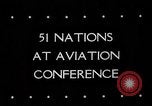
Delegates from 51 nations meet for Convention on International Civil Aviation in Chicago.
Scenes from the first International Civil Aviation Conference (ICAO) in the city of Chicago, Illinois. At the invitation of the United States, delegates from 51 nations arrive to begin drafting and concluding the Convention on International Civil Aviation (Chicago Convention), including discussion on freedom of aircraft traffic in the world's aviation routes. Opening scene shows the Stevens Hotel at 720 S. Michigan Avenue, Chicago, United States, with automobile traffic driving past it on the street. Delegates from 51 nations are seen entering the hotel Grand ballroom, being monitored by U.S. Army Military police, as they enter. View from inside the ballroom as delegates enter. Some are seen standing around a globe of the world, discussing the transfer of military air routes back to civilian operations, in the future after the end of World War 2. View from a balcony of the delegates gathered below. Closeups of delegates from: Belgium; a military aviator in uniform, representing Haiti; delegates from Iraq, India, Australia, and Norway. Assistant Secretary of State, Adolf A. Berle Jr., Head of the U.S. delegation, delivers a brief welcoming speech, on behalf of President Roosevelt, from a podium behind which flags of participating nations are displayed. He speaks of the importance of freedom of air space, noting that closed air space can lead to war. He says that the air which God gave to everyone, should not become the means of domination over anyone.
CRITICALPAST.COM: About Us | Contact Us | FAQs - How to Order | License Agreement | My Account | My Lightboxes | Shopping Cart | Advanced Search | Featured Collections | Website Terms & Conditions | Privacy Policy ©2026 CriticalPast LLC.
License Agreement |
Terms & Conditions |
Privacy Policy
©2026 CriticalPast LLC.