


 Francais
 Deutsch
 Italiano
Refine Your Search
US-Gliders- stock footage and images
- Showing 12973 to 12978 of 21917 results more
more Hide
Hide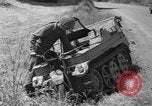
Italian Campaign in World War Two. Scenes of Allies on the road to Rome
The Italian Campaign during World War II. An American soldier inspects a damaged German Kettenkrad tracked motorcycle abandoned at a roadside. Allied truck, jeeps, halftracks, and towed field artillery moving along a road. Sign on road near destroyed buildings identifies Highway 7 and points to towns of Gaeta, Velletri, Albano, Genzano, and Rome. U.S. Sherman tank on road passing bombed out buildings. Allied military ambulances on the road. More views of destroyed buildings. A damaged Sherman tank. A damaged German tank. A U.S. soldier climbs out his bunker carved out of rubble.
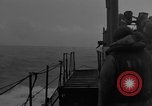
Coastguardsmen rescued from sinking Higgins boat during D-Day landings on Omaha Beach, Normandy in World War II
View from a U.S. Landing Craft Infantry (LcI), of four U.S. Coast Guard personnel in a sinking Higgins boat from the Attack Transport, USS Bayfield (APA-33), off Omaha Beach on D-day, in World War 2. Another Higgins boat, from the Bayfield is nearby. The four Coastguardsmen pose standing in their stricken boat. Then it goes under and they must swim. The LCI crew throw life rings to them and pull them aboard.
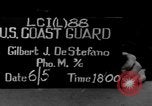
United States ships and USS Samuel Chase underway from England for invasion of Normandy, France (WW2)
Landing Crafts Infantry leave England for World War II D-Day invasion of Normandy, France. Stern and U.S. flag in foreground. Gun at the stern of ship. USS Samuel Chase APA-26 underway. U.S. destroyers underway in the background.
The film of T-3A camera developed and a print is taken from B-7 printer in United States.
A U.S. Army training film about developing camera film containing aerial reconnaissance views. Film titled 'Aerial Photography', Part -5, 'Processing the Film'. A T-3A camera is unloaded from a plane. It is taken to a dark room at photographic laboratory Dept. 59. Exposed film roll is removed from camera and is put into its original box. The T-3A film development assembly, placed on table consist of 3 metal boxes, spool plates and motor to transfer film and a loading plate. Development of film starts with first fixing the film onto the loading plate and transferring it on to spools. These spools are then immersed in clean water and transferred from one solution to other. It is then transferred to the developing solution, then in water and hypo solution and then kept in fixing base for 30 minutes. It is washed in running water for 30 minutes. Film is then dried on film dryer blower drum. Then it is transferred to take up spool and laid on lettering table. Each film is lettered on right lower side with title, location, organization, date, day, length and altitude. Developer is prepared at appropriate temperature with water. Print is taken on paper. A B-7 printer is used for printing. The paper is immersed into different solutions and then dried on a canvas belt over a heated drum.
Parts of a K-12 camera described in United States.
A U.S. Army training film about parts of the K-12 camera. Title of the film 'Aerial Photography', Part 2, 'The K-12 Camera'. A man shows a K-12 camera used for night photography. A diagram of the camera. A pointer shows parts of the camera like photo electric cell and amplifier. A solenoid is attached to the shutter. Lenses and 12 volt battery. The aligned system of camera must be 13 and a half inches. Portals attached to a battery current. Before assembling the camera it is cleaned by air blower. Lenses are wiped. Amplifier is attached and locked over camera. Electric nodes are fastened. horizontal and lateral leveling of camera is measured. Number of exposures are calculated. Shutter speed is provided at three levels. Shutter and amplifier are set at on position. Cut film holder is loaded in a dark room and roll film magazine is loaded. The man shows the parts of camera mount.
The importance of gas mask depicted through dramatization in United States.
A U.S. Army training film about gas masks. The film is titled 'Defense Against Chemical Warfare'. A soldier lies down removing his gas mask kit. His sergeant tells him not to do so. He tells him a story about a soldier named Joe. He says when the call of joining army came, many people came from different professions. Joe used to think that the training with a gas mask was a joke. Soldiers were tested in a gas chamber but Joe did not learn from that experience. They were sent to the front as advance patrol. Soldiers passed through a chemical contaminated area. The general of patrol had given maps of contaminated area to soldiers. Joe did not pay much attention to this information. During an enemy attack he got hit by gases and fell on ground. Soldiers put gas mask over his face and left him there only. He was then taken on a stretcher. Medical vans pass on road. A bomb explosion on road. Soldiers hide at sides. (World War II period).
CRITICALPAST.COM: About Us | Contact Us | FAQs - How to Order | License Agreement | My Account | My Lightboxes | Shopping Cart | Advanced Search | Featured Collections | Website Terms & Conditions | Privacy Policy ©2026 CriticalPast LLC.
License Agreement |
Terms & Conditions |
Privacy Policy
©2026 CriticalPast LLC.