


 Francais
 Deutsch
 Italiano
Refine Your Search
US-Gliders- stock footage and images
- Showing 13057 to 13062 of 21917 results more
more Hide
Hide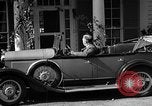
President Roosevelt drives his personal car at Little White House in Warm Springs, Georgia.
President Franklin D Roosevelt during a vacation at the Little White House in Warm Springs, Georgia. President Roosevelt sits in his personal hand-controlled 1932 Plymouth PA Phaeton open car, outside the little White House in Warm Springs, Georgia. He sits in the car as photographers take pictures. U.S. Marine guard stands at attention , in background. A man sitting in back seat of the open car moves to the front and sits next to President Roosevelt, who then drives the car, with the man, smiling beside him. Front view of the car shows a triple A insignia and license plate displaying the single letter "R." A Secret Service agent jumps on the running board as the car comes past him. Other Secret Service Agents follow in another car. The two cars are seen under the entrance sign to "Georgia Warm Springs Foundation." The President is driving with three passengers in his car, followed by the Secret Service car. They proceed out on the public highway, past a gasoline station with "Standard Oil Products" sign in front. A U.S. Marine guard in uniform, stands beside large sign reading: "This is The Little White House." it asks the public not to intrude.
Coast Guard Rescue Stations along the Eastern and Southern coasts of the United States
After extensive slate of historical information, this film shows U.S. Coast Guard personnel launching a large dory (life boat) from the U.S. Coast Guard Gloucester Station in Gloucester, Massachusetts (Old House Cove, westerly side Gloucester Harbor). They slide the boat down rails, launching it directly into the water. Coast Guardsmen in foul weather gear are seen rowing a large lifeboat in rough waters near rocky shores. Eight men row, sitting in four pairs side-by-side on fixed thwarts (benches) and one stands in the stern (a coxwain) steering with a 16’ oar. A powered life boat is seen briefly, in extremely rough waters. Remainder of the film shows an animated map of the East and South coasts of the United States with dots identifying Coast Guard Stations on those coasts. At this point, the film concentrates on Rescue Stations in the Boston Division. A beached two-masted sailing ship is shown. A large steamship emitting black smoke from her funnel, is seen beached and listing on a shore. Aerial view of Light House on Block Island, off Rhode Island. Aerial view of a freighter run aground just off shore. Aerial view of a Coast Guard Station with a highway running past it. Aerial view of another Coast Guard Station located where narrator says is a dangerous point.
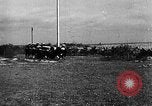
Coast Guardsmen conduct a breeches buoy drill
Coast Guardsmen in uniform wheel a beach cart containing a lyle gun and other equipment for firing a shot line to a vessel in distress. They are conducting a breeches buoy drill. They remove a lyle gun and flaking box from the cart and uncover the shot line which they place in the gun. Using a long lanyard, one guardsman fires the gun. Closeup of the shot line smoothly paying out from the flaking box. It is fired to a simulated mast (tower) on the beach. Closeup of large spools of whip line with instructions to the distressed crew about their use. After the whip line and block are set on the distressed ship's mast, the Coast Guardsmen now prepare the whip line to move large hawser line to the mast. Large spools of hawser line are seen in background. Closeup of Guardsmen pulling hawser from the spools. Guardsmen tie the hawser to the whip line for hauling aboard the distressed vessel. Closeup of the whip line pulling the hawser across the sand to the tower. Guardsmen working rapidly to accomplish this. A breeches buoy being attached to the hawser which is then propped up for elevation. View of the Breeches Buoy traveling up to the tower. A guardsmen riding the breeches buoy down from the tower. He is helped by others when he reaches the ground. Closeup of a clamp placed on the hawser to retrieve it from the vessel. The hawser being retrieved.
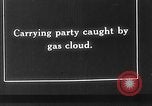
American Expeditionary Forces soldiers show techniques for coping with gas attacks
Several soldiers of the American Expeditionary Forces (AEF) are seen moving through a trench, carrying supplies to their sector. Snow is on the ground all around the trench. Suddenly they stop and don their gas masks. The sit down in the trench as a gas cloud comes over them. Scene changes to a group of soldiers digging defenses at the base of a earthen berm. A lookout sentry standing above them sees a gas cloud headed their way and alerts everyone. All stop what they are doing, don their gas masks, and take up positions to better observe. Some remain behind the berm and other stand upon it. The next sequence illustrates the use of Ayrton fans to clear gas from a trench. Soldiers waving the fans move, one behind the other, low in a deep trench. In the next scene, drifting gas partially obscures a dugout entrance in a trench. A soldier, uses an Ayrton fan to dispel the gas. In the final scene, soldiers in gas masks are in firing positions in a trench. A gas cloud appears to have dissipated. One soldier removes his gas mask make sure it is safe, and then tells the others, who remove their masks and stow them away. (World War i; World War 1; WWI; WW1)
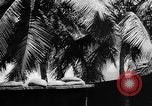
Protective measures taken by Americans in Hawaii, after the Japanese attack on Pearl Harbor.
Aftermath of Pearl Harbor attack. People in Oahu, Hawaii, prepare to deal with more air attacks by Japanese. Armed U.S. soldier in sandbagged position, in Hawaii. The territorial governor of Hawaii, Joseph Poindexter, signing a declaration of Martial Law. Four thousand members of Oahu's Civil Defense Committee, dressed in dark bottoms and white tops, wearing steel helmets with "W" on them, standing at attention in formation on grounds of a stadium. Windows in all downtown shops taped to prevent flying glass. Sand bags surrounding a power substation. Huge quantities of barbed wire in a storage yard and strung along the beaches, along highways, around schools, and public buildings of Oahu. A man pushing a lawn mower between sandbagged defense positions in a residential neighborhood. Construction machinery digging defensive trenches. Bomb shelters being constructed of precast concrete. Air raid sirens installed and school children leaving their building and sheltering in deep trenches during a test. Very small children taking shelter in zig-zag trenches and donning gas masks. Huge assemblies of children, and of grownups, all donning gas masks. Little children being dressed in capsule-like "bunny mask" protective gear.One of them crying inside the covering. Crowds of women and children lined up on a veranda waiting to receive these "bunny masks." Military personnel, civilians, and school children, all carrying personal gas masks with them at all times. Innumerable old rubber tires saved in an open yard. Japanese-Americans donating blood to the American Red Cross and lined up to buy war bonds. Soldiers arresting a Japanese resident known to be an enemy agent. Boarded up shops of Japanese-Americans, who had been interned. Japanese-Americans removing all Japanese language signs from their areas. Language school buildings with closed signs. An empty and boarded-up Shinto temple. One Japanese-American replacing his cafe sign with one reading: "Keep 'Em Flying Cafe." U.S. Army troops posted on roadways. The Aloha Tower in camouflage paint. A Lurline steamship leaving port, and being replaced by warships. Prewar view of people enjoying Waikakee beach, and current view of two boys playing in sand near barbed wire barriers. City streets deserted at twilight, as blackout procedures take effect at dusk. Views of darkened homes and palm trees silhouetted against sky at dusk. The "ghost" of a sailor killed in World War II, stands in front of Arlington cemetery, Washington, DC, and converses with the ghost of a soldier killed in World War I. They discuss idealistic notions about ending wars for good. Displays of flags is seen, including: Australia; Belgium; Brazil; Canada; China; Costa Rica; Cuba; Czechoslovakia; Dominican Republic; England; Ethopia; Greece; Guatemala; Haiti; Honduras; India; Yugoslavia; Luxembourg; Mexico; The Netherlands; New Zealand; Nicaragua; Norway; Panama; The Philippines; Poland; Russia; El Salvador; South Africa; and the U.S.A. "V" created in the sky by a skywriting airplane.
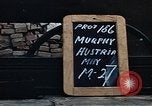
American soldiers encamped in hills above town of Gramastetten, Austria, at end of World War II.
End of World War II in Europe. American Army troops make camp in hills overlooking Austrian town of Gramastetten. Several U.S. tanks are parked along a ridge. Soldiers clean out the tanks. Several U.S. soldiers pose as they look out at the town. Gramastetten Church (Pfarrkirche Gramastetten, Marktstraße 1, 4201 Gramastetten, Austria) is seen with smoke and buildings on fire in foreground, in market area near the church. The church view is obscured by smoke from the market area fire that drifts in front of the church.
CRITICALPAST.COM: About Us | Contact Us | FAQs - How to Order | License Agreement | My Account | My Lightboxes | Shopping Cart | Advanced Search | Featured Collections | Website Terms & Conditions | Privacy Policy ©2026 CriticalPast LLC.
License Agreement |
Terms & Conditions |
Privacy Policy
©2026 CriticalPast LLC.