


 Francais
 Deutsch
 Italiano
Refine Your Search
US-Gliders- stock footage and images
- Showing 13063 to 13068 of 21917 results more
more Hide
Hide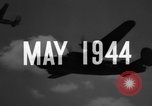
American aircraft bomb German targets in France during World War II.
Allied aircraft bombard German targets in France before the invasion of Normandy during World War 2. A formation of U.S. B-24 Liberator bombers is silhouetted against the sky,. Next is a view from a bomber as its bombs fall away towards targets below. Flashes of bombs exploding in a row on the ground causing smoke to rise upwards rapidly. Glimpse of a U.S. B-17 bomber in flight. A descending trail of white smoke is seen behind the B-17. More views from an airplane of bombs falling from it through contrails below. Views from above of the bombs striking and raising smoke below.
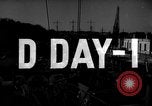
Montage of scenes from the day before the invasion of Normandy in World War II
D-day minus 1 (June 5, 1944) during World War 2. U.S. soldiers eat a meal while seated on the deck of a Large Landing Craft Infantry LCI(L) number 88, docked in Weymouth, England. (This ship would be the first LCI(L) to carry troops to the Easy Red landing zone during the second wave of landings at Omaha beach, on D-Day. Among troops landing there would be the 16th Regiment, 1st Infantry Division, with support from 7th Field Artillery Battalion;1st Engineer Combat Battalion; 1st Medical Battalion; 741st Tank Battalion (DD); 62d Armored Field Artillery Battalion; and 20th Engineer Combat Battalion.) A Captain and a field grade officer sit next to each other on the ship's deck. One soldier looks through his binoculars at an English woman standing outside her back door, looking back at him through her binoculars. Wash is drying on her line. The soldier tries to call out to her, but stops, realizing it is futile. Several of his buddies are amused by the whole event. Scene shifts to U.S. Army Air Forces B-26 bombers flying in formation, and then to aerial views from an aircraft, of bombs exploding on the ground in a city below. Next, a formation of B-17 bombers is seen, escorted by P-47 fighters. Scene shifts back to Weymouth harbor again, where American troops attend a Roman Catholic mass on the pier, adminstered by a military chaplain, wearing traditional clerical garb. LCL(L)s number 89 and 93 are seen tied up in the background. Coast Guardsmen gather around one of their ship's officers who briefs them on the operation.
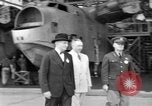
Aviation business and military leaders meet at Consolidated Aircraft; views of aircraft assembly plant operations
A meeting of business and U.S. military leaders at a Consolidated Aircraft assembly plant during World War II. View of General Henry "Hap" Arnold, Consolidated Aircraft founder Reuben H. Fleet, and William S. Knudsen (President of General Motors, and appointed by President Roosevelt as Director General, Office of Production Management. He developed the "Knudsen Plan" for rapid U.S. war materiel production expansion in World War 2). The three men are walking in front of an aircraft hangar with partially finished PB2Y Coronado flying boat aircraft at the Consolidated Aircraft factory in San Diego, California. Group of American military and industrial leaders gathered talking at the site, including Henry Ford of Ford Motor Company, and James H. "Dutch" Kindelberger, President of North American Aviation. (Consolidated, North American, Douglas, and Ford all produced B-24 bombers during the war.) Change of scene: Men at unidentified location view blueprints for expanded aircraft manufacturing and assembly facilities. View of war production factory workers as they stream out of a factory at end of shift. Views of PB2Y Coronado flying boat patrol bomber, and B-24 Liberator bombers under construction. Views of factory operations with metal forging and tempering work. Views of wing and engine assembly operations.
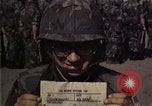
Guards checks ID cards of American marines at their camp in Beirut, Lebanon.
Events related to the barracks bombing in Beirut, Lebanon. A road barricade lifts at the United States Marines Corps (USMC) camp site. U.S. soldiers riding in a motor cart enter. The U.S. soldiers enter in a jeep. Guard at the entrance checks their ID cards (Identity Cards). Sign board at a fence reads, 'Show ID Cards'. Guards armed with M-16 rifle. Another jeep arrives. Guard lifts the barricade. Guard checks their IDs.
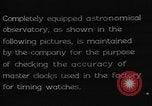
The Astronomical Observatory of the Illinois Watch Company in Springfield, Illinois.
The intricate processes in the manufacture of watch parts at the Illinois Watch Company in Springfield, Illinois. View of the Astronomical Observatory. An old man operates 'Transit' device used to obtain accurate time by observing the passage of stars across the meridian. A 'Chronograph' machine is shown where the time obtained from the 'Transit' is compared with a sidereal clock. Telescope is used for general astronomical observation.

American Expeditionary Forces counter attack against the Japanese forces in Australia.
Troop transport ships loaded with American Expeditionary Forces troops at dock in Australia during World War 2. Troops wave and cheer. A line of U.S. Army women from the Women's Nurses Corps waves from a ship as it docks. A rescued Japanese pilot talks with U.S. soldiers on the deck of an American vessel. The pilot is offered a cigarette. He smokes the cigarette and talks to American sailors. Army nurses at an American base in Australia. View of a hospital wound dressing station at the base. Patients in waiting room and on beds in the hospital. A surgery is performed inside an operating room. The nurses play with koala bears and kangaroos at a local zoo. American antiaircraft (AA) units on full alert. Troops take positions inside camouflaged gun emplacements and sandbagged bunkers. Antiaircraft and mortar crew take their positions. American fighter planes take off from an airfield. AA gun are fired on Japanese planes.
CRITICALPAST.COM: About Us | Contact Us | FAQs - How to Order | License Agreement | My Account | My Lightboxes | Shopping Cart | Advanced Search | Featured Collections | Website Terms & Conditions | Privacy Policy ©2026 CriticalPast LLC.
License Agreement |
Terms & Conditions |
Privacy Policy
©2026 CriticalPast LLC.