


 Francais
 Deutsch
 Italiano
Refine Your Search
US-Gliders- stock footage and images
- Showing 1411 to 1416 of 21920 results more
more Hide
Hide
During a presidential election debate in the US, John F Kennedy and Richard Nixon comment on the necessity to defend Berlin.
The third Kennedy-Nixon Presidential Debate in the United States. Moderator Bill Shadel introduces the candidates and tells that candidates will not share the same platform. Republican candidate U.S. Vice President Richard M Nixon is in a Los Angeles studio and Democratic candidate Senator John F Kennedy is in New York. He also introduces the panel of correspondents who will question the candidates. The panel includes Frank McGee from NBC News, Charles Van Fremd from CBS News, Douglass Cater from Reporter magazine and Roscoe Drummond from New York Herald Tribune. Frank McGee asks Kennedy whether he would take military action to defend Berlin. Kennedy answers and says that the U.S. has contractual right to be in Berlin coming out of the conversations at Potsdam and of World War II. He states that the United States must meet its commitment on Berlin in order protect the security of Western Europe. He concludes by saying that the U.S. will meet its commitments to maintain the freedom and independence of West Berlin. Nixon disagrees with Kennedy's statement that the Republicans are trigger-happy and lead the nation into wars. He talks about the Democratic presidents who led the U.S. into wars. He concludes and states that he thinks there isn't any question about the necessity of defending Berlin.
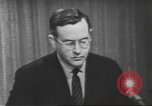
Vice President Nixon and Senator Kennedy debate over Quemoy and Matsu issue prior to presidential elections in the U.S.
The fourth presidential election debate held between Democratic nominee Senator John F. Kennedy and Republican nominee U.S. Vice President Richard Nixon in New York, United States on 21st October 1960. ABC News correspondent Quincy Howe speaks during the debate and allows NBC correspondent John Chancellor to pose a question to Richard Nixon a . Correspondent Chancellor asks a question about Quemoy and Matsu issue. Vice President Nixon points out inconsistency of Senator Kennedy. He further explains it by saying that Senator Kennedy signed a resolution in 1955 which gave the president the power to use United States forces to defend Formosa (Taiwan) and offshore islands. But he also voted for an amendment which was lost, an amendment which would have drawn a line and left out those islands. Vice President Nixon supports President Eisenhower's position. Correspondent Howe asks Senator Kennedy to comment on the topic. He speaks about President Eisenhower sending a mission to persuade Chiang Kai-shek in the spring of 1955 to withdraw from Quemoy and Matsu because they were exposed. The President was unsuccessful. He refers to the fact that in 1958, as a member of the Senate Foreign Relations Committee, he was very familiar with the position that the United States took in negotiating with Communist China (PRC) on these two islands. He further that the U.S. was unable to persuade China's Chiang Kai-Shek to withdraw and thus it was decided by the U.S. to defend the islands.
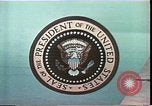
U.S. President Richard Nixon joins in the signing of a SALT treaty with Soviet leader Leonid Brezhnev in Moscow, Soviet Union.
U.S. President Richard Nixon visits Moscow, Soviet Union for a summit with Soviet leaders. The Seal of U.S. President on a U.S. Air Force VC-137C SAM 27000 aircraft in flight. U.S. and Russian flags fly from poles. A motorcade bearing President Nixon passes along streets. The motorcade passes a sign featuring the face of Russian Communist Revolutionary Leader Vladimir Lenin alongside the street. President Nixon arrives at a The Kremlin and is greeted by Russian officials including General Secretary of the Communist Party of the Soviet Union Leonid Brezhnev. President Nixon poses for pictures with Soviet dignitaries. Dignitaries take their seats at a table. Richard Nixon joins in the signing of an anti-ballistic missile treaty with Leonid Brezhnev. Standing at the back of the two leaders are important figures from each side's government. Both the leaders shake hands after signing the treaty.
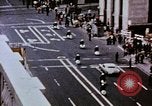
U.S. President Richard Nixon reviews First Marine Division, returned from Vietnam, and awards Presidential Unit Citation
Scenes of Washington DC streets. A white car is escorted by police motorcycles. Parking area across from the White House. US President Richard Nixon reviews U.S. Marines at Camp Pendleton, California. He troops the line, standing in a jeep. Field artillery guns are fired in salute. Large crowd attends ceremony. Presidential helicopter parked near parade grounds. President Nixon and U.S. Marine Commandant,General Leonard Fielding Chapman, walk across lawn together. Marines of First Marine Division, march in fatigue uniforms, with sleeves rolled. Marching band moves to center of field and then performs a slow-step march, while playing. Colors of Units from the First Marine Division assemble in the field and are carried forward. A U.S. Marine Corps flag is lowered and President Nixon fastens a Presidential Unit Citation streamer to it, as General Chapman and a Marine officer in fatigues stand beside him. President Nixon and the officers then turn and walk back towards reviewing stand. President Nixon puts his arm on shoulder of officer in fatigues and converses with him. Nixon shakes his hand. President Nixon and General Chapman join other officials on reviewing stand, where Nixon steps to microphone and begins to speak. (Vietnam War period).
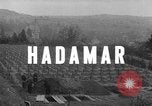
U.S. officials question Nazi prison doctors at the Hadamar Prison Camp (Euthanasia Centre) towards the end of World War II.
U.S. officials inspect the Hadamar Prison Camp or Hadamar Euthanasia Centre in Germany after its liberation by the U.S. Army towards the end of World War II. Men dig graves to remove corpses for autopsy. U.S. officials question Nazi prison doctors, including Adolf Wahlmann with head nurse Karl Willig, about poisons used to kill the inmates.
U.S. Task Force ships down Japanese bombers in the Pacific Theater during World War II.
U.S. Task Force ships battle Japanese enemy aircraft in the Pacific Theater during World War II. A Japanese aircraftgoes down in flames as the United States Task Force battles a sudden air attack. A U.S. fighter aircraft lands on a carrier deck on one wheel. Nigh attack scenes (or possibly dawn or dusk): Two Japanese airplanes are attacked by massive barrage of anti aircraft fire from U.S. Navy ship. One of the aircraft is seen on fire, in a slow arc low arc across the sky until the aircraft, in flames, crashes in the ocean water. Dramatic battle scenes as U.S. ships fight Japanese aircraft at night.
CRITICALPAST.COM: About Us | Contact Us | FAQs - How to Order | License Agreement | My Account | My Lightboxes | Shopping Cart | Advanced Search | Featured Collections | Website Terms & Conditions | Privacy Policy ©2026 CriticalPast LLC.
License Agreement |
Terms & Conditions |
Privacy Policy
©2026 CriticalPast LLC.