


 Francais
 Deutsch
 Italiano
Refine Your Search
US-Gliders- stock footage and images
- Showing 14413 to 14418 of 21917 results more
more Hide
Hide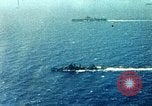
Navy men on 'The Fighting Lady' in the Pacific Ocean play games and write letters on the day before attacking Marcus Island.
Crew activities aboard 'The Fighting Lady', the USS Yorktown, CV-10, in the Pacific Theater during World War II. Sailors on board the day before attacking Japanese forces on Marcus Island. USS Yorktown underway in the Pacific Ocean. U.S. navy sailors drink coffee and play cards. They lie on bunk beds while listening to a crewman play an accordian. Men with tattoos on their legs and hands. Men play cards. A tanker comes to refuel the ship. Fuel lines between ships with rough seas. A weather balloon is released by a crewman. The skipper talks to the air group commander and view maps of Marcus Island. An animated map with large Japanese logo on it shows the path the USS Yorktown will take through the Marshall Islands to Marcus Island. The air group commander explains about the attack and shows with his hands some fine points in air dog fighting. The crewmen play games and write letters home before the strike. The radio plotting room. A lieutenant named E.T. Stocker plays cards with other officers. Sunset wide shot of USS Yorktown underway.
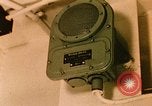
General quarters sounded as USS Yorktown pilots gather in flight ready room and take off to attack Marcus Island.
View of general quarters alarm as the USS Yorktown (CV-10) in the Pacific Theater during World War II prepares for attack of Japanese forces on Marcus Island. Men run up and down stairs and close hatches and watertight doors while pilots gather in the flight ready room. The U.S. Navy fliers wear their flying suits and get ready for the attack. A sailor responds to an intercom call to flight ready room three and orders pilots to man their planes. The pilots board the planes. The fighter planes. A radio plotting room to keep track of all the planes. The planes fly low and suddenly climb up. View of Marcus Island. The planes bomb Marcus island. Smoke due to bombardment. The bombing of the enemy boats and supply ships. A ship is destroyed. Smoke on the island. The planes in flight return back after the victory. A sailor nicknamed Smoky tracks the flyers to check that none of them is missing.
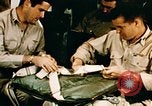
Sailors and crewmen work on weapons and load bombs into aircraft aboard the USS Yorktown in the Pacific.
U.S. Navy documentary highlights functions, duties and crew activities aboard 'The Fighting Lady', pseudonym for the USS Yorktown (CV-10) in the Pacific Theater during the Battle of the Philippine Sea. The carrier advances towards the Mariana Islands. Sailors work on weapons and special devices including magazines, bullets. They work on the bomb line. Sailors prepare the torpedo planes. Aircraft lined on the flight deck. Crewmen arm planes with 500, 1000, and 2000lb bombs, torpedo Iincendiaries, anti-personnel bombs called Daisy Cutters. Sailors pull trolleys with bombs towards the bombers, load the bombs including armor piercing bombs and bombs with delayed action fuses. A crewman pushes new rockets on trolley to be loaded onto the planes. (World War II period).
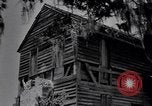
Forks of Cypress plantation home and other sites, likely in Alabama, circa 1939; African American man tending a large bell.
From the U.S. Department of Agriculture documentary "The Land." A seemingly abandoned, dilapidated house at an unidentified farm or former plantation location, possibly in Alabama, during the Great Depression. Spanish moss hanging from nearby trees. Views of a different, wooden, rundown house with a front porch, possibly at a different location. Scene changes again to a third different house, this one made of brick. A lone African American man emerges from double doors of the house. He walks up to a bell, cleans it, and rings it. Distant open view in front of the bell includes a valley and river (possibly the Tennessee River in western Lauderdale County, but not confirmed.) Scene changes again to show the first house and the trees with Spanish Moss. View returns to the location with the man tending the bell. Next scene shows the Forks of Cypress plantation house in Florence Alabama, (Lauderdale County). View of the old main Greek Revival Forks of Cypress house built in 1830 for James Jackson. View of the west elevation of the house. The smokehouse is seen behind and to the side of the main house. A clothes line with clothes on it is beside the smokehouse. Chickens walk on the porch of the house, past its tall colonnade of 24 ionic columns. (Note: The house burned completely in a 1966 fire). Next scene is again the elderly African American man at the brick house location. He looks around, mumbling to himself, walks back towards the house, and pauses on the front steps. The first wooden house with Spanish moss in nearby trees is shown again. Scene returns to the elderly African American man who enters the brick house and closes the doors behind him. Film directed and narrated by Robert Flaherty.
A USAF guard at an air base and two soldiers at a military check post in Vietnam.
An orientation film for United States Air Force personnel assigned to Southeast Asia. A USAF Base in Vietnam. An airman stands guard near sand bags on the air strip. U.S. aircraft parked in the background. Equipment and trolleys around the airplane. Enclosures on either side of the airstrip. The guard on duty with aircraft parked in the background. Aircraft with the cockpit hoods open. Airmen in a sandbag enclosure at a check post. A military jeep approaches, halts and passes. The guards with a rifle and a machine gun. A military jeep halts, the guards give the driver directions and the jeep moves on. The guards with their weapons. (Vietnam War period).
A USAF Air Policeman checks a civilian's identity and another airman with a German Shepherd at an Air Base in Vietnam.
An orientation film for United States Air Force personnel assigned to Southeast Asia. A USAF Base in Vietnam. U.S. Air Force AP (Air Policeman) stands guard outside the check post cabin near the dining hall. Airmen emerge from the dining hall. The AP talks to an airman's and checks the accompanying civilian's identification. A Dodge truck passes by. A USAF airman with a German Shepherd on a leash. They walk along a barb wire fence on the roadside. (Vietnam War period).
CRITICALPAST.COM: About Us | Contact Us | FAQs - How to Order | License Agreement | My Account | My Lightboxes | Shopping Cart | Advanced Search | Featured Collections | Website Terms & Conditions | Privacy Policy ©2026 CriticalPast LLC.
License Agreement |
Terms & Conditions |
Privacy Policy
©2026 CriticalPast LLC.