


 Francais
 Deutsch
 Italiano
Refine Your Search
US-Gliders- stock footage and images
- Showing 15301 to 15306 of 21917 results more
more Hide
Hide
War causalities are loaded aboard LCVPs (Landing Craft Vehicle Personnel), on beach at Iwo Jima, Japan
War causalities are loaded aboard LCVPs (Landing Craft Vehicle Personnel), on beach at Iwo Jima, Japan during World War II. Beachhead scenes show several LVTs (tracked landing vehicles) in operation. Heavy smoke rises in background and Mt Suribachi partially seen obscured in smoke. U.S. medics carry wounded on stretchers along the beach. Face wound of a Marine on a stretcher. Small boats come alongside an APA (Amphibious Attack Transport Ship). Small boats loaded with Marines on way to the beach.
The Battle off Samar near the island of Leyte in the Philippines on 25th October 1944.
Shows the Battle off Samar which was the central action of the Battle of Leyte Gulf. It took place in the Philippine Sea off Samar Island near the island of Leyte in the Philippines on 25th October 1944. Animated map shows advancement of U.S. armed forces on Leyte Island. An Allied fleet of destroyers and escorts shown on map. USS Fanshaw Bay is their flagship. Signal-man intercepts Japanese communication relays in a Combat information center. Shows naval battle between Allied and the Japanese armed forces. (World War II period).

Documentary on League of Nations titled ' The League at Work '.
Documentary on League of Nations titled ' The League at Work '. Cemeteries and war graves. Grave reads ' Private Harmon Cheshire Regiment '. Versailles Treaty. Explains covenant of League and shows League's founder Woodrow Wilson. Exterior of League of Nations building. League President Joseph Avenol speaks on the functions of each branch. League Post Office. Man with post trolley, women typists in typing pool use typewriters, women operating roneo copying machines (also called mimeograph machines). Man in office with secretary translating. Post room where incoming and outgoing mail are stamped. In a reference library, man walks amid racks holding books. Seymour Jacklin Treasurer tells of League finances. Writing on blackboard shows how budget is worked out. Various buildings for which the League is financially responsible.
President Roosevelt visits the Pine Mountain Valley Resettlement Administration project.
President Roosevelt visits the Pine Mountain Valley Resettlement Administration project in his convertible. Officials and bodyguards surround his car. Hundreds of children with U.S. flags in hands give him a rousing welcome.
President Lyndon B. Johnson signs the Civil Rights Act at the White House in Washington DC.
United States Congress passes the Civil Rights Bill. After the House votes on the measure, President Lyndon B. Johnson signs the Civil Rights Act of 1964 into law before an audience of Legislators and Civil Rights Leaders at the White House in Washington DC. He calls it 'a turning point in history' and uses one hundred pens to affix his signature. Many civil rights and government leaders seen behind the President, including Everett Dirksen and Hubert Humphrey, Marting Luther King Jr., and J. Edgar Hoover, all of who receive signing pens. President Johnson hands several signing pens to Attorney General Robert Kennedy, for members of the Kennedy family.
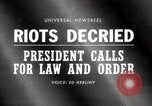
Urban racial violence, riots, looting, and arson in Detroit, Michigan.
Riots, looting, and arson during an outbreak of urban racial violence in Detroit, Michigan. Entire blocks of homes on fire as seen at night. 36 are dead, over a thousand injured during period of unrest in the civil rights movement. A fire truck arrives at the scene. A house on fire. Firemen put out fire. A building engulfed in flames. Sniper groups keep watch outside shops to prevent looting. A looted and trashed shop. Storefront window glass is shattered. People walk on the trashed streets of Detroit. Firemen use jets of water to put out fire. President Lyndon B. Johnson denounces the riots and urges national law and order. “Pillage, looting, murder, and arson have nothing to do with civil rights” President Johnson said.
CRITICALPAST.COM: About Us | Contact Us | FAQs - How to Order | License Agreement | My Account | My Lightboxes | Shopping Cart | Advanced Search | Featured Collections | Website Terms & Conditions | Privacy Policy ©2026 CriticalPast LLC.
License Agreement |
Terms & Conditions |
Privacy Policy
©2026 CriticalPast LLC.