


 Francais
 Deutsch
 Italiano
Refine Your Search
US-Gliders- stock footage and images
- Showing 15445 to 15450 of 21917 results more
more Hide
Hide
Parts of the Fi103 flying bomb (V-1) in Peenemunde, Germany.
Fi103 (V-1) launchings in Peenemunde, Germany. Complete view of the Fi103 flying bomb lying stationary on the concrete ramp. Three workers pull the bomb on the ramp. Bomb moves on the ramp with small wheels attached to it. Fuselage rod attached at the side. Workers attach wing to the fuselage rod. A worker works on tip of the wing section. Views of various parts: Schmidt-Argus Reed intermittent jet engine; air intake; fuel line inlet; air intake; grill of the air intake and fuel nozzle; radar homing device unit used to control the V-1 flight (World War II period).

German officer and Technical Sergeant discuss ME-262 aircraft during pilot training. Views of jet plane cockpit
ME-262 aircraft training in Germany. A German Air Force officer enters his office, at an airfield, followed by a Technical Sergeant. The officer rummages through some papers on his desk and displays a simplified drawing of an ME-262 jet airplane. Closeup of the drawing. The officer highlights parts of the drawing while describing aspects of it. He sits in his chair and talks about flying the jet plane, using his hands to illustrate as he speaks. Closeup of the Sergeant paying close attention to the officer. Change of scene shows a pilot in the cockpit of a ME-262, he holds the control stick with a gloved hand.Camera focuses on the engine controls beside the pilot. Pilots gloved hand points to engine starting controls. View of pilot's feet on rudder pedals. Pilot pulls on a long lever in the front panel and releases it. More views of engine controls. Pilot points to engine start buttons and grasps power control lever. Another brief view of pilot's hand on flight control control stick. Film fades to the officer describing these actions while seated in his office. Closeup of an ME-262 performance graph showing altitude vs. airspeed. It is marked at 620 Km per hour and some undiscernible altitude. (World War II; WW II; World War 2; World War Two)
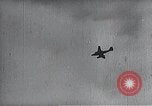
German officer instructor pilot and Technical Sergeant student discuss and observe ME-262 jet airplanes at an airfield
Opening scene shows a German ME-262 jet airplane speeding across the sky. An officer instructor pilot and a student Technical Sergeant observe it from the ground on a snow covered field. They both wear winter flyer's garb. They walk together toward the camera, discussing the jet airplane as they walk. An army truck passes behind them and some buildings and a radar antenna are visible in the background. A soldier on a bicycle and another, walking are seen in background. The instructor and student stop walking. The Officer gives the student a set of binoculars which he peers through. Next, the camera focuses on an ME-262 jet plane coming in for a landing. It is in the process of lowering its landing gear. The officer and student watch. The student using the binoculars. (World War II; WW II; World War 2; World War Two)
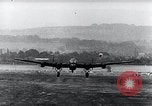
Design description of the British Lancaster Bomber and differentiation from other bomber aircrafts
Aircraft recognition training film. British Lancaster Bomber in England. Lancaster moves on runway and takes off. Lancaster is the modified version of Manchester bomber used earlier. Differentiation of Lancaster from other heavy bomber aircraft. Drawings contrast the design of the British Lancaster with the following: Manchester, Russian TB-7, German FW-200, British Halifax, American B-17E, British Stirling and American B-24 heavy bombers.
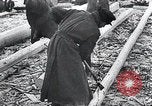
Russian prisoners construct block houses for German soldiers on the Eastern front (WW2)
Block houses for German soldiers on the Eastern front in World War II. Russian war prisoners with axes cut down the trees into logs from snow covered forest areas. Men with hatchets and saws cut logs and smooth them for use in construction. War prisoners construct the block houses while German soldiers instruct and inspect them. Views of constructed block houses covered with snow. German soldiers work, drink, smoke, and relax in the block houses. View of several block houses in snow covered areas.
Canadian Lancaster bomber KB-700 night raid bombing Berlin Germany
Participation of Canadian Lancaster bomber aircraft over Berlin Germany in World War II. Lancaster bombers loaded with heavy bombs take off from England for the night time bombing. Scenes from dining hall of Victory Aircraft Plant in Malton Ontario Canada as war production workers workers learn about their "Q for Queenie" (nickname) first KB-700 Lancasters being used to bomb Berlin. Views from inside Lancaster bomber aircraft as crews fly toward Berlin. Internal views of pilots, cockpit, bombardier area, navigator area. Flak and planes evading flak and anti aircraft fire from German ground forces. Views of the impact of bombing along with the explosion sound in background. Bright lights and flashes on ground as bombs impact and fires burn on ground in Berlin, as seen from Canadian Lancaster bomber flying overhead during mission. Radio conversation of pilots and ground men, explosion sound and the victory shouts heard in background.
CRITICALPAST.COM: About Us | Contact Us | FAQs - How to Order | License Agreement | My Account | My Lightboxes | Shopping Cart | Advanced Search | Featured Collections | Website Terms & Conditions | Privacy Policy ©2026 CriticalPast LLC.
License Agreement |
Terms & Conditions |
Privacy Policy
©2026 CriticalPast LLC.