


 Francais
 Deutsch
 Italiano
Refine Your Search
US-Gliders- stock footage and images
- Showing 15493 to 15498 of 21917 results more
more Hide
Hide
Space research about the ionosphere from the ground by the National Bureau of Standards.
Film entitled 'Scatter Radar', from The National Bureau of Standards, United States Department of Commerce. Depicts space research from the ground. The globe rotating. A satellite antenna moves into position. Radio instruments. Red optical instruments used to study the sun. Clouds in the upper atmosphere. Animation: Ionosphere reflects radio waves to the planet. A smoke of cloud rises during the launching of a rocket. An artists' conception of the Van Allen Radiation Belt above the Earth's ionosphere discovered by Explorer I and Pioneer III. A satellite orbits the globe. Men watch as a rocket is erected and fired. A scientist at the National Bureau of Standards works on a formula. A man at the controls of a scatter radar fro space research. Animation: Ionized and neutral particles as well as free electrons that permit long distance communication. free electrons reflect radio energy. Radio waves penetrate the ionosphere. A scientist at the Ionosonde model C4 to measure electron density variations. Electron density model on the monitor. Two Oxygen atoms. An electron detaches and becomes a free electron. Radio waves pass by, the electron and waves oscillate and scatter energy. Animation: Need to excite electrons sufficiently so that their energy radiated can be detected from the ground. The process requires a powerful transmitter, large antenna, and a sensitive receiver.
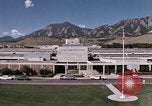
Scatter Radar experimentation with Dr. Kenneth Bowles and his team, and their efforts in Lima Peru
Space research from the ground with a Scatter Radar. National Bureau of Standards laboratories in Boulder, Colorado. The Central Radio Propogation Laboratory. Cars parked outside. Hills in the background. Dr. Kenneth Bowles and a colleague work on a formula. Animation: Incoherent scatter of radio waves by electrons in the ionosphere. Transmission of powerful pulsed radio signal in a narrow beam. The beam penetrates the ionosphere and excites the free electrons. The scatter a weak signal which is detected by a sensitive antenna, and the signal comes back to Earth. Remaining portions of a sensitive antenna at the pioneering field site in Havana, Illinois. Dr. Ken Bowles and other scientists decide on a site. Animation: The magnetic equator and lines of the magnetic field. Pulsed radar signals and lines of force on the monitor. Animation: Chemical composition of the Earth's atmospheric gases. The scientists decide on Lima in Peru, due to its proximity to the magnetic equator and U.S. Lima, Peru: Buildings, guards, churches, plazas and boulevards in Lima including the Government Palace in Lima with guards in front, the Catedral de Lima (Catheral of Lima) and the Plaza Mayor de Lima . Construction work in Lima. Cars on a market street. People on the sidewalk. Shipping and port facilities in Callao, Peru. Workers unload goods. People board a Braniff International aircraft. Housing facility in the Lima suburb of Miraflores.
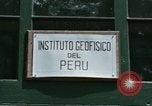
Construction begins on the Jicamarca Observatory site for the Scatter Radar antenna as staff families settle down in Peru.
Space research from the ground with a Scatter Radar. Scientists outside the Instituto Geofisico Del Peru, scientific research organization of the Peruvian government. A train of the Ferrocarril Central Andino (FCCA) on its way to the Institute's observatory. It travels through the Rimac Valley in the Andes, including Ticlio at nearly 16,000 feet. It is the highest elevation railway junction in the world. View of a snow-covered mountain (possibly Yuraqqucha on border of the Lima and Junín regions). Llama graze and move about high up in the mountains. Huancayo (Wankayu) Village: Local Quechuan Indians trade in the weekly market. Shops in the street, street vendors with their goods. The Jicamarca Observatory, new National Bureau of Standards facility near Lima. Scientists work at scopes and other instruments. Aerial view of the Peruvian coastline. The valley 17 miles from Lima. Rocks on the arid coast. Green vegetable fields and broad flat plane in the arid valley. The site for the antenna. Bulldozers prepare the site for construction. A diversion dam constructed on the site. Gully in the valley floor. Peruvian workers lay wire to sound an alarm in case a mudflow should come. Men mark ground and align places for post holes, lay wood posts to support the antenna dipole. They assemble inserts, connect the antenna, and lay bricks. The workers collect their pay. Bureau of National Standards staff and their families in Chaclacayo community. The families gather with locals for a Anticuchos barbecue (Peruvian beef kabobs). The wives of the U.S. scientists shop for fruits and vegetables in the local market.
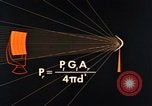
Formula expressing relation between transmitted and received power and factors affecting Space Communications.
Space Communications and the related problems and developments. Animation: Final formula expressing the relation between power transmitted and power received. Comparison of the distance between Earth and the moon, and Earth and Pluto. Factors effecting Space Communication. Payload factor: Effect of payload weight of a communication equipment, transport of equipment, need for small and light equipment. Limitations in miniaturization of components: Inaccessibility in term of maintenance and service. Depicts longevity of power based on available power sources. Advantages and drawbacks of chemical batteries, solar batteries, nuclear batteries. States methods for reducing power consumption: equipping vehicles with command transponders. Factors effecting Sapce Communication: Spatial environment and equipment used. Example of information required to study the planet Venus: atmospheric composition, surface temperature changes and exact period of rotation. Explains spatial movement and solution for this factor: Placing four equally spaced terrestrial stations around the globe, joint by reliable communication links for continuity and data reception.
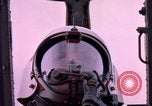
USAF pilot wearing MA-2 helmet in the cockpit of an aircraft in flight
U.S. Air Foce pilot in cockpit of aircraft wearing MA-2 helmet. The pilot in cockpit. Views of the helmet. Shell and faceplate of the helmet.
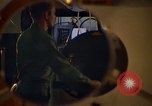
Technicians make adjustments on laser machines and equipment at a Mobile Test Station in New Mexico.
Laser induced lightning experiments conducted by Electromagnetic Hazards Group at the Air Force Flight Dynamics Laboratoryon Mobile Test Station on Mt. Baldy, Colfax County, New Mexico. U.S. Air Force personnel opens the door to part of the laser setup. The laser can be directed vertically into heavy clouds to break down atmosphere and cause lightning strikes. A civilian technician makes adjustments on part of the laser apparatus. He rotates a knob repeatedly. Another technician rotates a knob on a Laser Machine.
CRITICALPAST.COM: About Us | Contact Us | FAQs - How to Order | License Agreement | My Account | My Lightboxes | Shopping Cart | Advanced Search | Featured Collections | Website Terms & Conditions | Privacy Policy ©2026 CriticalPast LLC.
License Agreement |
Terms & Conditions |
Privacy Policy
©2026 CriticalPast LLC.