


 Francais
 Deutsch
 Italiano
Refine Your Search
US-Gliders- stock footage and images
- Showing 15559 to 15564 of 21917 results more
more Hide
Hide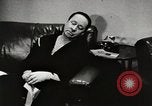
Robert Benchley shares his navy experiences with an expert in the United States.
Rehabilitation of U.S. sailors. A dramatization: Robert Benchley sleeps on a sofa. His portrait on a wall. He talks to his own portrait. He talks to an expert about his experiences while working in the navy. The sailors get their physical checkup done.
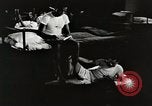
Sailors discuss returning to civilian life and Robert Benchley's pajamas in the United States.
Rehabilitation of U.S. sailors. A dramatization: Sailors discuss about their experience of an interview. Robert Benchley enters a room. The sailors are amazed to see his pajamas. They move near him and discuss his pajamas. He goes to sleep and dreams: He stands near a piano. He goes to get another drink. A woman approaches him but he does not find her attractive, until he has several more drinks and she turns into movie star Ava Gardner (who makes a cameo appearance in this scene).
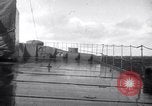
Crew of Japanese light cruiser battle weather and ice in Aleutian waters during World War II
Stern deck of Japanese light cruiser awash as she makes way in heavy seas near Aleutians during World War 2. Japanese sailors breaking ice from her deck. Deck life lines, anchor chain, and stanchions covered in ice. End of deck gun barrel enclosed with canvas cover. Mountainous snow-covered terrain nearby in background. Officers on bridge of the ship. Closeup of one using binoculars.
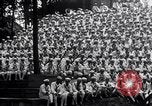
Sailors in training sit in an amphitheater while a band plays at the Great Lakes Naval Training Station
U.S. sailors in training at the Great Lakes Training Center, sit in an amphitheater, in a glade, as a band plays. Camera pans over the large filled circular seating area. The sailors all rise at a command, and salute the colors, as the National Anthem is played. They then take their seats, again. (World War I; World War 1; WWI; WW1)
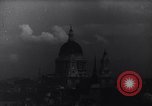
German blitz attacks on London and rescue of people from ruins of buildings during Battle of Britain in WW2
Blitzkrieg attack on London by Germany during World War II beginning in September 1940. Scenes of London city. Soldiers help civilians to move to safety underground in air raid shelters. A building is evacuated. A man talks over a telephone reporting incoming German aircraft. Officers watch through binoculars. German planes over the city. British pilots in aircraft defend the city. British citizens gathered sleeping and waiting on platform at the underground Picadilly Circus tube station. A train arrives at station. German aircraft drop bombs. Aerial bombs away views of bombs falling from German bombers, and views of German pilots in cockpit, and from point of view of German pilots. View of damaged buildings in London, rubble, and devastation. Men around the remains of the damaged buildings. Exterior and interior views of damaged and destroyed shops, homes, hospitals, and churches. A view of Big Ben in the distance and rubble from bombing in the foreground. British people climbing on piles of rubble and beginning to clear the damage. A man carrying an unexploded bomb or delayed action bomb on his shoulder to remove it from an area. A man drives a car. British people in a market using ration stamps for food. British people work in a factory continuing the war manufacturing effort. People inside underground rail system at Picadilly Circus station, serving as an air raid shelter. A man plays a harmonica to entertain civilians in the crowded air raid shelter. Doctors operate on a casualty. Soldiers rescue people from ruins of blitz damaged buildings. Fire fighters spray fire hoses on a building. Men take a break from clearing rubble and drink beer from glasses at the base of a ladder. A girl sits outside a damaged house and pets a cat. Civilians gather as King George VI and the Queen of England visit citizens amidst the rubble.
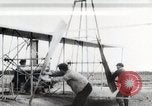
First joint flight by Wright Brothers in 1910 near Dayton Ohio. Also scenes from other "firsts" in early aviation history up until 1919.
Wright brothers' first aircraft flight together near Dayton Ohio in 1910. Wilbur Wright is in the pilot's seat with Orville Wright as passenger to his right. (Until this flight, the Wrights had never flown together so that if one of them was killed, the other could continue their work.) Next, a view of Alberto Santos-Dumont, and the first European flight made by him on 13 September 1909. Following segment shows crowds gathered at Washington DC Polo field as truck arrives carrying mail to be loaded on the first U.S. Air mail flight, May 15, 1918. Army pilot, Lieutenant Webb, in his JN-4H airplane, on Southbound flight from New York, takes off from Philadelphia, where he stopped to pick up more mail. He flies over the Washington Polo Field upon arrival. We see his airplane being unloaded as he jumps down from cockpit and crowds watch. Views of first transatlantic flight begins with takeoff of three out of four existing United States Navy Curtiss flying boat aircraft from Newfoundland, on May 16, 1919. Curtiss flying boats NC-1, NC-3, NC-4 are seen at takeoff from Newfoundland on first leg of the transatlantic journey. Flying Boat NC-4 is also seen at one of its foreign ports, though which is unclear (Azores, Lisbon, or England).
CRITICALPAST.COM: About Us | Contact Us | FAQs - How to Order | License Agreement | My Account | My Lightboxes | Shopping Cart | Advanced Search | Featured Collections | Website Terms & Conditions | Privacy Policy ©2026 CriticalPast LLC.
License Agreement |
Terms & Conditions |
Privacy Policy
©2026 CriticalPast LLC.