


 Francais
 Deutsch
 Italiano
Refine Your Search
US-Gliders- stock footage and images
- Showing 16309 to 16314 of 21917 results more
more Hide
Hide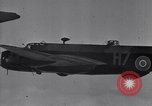
British Royal Air Force aircraft conduct 700-airplane bombing raid over Cologne during World War II
Narrator states that on March 2, 1945, during World War 2, 700 Lancaster and Halifax bombers of the British Royal Air Force fly over Cologne, Germany, to bomb roads and bridges leading across the Rhine River. Closeup aerial view of a British Halifax bomber with H7 painted on its fuselage, identifying it as belonging to No.346 Squadron RAF. (This is a Free French bomber squadron incorporated into the Royal Air Force and operating out of RAF Station Elvington.) View from one of the aircraft looking down on the city below as bombs fall from the plane. Narrator refers to U.S. 1st Army attacking Cologne and this bombing to strike German forces fleeing the city. Heavy smoke seen rising from bomb explosions below. A huge black cloud is seen in the air as a German scarecrow bomb hits a Lancaster bomber and destroys it (Narrator calls it a scarecrow bomb. Later analysis concluded that "scarecrow" bombs may have been attacks by Luftwaffe aircraft equipped with upward facing cannons, or so called "Schräge Musik" attacks.) Smoke rising from the city. Narrator emphasizes that the Cologne Cathedral is not touched.
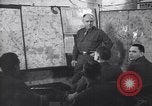
Colonel from G-2 (Intelligence) briefs Commander, 29th Infantry Division, and his staff, during World War II
Major General Charles Gerhardt, Commanding General, U.S. 29th Infantry Division, with members of his staff, at their Headquarters in occupied Germany, during World War 2. He stands in front of a series of maps and discusses the status and plan for the Allied offensive in Germany since the securing of bridgeheads across the Ruhr River. A Colonel from G-2 (Intelligence) explains the enemy capabilities and other details to the officers. He also answers General Gerhardt's questions.
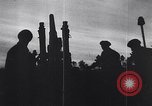
British and Canadian Infantry of 1st Canadian Army capture Kleve (Cleve) Germany during World War 2
Artillery batteries of British and Canadian forces, under command of Field Marshal Montgomery, bombard German positions on the German-Dutch border.British artillery firing BL 4.5 inch Medium Guns and 155mm heavy guns, in an 11 hour bombardment of German positions east of Nijmegen, Netherlands. Snow covers the ground. A British Land Mattress rocket launcher firing a salvo of 3-inch rockets. I Infantry of 1st Canadian Army, under command of General H.T.G Crerar, march toward an area between the Mars and Rhine rivers. They move through forest of the Reichswald, where they encounter Siegfried Line obstacles. British and Canadian tanks using heavy chain mine flails are seen beating their way through mine fields. Infantry in single file silhouetted against a light sky. Canadian Sherman tanks advancing with infantry. One is labeled "Spitfire II." Churchill tanks and heavy vehicles advance, including Churchill AVRE fascine mat-laying vehicles and Churchill ARKs (Armoured Ramp Carriers). Sherman tanks pass, including one named "Diana." British Armor pushing through rain-soaked and partly flooded towns towing BL 4.5 guns. They reach Kleve (formerly spelled Cleve) on February 11, 1945. Roadside sign reads: "Reichs-Grenze"(Border of Germany). Sherman tank of the 6th Guards Tank Brigade firing point blank on city street in Kleve. British troops taking cover behind tank destroyer moving slowly along street. Large number of German prisoners of war being marched to an assembly area. British infantry continuing their advance toward Goch, Germany.
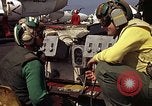
Navy airplanes take off from the carrier Kitty Hawk in Pacific Ocean
Sailors work on catapult control panel on board United States super carrier Kitty Hawk in Pacific Ocean. Another sailor cleans the canopy of F-14A aircraft. Anti sub marine helicopter SH-3D lands and US-3A aircraft takes off on board the carrier. A pilot in the cockpit of United states Navy F-14A gets ready for a flight. A-6B aircraft moves to catapult, unfolds wings and takes off. F-14 Tomcat, A-7E and E-2C aircraft take off, one by one.
Various United States Navy aircraft take off from aircraft carrier USS Kitty Hawk (CV-63) in Pacific Ocean
United States Navy aircraft F-14A Tomcat parked on the edge of the flight deck on board super carrier USS Kitty Hawk (CV-63) in Pacific Ocean. US-3A takes off. Chicago guided missile cruiser is seen at the sea. United States Navy A-6B,F-14 Tomcat and F-8B take off aboard the carrier USS Kitty Hawk.
United States Navy, A-7E aircraft being towed across the deck aboard Super carrier Kitty Hawk in Pacific Ocean
A man checks the arresting cable aboard the Super carrier Kitty Hawk in Pacific Ocean. United States Navy aircrafts A-7E being towed across the deck as UH2C helicopter is seen in the background. Aircrafts land on the super carrier. A man picks up the arresting cable and uses his feet trying to knock out a pin to change cable.
CRITICALPAST.COM: About Us | Contact Us | FAQs - How to Order | License Agreement | My Account | My Lightboxes | Shopping Cart | Advanced Search | Featured Collections | Website Terms & Conditions | Privacy Policy ©2026 CriticalPast LLC.
License Agreement |
Terms & Conditions |
Privacy Policy
©2026 CriticalPast LLC.