


 Francais
 Deutsch
 Italiano
Refine Your Search
US-Gliders- stock footage and images
- Showing 1669 to 1674 of 21921 results more
more Hide
Hide
U.S. Troops formally depart from France
U.S. Troops formally depart from France. Brief ceremonies mark the closing of U.S. Military Command Headquarters at Saint Germain-En-Lay in France. 26 Thousand NATO (North Atlantic Treaty Organization) Troops leave France by order of French President De Gaulle. U.S. and French Flags are lowered together.
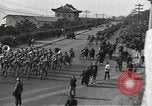
U.S. 6th Marine Division marching into Tsingtao, China, after Japan's surrender ending World War II
Following the Japanese surrender, ending World War 2, on September 2, 1945, U.S. Marines were sent into China to help the Nationalist Chinese Government with the surrender of Japanese forces occupying parts of China. This film shows Marines of the 6th Marine Division marching into Tsingtao (aka Qingdao) China on that mission. Headed by a brass band, they march along an avenue in the city. A number of Chinese civilians walk alongside them. A man riding an empty rickshaw, is seen on the sidewalk. A U.S. military policemen stands guard along the line of march. Some Chinese enter the roadway to follow the band, walking, riding bicycles, and several on a horse-drawn wagon. They have to move aside to avoid interfering with the first contingent of marching Marines following the band. Next a squad of Marines is seen marching onto a dirt field. Many Marines are assembled in another field across the road in the background, where a U.S. M4 Sherman tank and other armor are also seen. The squad is followed by a larger group of Marines. Shift in scene shows Marines marching past a building displaying the Nationalist Chinese (Republic of China) flag.
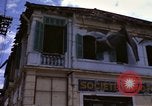
Military Police on guard outside the U.S. Embassy after Tet Offensive bombing in Vietnam
Aftermath of Tet offensive bombing on the United States Embassy (4 Le Duan Blvd., District 1, Ho Chi Minh City, Vietnam) in Saigon, Vietnam. Shattered windows of the Embassy. Wreckage of car which carried the explosives. Another damaged building. Wrecked cars in street. Burned-out motor scooter. U.S. Embassy seal above entrance. Smashed windows. U.S. Military Police on guard outside the building. Several people stand in front of the U.S. Embassy.
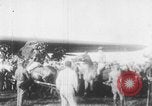
U.S. Army Lieutenants Lester J Maitland and Albert F Hegenberger land in Hawaii after flight from California
U.S. Army soldiers surround aviators and their aircraft at Wheeler field in Hawaii. U.S. Army aviators Lieutenant Lester J Maitland and Lieutenant Albert F Hegenberger wear Hawaiian flower Leis, presented upon their arrival in Hawaii after flying from Oakland, California. The aviators completed the first flight from mainland U.S. to Hawaii, some 2400 miles, setting a new record. Their airplane, a Fokker Trimotor, named Bird of Paradise, is seen in background. They hold a news conference.
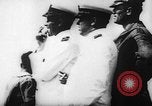
VE-7 and JN-4 biplane aircraft land on flight deck of USS Langley during operations with the U.S. Pacific Fleet
Officers aboard U.S. Navy's first aircraft carrier, USS Langley (CV-1). View of the Langley passing through the Gaillard Cut in the Panama Canal, her deck filled with airplanes, en route to join the Pacific Fleet. Activities aboard the Langley as U.S. Navy works to refine carrier operations. Numerous views of Landing mishaps, including landing hook problems, nose-overs, wings striking deck, power-on stalls, and even a VE-7 ditching in water between the Langley and a U.S. Destroyer.
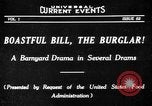
A German who tries to steal away a pig from an American farm is attacked by the U.S. Navy.
U.S. National Food Administration animated save food campaign in the United States during World War I. A man at a farm. Pigs and chicken at the farm. The man leans against a wooden fence with a wind mill in the background. A donkey symbolizing U.S. Army and a goat symbolizing U.S. Navy at the farm. A German man tries to steal away a pig from the farm but the United States Navy symbolized by the goat attacks the man. The American man empties out a bag brought by the German with the donkey, the goat, pigs and chickens in the background.
CRITICALPAST.COM: About Us | Contact Us | FAQs - How to Order | License Agreement | My Account | My Lightboxes | Shopping Cart | Advanced Search | Featured Collections | Website Terms & Conditions | Privacy Policy ©2026 CriticalPast LLC.
License Agreement |
Terms & Conditions |
Privacy Policy
©2026 CriticalPast LLC.