


 Francais
 Deutsch
 Italiano
Refine Your Search
US-Gliders- stock footage and images
- Showing 17977 to 17982 of 21918 results more
more Hide
Hide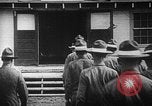
United States airmen trained to build America's air power after World War I.
World War I is over. Congress authorizes renewed Air Service training. U.S. airmen lined up. Airmen at training camps. Officer explains aerial photography. Men develop photographs and print and paste them into mosaics. Pilots stand in formation in front of hangar before departing for strafing training mission. Ground crewman pushes back on right lower wing of a Spad airplane as it begins taxiing out for takeoff. Airplanes participate in maneuvers with American ground troops whom they pretend to strafe while the troops fire back with blank ammunition. In Scottfield Illinois, men train with Balloons and nonrigid and semirigid airships. Major Gen. Charles T. Menoher, Chief ot the Air Service discusses maneuvers with the Commandant of 5th Army Corps. Major Carl Spaatz stands in field and signals to air crews for start of graduation review. Squadron of Spad aircraft take to the air and demonstrate aerial maneuvers. Parachutist jumps backwards from an airplane wing as part of a test. Another parachutist faces forward and allows the slipstream to open his chute and pull him from the wing. Open parachutes descending in air.
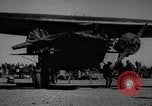
In 1927, Lieutenant Hegenberger and Lieutenant Maitland make record-breaking flight over water from California to Oahu Hawaii.
U.S Army ground crews prepare Fokker C-2 Trimotor aircraft called "Bird of Paradise." Crowd at Oakland Airport as plane takes off. Aerial views of Oakland Airport and surrounding area, as seen from aircraft over San Francisco Bay. Aircraft in flight. Aircraft lands in Hawaii less than 26 hours later. Lieutenant Alfred Hegenberger and Lieutenant Lester Maitland are greeted by large crowd in Honolulu, Oahu, Hawaii, as they were the first aircraft ever flown from the United States to Hawaii. Leis placed around neck of Hegenberger and Maitland.
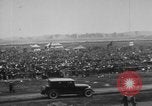
Lieutenant Cyrus Bettis and Lieutenant Jimmy Doolittle win air races in 1925.
In October 1925, crowd gathered to watch the Pulitzer Trophy air races at Mitchel Field, Long Island, New York. VIPs arrive in various automobiles. Army Air Service Curtiss R3C-1 airplane is pushed onto the field. Air Service Chief, General Patrick , speaks with Lieutenant Cyrus Bettis as Lieutenant James Doolittle listens. A Navy crew works on their entry in the race, similar to the Army Air Service airplane. Navy Lieutenant Al Williams seen with a pipe upside down in his mouth. Lieutenant Bettis taxis out for takeoff in his airplane number 43. Then Navy Lt. Williams proceeds to take off in his aircraft, number 40. Lt. Bettis breaks ground and begins to fly the closed course, coming very close to the ground at times. He lands and climbs out of the cockpit, surrounded by spectators and officials who are convinced he has won, registering a speed of 249 miles per hour. Navy Lt. Williams lands shortly thereafter having averaged 242 miles per hour. He is greeted by several spectators, including a young woman. Two weeks later, the U.S. Army was represented by Lieutenant Jimmy Doolittle, who flew the Curtis R3C-1, again, but this time fitted with floats, at the Schneider Cup Seaplane Race in Baltimore, Maryland. He shakes hands with a young woman, just before the race. The Navy also entered with a similar seaplane, shown being pushed into the water. The British entry, a Glouster-Mapier IIIA is seen (replacing the Supermarine-Napier S.4, that was damaged). The Italian Macci M.33 is seen on a dock with engine running. The float planes taxi out over the Chesapeake bay waters to takeoff position. Doolittle is the first to take off and to return, logging an average speed of 232 miles per hour. He is seen smiling after the race.
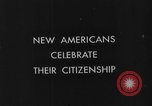
American citizens celebrate "I am an American Day" in New York City during World War II.
Opening slate reads “New Americans Celebrate their Citizenship.” Huge Crowd is gathered in New York City’s Central Park, on “I am an American Day,” which also includes newly naturalized American citizens (although they are not featured, as such, in the film). New York Mayor, Fiorello LaGuardia, presides and delivers a speech from a podium. New York clergymen are seated with one another on a front row seat where patriotic bunting is draped. Vice President Henry R. Wallace is also seen in that front row. Various views of U.S. military units parading along 5th Avenue in New York City. The units include huge columns of United States soldiers, including one large group of African American soldiers.
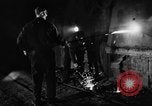
Steel production covers open hearth furnace, ingot molding, and hot strip milling.
Examines the steel industry in Youngstown, Ohio during World War II. Focuses on the steel production including the open hearth furnace and hot strip mill. Workers Mike Ubinski and Earl Strong remove a molten sample from an open hearth furnace and quench it in water. They then hammer the sample to prepare it for analysis. Earl Strong playing bass in the Youngstown Orchestra. The conductor is Michael Ficocelli, who is also time keeper at the steel mill. Shot of old man playing the violin. At the steel mill, the open hearth furnace is tapped. A 'pit gang,' several worker, throw alloy metal into the pit furnace from above. The 100 ton ladle containing molten steel is moved by crane and poured into ingot molds. A worker pulls another molten test sample from the ingots for testing. Ingots on train move from open hearth furnace to the ingot mill. Hot ingots being rolled by machine into slabs. Workers George Bannin and Clarence Ginny manipulate controls for machinery that rolls ingots into slabs. Worker Fred Ingram controls machinery that cuts steel slab using hydraulic sheers. Union workers gathered at a conference table as union leader Fred Ingram leads them in discussion. Hot strip mill where steels slabs are rolled into steel sheets. Sheet of hot steel moves down conveyor to end of mill. Steel workers leaving the steel plant at end of their shift. Exterior views of steel plant in Youngstown, Ohio.
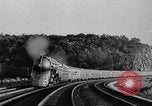
Couriers and United States postal service reaching everywhere across the nation by transportation system.
A streamliner locomotive pulling a train and moving quickly toward camera position. Scene changes to view of the George Washington Masonic National Memorial building (101 Callahan Drive, Alexandria, Virginia) in Alexandria, Virginia. Next scene shows a TWA gate area at Albuquerque New Mexico airport. A TWA Lindbergh Line DC-3 airplane taxis to a stop. A frozen park scene in Minneapolis Minnesota. An aerial view of Miami. A tall white tower in San Francisco (Ferry Building?). Wide pan view of skyline and skyscrapers of New York City. Exterior of U.S. Post Office Building in New York City.
CRITICALPAST.COM: About Us | Contact Us | FAQs - How to Order | License Agreement | My Account | My Lightboxes | Shopping Cart | Advanced Search | Featured Collections | Website Terms & Conditions | Privacy Policy ©2026 CriticalPast LLC.
License Agreement |
Terms & Conditions |
Privacy Policy
©2026 CriticalPast LLC.