


 Francais
 Deutsch
 Italiano
Refine Your Search
US-Gliders- stock footage and images
- Showing 19249 to 19254 of 21918 results more
more Hide
Hide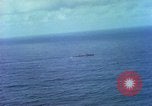
A Japanese destroyer, HMS King George V ship and an Iowa Class battleship underway off the coast of Tokyo, Japan.
Aerial views of U.S. fleet off the coast of Tokyo, Japan towards the end of World War II. A Japanese DD (destroyer) underway. HMS King George V of the United Kingdom British Royal Navy underway. A United States Navy Iowa Class BB (battleship) underway. A column of destroyer ships underway.
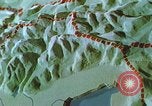
Transportation progress in Europe during the nineteenth century and into middle of 20th century after World War 2.
A model Relief map of Western Europe, with country borders marked in red. Animals used in rural areas. Italian farmers transporting milk cans and other things by donkey. A farm wagon being pulled by a horse. Road through the Simplon Pass, in Switzerland (constructed by Napoleon to transport artillery between the Rhône valley and Italy). Views of the mountainous area. Sketch of early English steam railroad train and of others in other countries, embraced enthusiastically by the local citizenry . Illustrations recording construction of the Britannia bridge across the Menai Strait between the island of Anglesey and the mainland of Wales. (It opened March 5, 1850.) Relief map of Europe focuses on Basle (Basel)in Northwest Switzerland. A modern-day signpost showing directions to France, Germany, and Switzerland. Freight trains arriving and cargoes being transferred by cranes of the Canal Barge operating company, Schweizerische Reederei. View of open storage yards, rail lines and a river. Freight trains carrying various loads to many different European destinations. Wrecked transport facilities left from World War II.
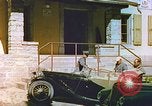
Views of border crossings by road and rail in Europe, and of Rotterdam Port
Motorists being processed at a German border crossing, including a man driving a MG T-Type roadster automobile. The Border guard examines items being carried across the border. the operator of a travel trailer presents documents. Views of trains stopping at borders, including famous trans-European trains such as the Edelweiss and the Nord Express between Paris and Copenhagen. Trans-European train crossing border where Swedish flag is displayed. Sign on a train listing stops including Stockholm, Copenhagen, Basel and Rome. Electric train passing through border. Railroad construction underway through the center of Brussels, Belgium. A large new train station being completed in the heart of Rome, Italy. An electric locomotive under construction in a train factory in Switzerland, where Swiss technicians employ use of new, lighter materials such as aluminum and rubber train wheels. A ship displaying Swedish flag loads cargo at Rotterdam. Panning wide views of the Rotterdam port, in the Netherlands. A 4-masted sailing ship docked at a pier in the Rotterdam harbor. The port's modern warehouses. Men step out on rotating platform high up in a warehouse building. View of cranes loading cargo for ships.
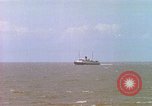
Postwar development of air transportation in Europe
Development of transportation in Europe after World War 2. An ocean-going ship is seen plying the waters of an estuary. A white tower is seen with moving radar antenna on top. A radar operator works in front of radar screens in the control room. He wears headset and microphone. Narrator notes how radar helps navigation in crowded estuaries like the Scheldt. Captain onboard ship ostensibly speaking to the radar operator. Another radar antenna rotating rapidly. A British European Airways (BEA) Vickers VC. 1 Viking airplane at Schiphol Airport (Evert van de Beekstraat 202, 1118 CP Schiphol, Netherlands) in Amsterdam. Glimpses of European airlines using the Douglas DC-3 aircraft such as the Belgian SABENA, Polish LOT and Scandinavian Airlines (SAS). A TAP Air Portugal (Transportes Aéreos Portugueses) DC-6 parked, and a KLM Royal Dutch Airlines (Koninklijke Luchtvaart Maatschappij) DC-6, named the “Vliegende Hollander”, taxiing. An Air France Sud-Est SE-161 Languedoc 4-engine aircraft, taxiing. View of control tower and related buildings at the airport. A person marking a carton for air delivery. A man loads parcels from his automobile trunk, into a Scandinavian Airlines DC-3 aircraft. Venue shifts to Orly airport (94390 Orly, France) in Paris, France, where a DC-6 airplane sits in front of a terminal building. Airport staff prepare to welcome a dignitary, including uniformed brass band seated at an awninged pavilion, and a military honor guard. A DC-4 aircraft parked in nearby background. A party welcomes the President of France, Vincent Jules Auriol, arriving on an Air France Lockheed Constellation airliner. A large contingent of Army troops are assembled in formation to honor the arriving President. He strolls across the ramp, accompanied by a French general and an admiral, among others. He climbs stairs of the pavilion as the band plays La Marseillaise (National Anthem).
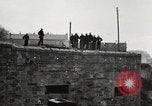
Vice Admiral Henry B Wilson visits a fortress on the coast of France, with members of his staff, at the end of World War I
Vice Admiral Henry B Wilson, Commander of U.S. Naval Forces in France, and about 20 members of his staff, visit a coastal fortress. American sailors walk along a an area overlooking the site's high walls. Camera pans to the left toward a group of Naval Officers climbing a tall berm that runs below the higher wall. The head of the group is Vice Admiral Wilson. A Navy Captain, in lighter color uniform, is acting as a tour guide. He pauses as the remainder of the visiting party catch up. The group poses. The fort wall and tops of buildings appear in the background. Admiral Wilson is flanked by the Captain tour guide and a Captain from his staff, in blues. All members of the party seem amused at being photographed by a cinematographer.
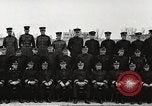
Naval officers photographed at The Naval Operating Base, Hampton Roads, Virginia in 1925.
The Naval Operating Base, Hampton Roads, in 1925 (re-designated "U.S. Naval Station Norfolk," in 1945). Opening scene shows Senior Naval officers (mostly captains plus a couple of rear admirals) seated in front row, and two rows of others officers standing behind them. At one point, they all remove their caps. Behind them is a concrete wall. But tops of some some buildings can be seen behind in the background. Closeup of a seated young rear admiral flanked by captains. In change of scene, all the officers are seen standing at attention, side-by-side on a gravel waterfront area, with a river and numerous buildings on the opposite shore visible in background. The camera pans across the assembled officers. Next, officers are seen on the waterfront, marching in white hats and carrying swords. (In these scenes, the motion is too fast, due to lack of compensation for low hand cranking speed of source camera.) The officers stop and stand in formation, and then march away.
CRITICALPAST.COM: About Us | Contact Us | FAQs - How to Order | License Agreement | My Account | My Lightboxes | Shopping Cart | Advanced Search | Featured Collections | Website Terms & Conditions | Privacy Policy ©2026 CriticalPast LLC.
License Agreement |
Terms & Conditions |
Privacy Policy
©2026 CriticalPast LLC.