


 Francais
 Deutsch
 Italiano
Refine Your Search
US-Gliders- stock footage and images
- Showing 2065 to 2070 of 21924 results more
more Hide
Hide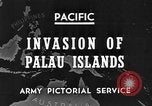
U.S. 1st Marine Division invades the Palau Islands during World War II.
Film opens with animated map showing places in the Pacific near the island of Palau. A formation of U.S. B-24 Liberator bombers is seen in flight. Glimpse from the air of the Palau archipelago. Aerial view from a B-24 of its bombs exploding on the center of a Japanese airfield below. Aerial view of a U.S. Independence-class Aircraft carrier of Task Force 58. Officers and sailors on carrier island watch as a Grumman F4F Wildcat aircraft takes off .from the aircraft displays geometric marking on its tail, known as a "G-symbol." In this case it is a large white diamond containing the airplane number inside another diamond. (The United States Navy Pacific Fleet, assigned G-Symbols to the CV and CVL class carriers of Task Force 58. These were assigned to each carrier and appeared on all aircraft operating from it. ) A formation of Grumman TBF Avenger aircraft flying above clouds. Closeup of one with diamond G-symbol and number on its tail. Broad view from the air of TBF Avenger aircraft in flight and Navy warships maneuvering in waters below. Sea level views of some warships in the Third Fleet. One is a Portland-class Cruiser. Wide aerial view of ships in the task force. Cruisers and battleships bombarding Palau and nearby targets. Closeup of heavy cruiser USS Louisville (CA 28) firing her port side 5 inch 25 caliber guns and 40 mm A/A guns from the stern.. A TBF Avenger dive bombs a shore target. More views of warships with shells bursting in background. Shells bursting at the shoreline. Closeup glimpse of marines in landing craft U.S. Marine Corps LVT(A)4 Amphibious Tanks heading toward the beach on September 15, 1944. An LCI(L) Landing Craft Infantry (Large) firing close to shore. Shells striking shoreline installations. View from aircraft of landing craft speeding toward the beach and many more maneuvering offshore. Closeup of marines moving about on the shore of Palau with smoke rising and sounds of gunfire. A marine running through foliage at the shore. Marines manning a command post and communications center in the jungle. Marines firing rifles from a tree line. One firing a Browning M1919 machine gun and another throwing a hand grenade. Marines firing rifle grenades. Marines move forward and encounter a dead Japanese soldier lying next to his flame thrower. They reach the edge of the airfield, where two Japanese aircraft are just barely seen. They walk past dead Japanese at a machine gun emplacement. More views of Marines fighting at the edge of the airfield, and entering into the open area of the field, where fires are burning. .Wrecked Japanese aircraft are seen on the field. Marine infantry cross the field behind an M4 Sherman tank. Barges are seen carrying construction cranes and equipment to the island. A tracked crane drives onto the airfield. Bulldozers work on the edge of the airfield. A power shovel fills trucks with coral deposit material for resurfacing the airfield. Trucks dumping their contents at the field. Bulldozers and earth scrapers level the airfield surface. A TBF Avenger aircraft is the first to land on the unpaved airfield.
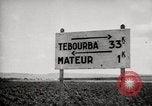
U.S. and British troops capture the cities of Tunisia during the Battle of Tunisia.
The Battle of Tunisia in North Africa during World War II. A sign board noting distances to Tebourba and Mateur. U.S. troops on trucks enter Ferryville. The troops on trucks hold rifles. Aerial view of American tanks arrayed on battlefield. U.S. tanks advance. Firing from across a lake. Buildings in Bizerte city in the foreground. U.S. troops on a truck fire guns. The troops in a jeep enter the city with little resistance. A sign reads 'Bizerte'. A tank drives past on a road and fires. Buildings on either side of a street. Smoke rises due to the firing. The troops advance forward. A soldier with a gun checks a building for German forces. The troops stand in a group. A damaged building in the foreground. British troops in jeeps and on motorbikes enter Tunis. British troops and a tank fire at German soldiers holed up in a building.
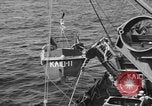
U.S. 80th Fighter Squadron receives instructions from 1st Sergeant aboard ship underway in the Philippines Sea.
U.S. 80th Fighter Squadron aboard a ship underway in the Philippines Sea during World War II. U.S. Army soldiers lower a landing craft over the side of the ship. A ship convoy underway at sea and change positions for a battle formation. The soldiers on alert at a 20mm gun. U.S. 80th Fighter Squadron on the deck receives instructions. A 1st Sergeant gives the instructions and they listen to him. The GIs clean guns. Initials S.G. on sleeves of a ship guard. A guard patrols on the ship.
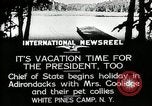
U.S. President Calvin Coolidge and his family arrive at his vacation home in Paul Smiths, New York.
U.S. President John Calvin Coolidge, Jr. with his family at White Pine Camp in Paul Smiths, New York during his summer holidays. Three guards stand in front of the Summer White House of the President. A car arrives at the house and stops. A guard opens a door of the car. U.S. President Coolidge, First Lady Grace Coolidge, and their pet collie dogs emerge from the car. They enter the summer home and look around the home. Views of the exterior of their summer cottage. Mrs. Coolidge and the President in a garden. A guard stands near the car in the background. U.S. Marine guards march in formation and enter the Presidential cottage, serving as protection for the President in his summer White House. Panoramic view of Lake Osgood (or Osgood Pond), dock area, and a boat anchored at the dock. View of Adirondack Mountains in the background.
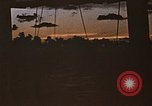
U.S. Marines launch amphibious assault against Japanese forces at Betio, Tarawa Atoll, in the Pacific during World War II
Scene is dawn viewed from deck of a troop transport ship off the coast of Tarawa, Gilbert Islands, on D-day (November 20, 1943) for the amphibious assault by U.S. marines against the Japanese- held atoll, in World War 2. Marines loaded into a Higgins boat at the side of the transport ship. Several such landing craft maneuvering off the ship's bow. Benson-class destroyer bombarding the coast. Closer view of the destroyer with landing craft nearby. Glimpse of Japanese Aichi D3A (Val) dive bomber above. Two bombs exploding in water near the camera ship. U.S. Navy F4F aircraft flying low bombing and strafing. Glimpse of Navy warships bombarding after Navy planes depart. Then many landing craft are seen, some from the USS Sheridan (APA-51). Mixture of quick views showing naval gunfire, Marines in landing craft (including closeup of two marines looking out from inside one). U.S. Naval aircraft bombing inland, close to the shoreline. A derelict Japanese ship, displaying battle damage is seen in the surf. (Narrator notes that Japanese machine guns were set up and fired at landing craft from this hulk.) Closeup of radio operator on deck of invasion vessel. Views of amphibious landing vehicles tracked (LVT) moving toward shore. All American Higgins boats and LVTs subject to heavy Japanese machine gun and mortar fire, as well as bombing by Japanese Aichi D3A dive bombers. Burning landing craft in the surf. Landing craft arriving at the beach under heavy fire. One is marked, "KA 20-11" indicating it is from the USS Virgo (AKA-20). Long shot of Marines strung out on section of beach. Closeup of marines wading ashore from wrecked LVT. Several marines move along a concrete pier. Many marines are hunkered down behind it. Various views of marines pinned down on the beach. Some sheltered behind an LVT.
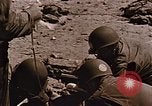
Day two of the amphibious assault on Betio, Tarawa atoll, by U.S. 2nd Marine Division, during World War II in the Pacific.
U.S. Marines of 2nd Marine Division setting up communications on beachhead of Betio, Tarawa Atoll, on day two of their amphibious assault against Japanese forces there, in World War 2. Individual marines moving low and fast across the sand, as gunfire sounds all around. Casualties being moved on litters. Entire area under fire with destruction everywhere. Marines taking cover wherever possible. Some firing machine gun from sandbagged position. Area covered by smoke from gunfire and explosions. Marines shielded by remains of Japanese structures as they move about, engaged in fierce fire fights. More wounded being tended. Marines using hand grenades and flame throwers against Japanese soldiers in fortified positions. Marines moving carefully across series of Japanese positions, checking for remaining Japanese defenders. Several move against a Japanese position in a hill, using small arms hand grenades and flame thrower. Many dead Japanese soldiers are seen on the other side of the hill, after it is taken. Marine carrying a machine gun and setting it up. An ambulatory wounded marine.
CRITICALPAST.COM: About Us | Contact Us | FAQs - How to Order | License Agreement | My Account | My Lightboxes | Shopping Cart | Advanced Search | Featured Collections | Website Terms & Conditions | Privacy Policy ©2026 CriticalPast LLC.
License Agreement |
Terms & Conditions |
Privacy Policy
©2026 CriticalPast LLC.