


 Francais
 Deutsch
 Italiano
Refine Your Search
US-Gliders- stock footage and images
- Showing 2071 to 2076 of 21924 results more
more Hide
Hide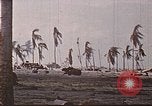
U.S. 2nd Marine Division begins mopping up operations during amphibious assault at Betio, Tarawa, during World War II
Marines of U.S. 2nd Marine Division moving toward the airfield on Betio, Tarawa atoll, during their amphibious assault against Japanese forces during World War 2. A Stuart M3 light tank driving rapidly at the edge of the field. A wounded marine is brought back in a jeep, under enemy fire. Back at the beachhead, a landing vehicle tracked (LVT) is seen towing several floating packages of supplies to the shore. Chaplain's assistants tend to U.S. marine dead lying on a beach. They remove on dog tag from each for registering while leaving the other for identification. Marine General Holland M.Smith, Commander of V Amphibious Corps, and Major General Julian C. Smith, Commander. 2nd Marine Division, are seen walking together and then consulting with Rear Admiral Harry W. Hill, Commander Amphibious Group Two, Fifth Amphibious Force. Marines using a bulldozer to dig Japanese defenders out of a pill box. This yields a half dozen Japanese prisoners, the first to be taken. Wounded American marines are given first aid and then seen being lowered in steel litters into landing craft and then being transferred to a transport ship, offshore.
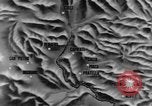
Activities of U.S. troops before attacking the German Winter Line in Italy during the Italian Campaign.
A documentary television program depicts the role of U.S. soldiers in the Italian Campaign during World War II. Animated map of Italy shows the location of U.S. troops. The Volturno River and a damaged bridge on the river. Light vehicles cross over the bridge. Soldiers carry shovels. Vehicles move from a temporary bridge. A damaged bridge. Trucks drive on a mud road and on the temporary bridge. A soldier walks through mud. Water on a road and a jeep drives through the water. Animated map shows the German Winter Line on mountain Mignano. A damaged bridge. Trucks move on a mud road. A soldier erects a sign board. Troops at work during the construction of a bridge. Mules carry supplies on their back. The troops load the supplies on the back of the mules. The mules carry the supplies and move. Animated map shows the location of British and U.S. troops before attacking the German Winter Line.
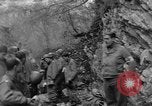
U.S. Army forces assault the German Winter Line of Defense during the Italian campaign of World War II
American troops of the 45th Infantry Division, are seen in mountains after breaking through the first segment of the German Winter Line, near San Pietro Infine, Italy, in World War 2. It is Christmas Day, 1943 and they occupy Mount Lungo. They receive Christmas dinner in their individual mass kits and sit down on the ground to eat it. On December 28th, they employ pack mules and also use stretchers to retrieve remains of fallen 3rd Division defenders down the steep mountain trails of Mount Lungo. They place the carefully wrapped remains at the base of a bullet pock-marked stone structure. Scene shifts to Mount Sammucro where American troops take advantage of a brief lull in fighting. On 1 January, 1944, Second Corp reinforcements have arrived and Americans commence a new assault on the German Winter Line defenses, with an artillery barrage on German positions guarding San Vittore del Lazio. View of smoke rising from that town. Shelling of Mountaintop flanking Highway 6held by Germans. Groups of American troops firing mortars from valley below. Shells exploding on German positions. Closeup of American gun crew loading and firing a 155mm long tom field gun. Soldiers holding their ears when gun fires. Bombs dropped from American warplane aircraft explode near roads in the valley. Glimpse from U.S. warplane flying overhead, of smoke rising from German positions in the Winter Line. Soldiers of the 168th Infantry Regiment firing a recoiless rifle from wooded area. Shells striking at base of mountain. Troops of the U.S. 137 Infantry Regiment advancing on San Vittore. view in the Italian town on 7 January, 1944, when street fighting has ended. American soldiers are seen mingling with the civilian inhabitants. German military equipment destroyed and burning during the American Winter Line offensive. Captured German soldiers being taken into custody, searched, and processed as prisoners of war.
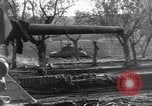
U.S. troops fire guns, advance on a field and drop bombs at a historic abbey in Italy during the Battle of Cassino.
A documentary television program depicts the role of U.S. soldiers in the Battle for Cassino which was a part of the Italian Campaign during World War II. U.S. 6th Armored Infantry Regiment troops advance on trucks. A barrel of a gun in the foreground. Fire by tanks and artillery. Mountains in the foreground. A town on the foot of Monastery Hill. A historic abbey which contains many medieval treasures. A German official at the abbey. A German soldier looks through binoculars. Troops around an artillery fire. A hand holding a leaflet. Leaflets are fired. A U.S. aircraft in flight over Monastery Hill and a pilot in the cockpit. Aircraft drop bombs over the abbey . Smoke rises due to an explosion. Soldiers fire guns. German troops at the abbey look through the binoculars. They fire guns. 5th Army troops on tanks advance. Aircraft in flight. Colonel William W. Quinn seated in a chair talks about the next story that is the invasion of Southern France.

Cordell Hull signs a new treaty with China and Chinese troops are carried by U.S. transport airplanes in China.
The U.S. and China sign a new treaty in China during World War II . Chinese Ambassador to the United States Wei Tao-Ming signs the treaty. U.S. Secretary of State Cordell Hull also signs. A close of the pact. They both shake hands after singing the treaty. Chinese troops board a U.S. transport aircraft. Another aircraft taxis in the background. The aircraft in flight over mountains. The troops seated inside the airborne aircraft. A view of the mountains. A pilot in the cockpit.

U.S. President Franklin D. Roosevelt addresses the Congress and gives a speech on hope and courage in Washington DC.
U.S. President Franklin D. Roosevelt addresses the Congress in Washington DC during World War II . The U.S. Capitol building. The U.S. flag in the foreground. New Congress members wave. Congress men seated in a hall. Roosevelt speaks into a microphone and addresses the Congress. He gives a speech on hope and courage.
CRITICALPAST.COM: About Us | Contact Us | FAQs - How to Order | License Agreement | My Account | My Lightboxes | Shopping Cart | Advanced Search | Featured Collections | Website Terms & Conditions | Privacy Policy ©2026 CriticalPast LLC.
License Agreement |
Terms & Conditions |
Privacy Policy
©2026 CriticalPast LLC.