Refine Your Search

US-Gliders- stock footage and images

- Showing 20965 to 20970 of 21891 results
American struggle for recognition as an independent nation, is illustrated by reenactments of battles in the War of 1812

John Charles Daly standing in the Hall of Heroes at the Pentagon in Virginia, United States, speaks of the period prior to the establishment of the U.S. Medal of Honor. Reenacted scenes of the War of 1812 are shown, including British and American naval engagements and Americans fighting British regulars in the Battle of New Orleans in 1815 .

Date: 1968
Duration: 1 min 57 sec
Sound: Yes
Color: Color
Clip Type: Edited
Language: English
Clip: 65675073607
Hall of Heroes in the Pentagon and Medal of Honor recipients from World War I

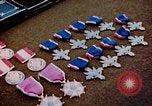
The U.S. Medal of Honor and World War 1. A flurry of Newspapers covering Election of Woodrow Wilson; the assassination of Archduke Ferdinand; German troops on the march; the sinking of the Lusitania by a German submarine; and outbreak of a World War. Film reenactments of armed soldiers marching quietly through a town in the evening; soldiers in trenches of No-mans-land; an American soldier in a trench during enemy shelling; German soldiers firing machine guns; American troops charging through obstacles and smoke; and hunkered down in a deep trench. Scene shifts to the Hall of Heroes in the Pentagon, Arlington, Virginia, where names of 95 Medal of Honor recipients from World War 1 is highlighted. John Charles Daly mentions several of these heroes, and points to the name of Alvin C. York, who as a Corporal,acting alone, brought in 132 prisoners during that war.

Date: 1968
Duration: 3 min 3 sec
Sound: Yes
Color: Color
Clip Type: Edited
Language: English
Clip: 65675073610
Union soldiers print the first issue of Stars and Stripes newspaper during the Civil War in the United States.

The history of the Stars and Stripes newspaper. Union soldiers print the first issue of Star and Stripes newspaper in a captured press in the U.S. on 9th November,1861 during the Civil War. World War I scenes show soldiers disembarking from a ship and advancing on a battlefield. Commanding Chief of the American Expeditionary Force John J. Pershing writes for the newspaper. Soldiers greet the Chief and wish him luck. After the end of World War I newspaper publication is ceased. During World War II the newspaper publication starts in London, England in 1942. Publication of the Pacific Stars and Stripes newspaper after the end of hostilities in Europe. Headlines in various editions of the Stars and Stripes.

Date: 1918
Duration: 1 min 54 sec
Sound: Yes
Color: Color
Clip Type: Edited
Language: English
Clip: 65675073617
Barbara Randolph serves as host disc jockey for American Forces Radio and Television Service in Los Angeles, California.

American Forces Radio and Television Service (AFRTS) facility in Los Angeles, California. U.S. Army personnel, in uniform, operate an AFRTS broadcast studio. Recording artist, actress, and singer Barbara Randolph seated in the sound room and working as the disc jockey for a radio program. She introduces a song and plays it for listeners. 45 rpm record playing on turntable. 1/4" reel to reel audio tape deck playing. Scene shifts to actor Robert Strauss, preparing to be filmed giving a promotional and public service message for American service personnel. Camera is ready. A man strikes a clapper, and the filming begins.

Date: 1974
Duration: 2 min 45 sec
Sound: Yes
Color: Color
Clip Type: Edited
Language: English
Clip: 65675073625
Senator John F. Kennedy and Vice President Richard Nixon face off in their first Presidential debate, in Chicago Illinois.

The first Kennedy-Nixon Presidential Debate in Chicago, Illinois. Moderator Howard K. Smith introduces the candidates-- Republican candidate U.S. Vice President Richard M. Nixon and Democratic candidate Senator John F. Kennedy. He talks about the opening and the closing statements to be given by the candidates. He talks about the questions which the panel of correspondents would ask the candidates. Senator Kennedy begins his statement. Kennedy talks about the direction of freedom for the Americans. He discusses domestic issues and the kind of society people live in. He talks about the strengths and the progress rate of the Americans. He urges people to make their country more powerful in every field. He feels disappointed about the unused steel-mill capacity, low rate of economic growth and poor educational system. He says he's not satisfied when he sees men like Jimmy Hoffa in charge of the largest union in the United States, and still free. He insists on overall infrastructural development and improvement of hydro power production where he says the Soviet Union has a lead. He states that every American should enjoy his full constitutional rights and they should meet their responsibilities. He says African American and Puerto Rican babies have much lower chances in education, work ,and advancement in the United States, and that this needs to change. He states that the government should provide effective programs and social security system for its citizens.

Date: 1960, September 26
Duration: 8 min 6 sec
Sound: Yes
Color: Monochrome
Clip Type: Unedited
Language: English
Clip: 65675073630
Nixon talks about the increase in GNP and average family income during the presidential election debate in Chicago, Illinois.

The first Kennedy-Nixon Presidential Debate in Chicago, Illinois. Moderator Howard K. Smith invites Republican candidate U.S. Vice President Richard M. Nixon to give his opening statement. Nixon begins his statement. He talks about the huge competition faced by the United States. He states that he disagrees with Kennedy's statement on the poor growth in national product. Instead he states that there has been a 6% growth of Gross National Product (GNP) in the past years. He compares the overall development of the country during the Truman Administration and the Eisenhower Administration. He states that there has been a continuous progress in the field of education, hydroelectric power, hospitals and highways. He discusses the improvement in Gross National Product and the average family income. He discuss effective plans and programs in the every field. He compares the effective styles of spending of the Federal government and the Democratic government. In his final point he states that his disagreement with Kennedy is not about the goals for America but only about the means to reach those goals.

Date: 1960, September 26
Duration: 8 min 17 sec
Sound: Yes
Color: Monochrome
Clip Type: Unedited
Language: English
Clip: 65675073631