


 Francais
 Deutsch
 Italiano
Refine Your Search
US-Gliders- stock footage and images
- Showing 21457 to 21462 of 21920 results more
more Hide
Hide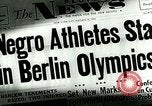
African American athletes make their mark at the 1936 Summer Olympic Games in Berlin, Germany
Opening scene shows stadium filled with spectators for the 1936 Summer Olympic Games in Berlin, Germany. View from behind six sprinters ready to start the 100 meter dash. Front view closeups of African American runners, Jesse Owens and Ralph Harold Metcalfe Sr. Official fires gun for the start, and the runners are off. Camera tracking the runners shows Jesse Owens well ahead of all the rest, at first, but Metcalfe soon catches up with him. Crowd roaring and cheering in the stadium. Scoreboard shows Owens first, Metcalfe, second, and Osendarp (of Holland) third, separated each by only one tenth of a second. The American National Anthem can be heard in the background. The next event is the men's high jump. Sign shows the bar initially set at 1.97 meters height. The first competitor is Gustav Weinkötz of Germany. He fails to clear the bar. Next is Hiroshi Tanaka of Japan, who also fails to clear. Bar is reset to 2.03 meters (6 feet-8 inches). African American, Cornelius Johnson makes the next attempt. He successfully clears the bar and the crowd roars its approval. (He had set a new olympic record.) Three American flags flying over the stadium as the U.S. National Anthem is again heard being played.
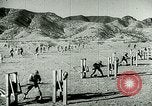
African American soldiers training during World War II, including some earning commissions as Officers
In opening scene, African American soldiers perform bayonet training at an Army Base in the desert. Then they run out of a trench in practice attack. Next, the troops are seen assembled in an outdoor stadium, where religiious services are being held. An African American Army Chaplain tells them of increased Officer Candidate opportunities. A group of Officer candidates is seen that includes a number of African American soldiers. Candidates are seen graduationg and receiving their commissions. A parade of ROTC (Reserve officers' training Corps) cadets is seen including mostly African Americans. Views of cadets at the U.S. Military Academy, in West Point, New York, receiving graduation diplomas. An African American graduate is among them. Scene shifts to an African American woman in a church, reading a letter from her son who has just been commissioned as an Army Officer. Glimpse of the congregation's pastor thanking her for sharing her letter. (World War II; WW II; World War 2; World War Two)
Pastor of African American church congregation speaks about defending America during World War II
Opening scene shows a battlefield wooden cross marking the grave of Private Robert. Woods. His photograph is shown.The narrator is an American Pastor of a predominantly African American congregation speaking from the pulpit about men who served America during World War 2. He cites U.S. Army bomber pilot, Colin Kelly, whose photograph is also seen. The pastor also mentions Meyer Levine, Kelly's bombardier (unseen) and an African American sailor, named Dory Miller, who shot down Japanese aircraft while defending the battleship West Virginia during the Japanese attack on Pearl Harbor. Miller is seen shaking hands with officers on the deck of a Navy ship. Camera focuses on a banner in the church displaying stars for the members of the congregation in the Armed Forces. He leads in a prayer of thanks for "this land which our fathers have helped to build." Camera pans over the congregation. The choir and congregation join in singing "Onward Christian Soldiers." Next, a large formation of African American soldiers marches in a parade. They wear uniforms including M1917 steel helmets, and carry rifles and field packs. Scene updates to African American soldiers marching wearing World War 2 M1 steel helmets. Scene shifts to African American Army Colonel and another officer reviewing marching troops on a snowy field. Next, African American women in the WAC (Women's Army Corps) are seen marching. African American troops are seen, again, parading in World War 1 steel helmets, and then others are seen parading in garrison caps. More views of these various groups parading with a glimpse of mounted cavalry inserted, as well. As the film ends, the background music is the singing of "Joshua Fit the Battle of Jericho." (World War II; WW II; World War 2; World War Two)
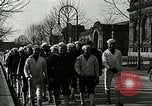
American sailors work unloading lumber and coal cars in the United States.
American sailors at work in the United States near grounds of U.S. Naval Training Station, Great Lakes training facility (Naval Station Great Lakes) in World War I. A group of sailors walks along a street. Buildings along street sides. The sailors carry boxes and lumber boards. They unload coal cars with shovels from raiload cars labeled C&E (Chicago and Eastern Illinois Railroad). The sailors aboard a small vessel 'SP-1011' underway in water. The vessel is tied up at a dock. A sailor mends his cap. A propaganda slate urges American citizens to support the country and the President.
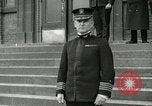
Captain William Adger Moffett and enlisted men pose on the steps of building in Great Lakes, Illinois.
The U.S. Naval Training Center in Great Lakes, Illinois (Naval Station Great Lakes) during World War I. United States Navy Captain William Adger Moffett, commanding the training station, poses on the steps of the building. Other officers join him. The group including enlisted men poses.
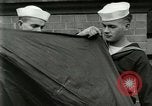
A sailor helps another sailor in putting on his uniform at Great Lakes Naval Training Station
Uniforms of U.S. Navy sailors in the United States in World War I. Two sailors at Naval Station Great Lakes fold and roll a neckerchief. A sailor places the neckerchief around the neck of the other sailor. He also helps the other with pea jacket, handling him rubber boots, shoes and helping him on with a poncho. The sailor puts on a cartridge belt, picks up a rifle and poses.
CRITICALPAST.COM: About Us | Contact Us | FAQs - How to Order | License Agreement | My Account | My Lightboxes | Shopping Cart | Advanced Search | Featured Collections | Website Terms & Conditions | Privacy Policy ©2026 CriticalPast LLC.
License Agreement |
Terms & Conditions |
Privacy Policy
©2026 CriticalPast LLC.