


 Francais
 Deutsch
 Italiano
Refine Your Search
US-Gliders- stock footage and images
- Showing 2479 to 2484 of 21924 results more
more Hide
Hide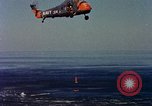
"Parachute pickup" rescue of a downed pilot, using a helicopter
U.S. Navy training film. Techniques used by a destroyer and its crew in rescuing downed pilot. A helicopter hovers over the pilot in the sea. It lifts the pilot and the parachute attached to the pilot also lifts along with the pilot. The pilot held firmly by the sailors on the destroyer. A sailor holds a green flag on the destroyer. The parachute separates from the pilot. Sailors gather near the pilot. They take him on a stretcher. Summarizing the rescue operations with the help of small boats, helicopter, swimmers and the destroyer.
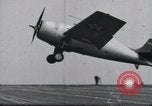
F4F aircraft crash on aircraft carrier, USS Wasp (CV-7) prior to U.S. entry into World War II
Crash of a Grumman F4F-3 aircraft from U.S. Navy Squadron VF-42, on the carrier, USS Wasp, early in 1941. In a slow motion sequence, a U.S. Navy F4F-3, with F-42-17 painted on its side (BuNo 2537) is seen rounded out too high for landing, above all arresting cables, and drifting into the carrier's island, where it impacts, losing its right wing, and flipping over to crash inverted on the flight deck. Sailors stand in the background. After the aircraft settles, a sailor runs across the deck to render aid. (Note: Navy Squadrons VF-42 and VF-71, assigned to the USS Wasp, received their F4F-3 Wildcats in January and February of 1941 under Bureau of Aeronautics contract C-68219, order number 48-020. These aircraft were painted overall aluminum with VF-42 having willow green tails and VF-71 having black tails. Later in 1941 the aircraft were repainted overall light gray.)
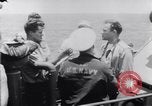
U.S. Navy Task Group led by USS Guadalcanal (CVE-60) tows captured German submarine (U-505) to Bermuda
A Task Group of the U.S. Atlantic Fleet captures and tows a German Submarine (U-505) to Bermuda. Views of captured German crew members being rescued. Destroyer USS Pillsbury passing a line to the U.S. boarding party aboard the U-505, which then collides with the Pillsbury, damaging her hull, and must be cut loose. Because a destroyer appears unable to tow the sea laden submarine, the USS Guadalcanal (CVE-60) does so herself. Views of captured German crew members exercising and bathing on deck of the Guadalcanal. View of the U-505 flying the American flag and entering harbor in Bermuda, on June 19, 1944..
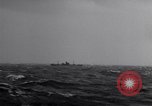
U.S. Coast Guard Cutter, Campbell, operating with convoy ON-166 during World War II
Allied freighter making way through heavy seas in Atlantic convoy ON-166, during World War 2. Several warships in distance. U.S. Coast Guard personnel perform preventive maintenance, oiling moving parts on a 3"/50 caliber gun aboard the U.S. Coast Guard Cutter, Campbell. Various ships in the convoy, as seen from the Campbell. A fast moving destroyer escort moves toward the rear of the convoy. At time 01:02 through 01:09, the surfaced German submarine, U-606, can be seen. (The Campbell was damaged by collision with the U-606,and is now without engine power.) Coastguard men are dispatched in boats from the Campbell, and head toward the Polish destroyer ORP Burza, as officers aboard the Campbell watch. The Campbell crew members are seen being helped aboard the Burza. Two coastguardsmen disassemble something in a boat.
U.S. Coast Guard Cutter, Campbell, makes temporary repairs, at sea, after collision with German submarine U-606 in World War II
Canadian corvette HMCS Dauphin (K 157) seen from the U.S. Coast Guard Cutter George W Campbell, as the Campbell makes temporary repairs at sea, following collision with German submarine U-606, during World War 2. Crew of the Campbell lowering heavy canvas over the side to staunch flow of water into her engine room from the collision. Crew members look over her side as others place the canvas into position. Coastguardsmen swarm over the canvas as they nail it fast to the deck. Crew members run lines up over the ship's side to secure the repair tight against the hull. Crew tilt a fabricated cofferdam and lower it overboard, where it is then seen floating next to the ship. Two crewmen in rubber gear stand on the raft and use poles to stuff material into the gashed hull. Ship's crew runs to starboard to tilt the port hull up for repair crew.Then they run to the port side. Officers make final check on a diver in rubber suit, who then descends side of the ship on a rope ladder. Another diver, sans suit, descends the ladder. Divers back on deck after completing work. Officer on the Campbell hailing a merchantman on a megaphone as she comes abeam, underway. The HMCS Dauphin providing protection for the Campbell. Crew of Campbell securing the cofferdam in place. All hands pulling on lines with block and tackle to tighten the repairs in place.
Navy film about proper handling of jet airplanes on U.S. aircraft carriers
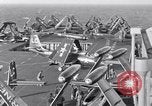
Blue shirts moving Marine F2H Banshee aircraft with folded wings, on flight deck of a U.S. aircraft carrier. They roll one by pushing on the leading edge, without rocking the aircraft. Diagram shows tendency of jets to rock fore and aft. They use a tug to move a jet forward only. Blue shirts rolling one back to allow forward towing. An F2H being taxied with wings folded. Blue shirts position one pointing aft overboard to minimize blast from engine during start. Wheels being chocked.
CRITICALPAST.COM: About Us | Contact Us | FAQs - How to Order | License Agreement | My Account | My Lightboxes | Shopping Cart | Advanced Search | Featured Collections | Website Terms & Conditions | Privacy Policy ©2026 CriticalPast LLC.
License Agreement |
Terms & Conditions |
Privacy Policy
©2026 CriticalPast LLC.