


 Francais
 Deutsch
 Italiano
Refine Your Search
US-Gliders- stock footage and images
- Showing 2557 to 2562 of 21924 results more
more Hide
Hide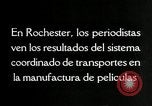
The Pan American Congress of Journalists see how cotton is harvested and used to make nitrocellulose film.
The Pan American Congress of Journalists visit Kodak in Rochester, New York to see cotton used in the production of nitrocellulose camera film. Views of African American men and women picking cotton. Cotton is baled and the bales are sent on conveyor to railroad yard. Bales are loaded onto a Southern railroad box car. Steam locomotive pulls train out of terminal yard. Map shows flow of cotton from the South to New York. At Eastman Kodak, view of cotton being processed into nitrocellulose film, also known as nitrate film for use in motion picture film cameras. View of perforation machine cutting perfs into motion picture film. Film is wound into rolls. Woman worker wraps each film roll in black paper for shipment. Pan American Congress members board a Mack 'Shock Insulated' bus for further travel.

Women from Goodyear show use of Pliofilm bags to protect personal articles from water when swimming
Women from Goodyear rubber company show new use of Pliofilm in Akron Ohio. Man gives pliofilm bags to women. The pliofilm bags serve as waterproof purses for the women's things. Women in swimsuits walk towards the lake on a dock. They swim and then later apply make-up. They swing on a swing set above the water. Narrator describes how Pliofilm is also used for defense purposes, in parachutes, food packages and bandages.
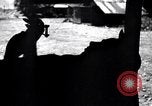
Crews of U.S. Air Force 80th Fighter Squadron and their P-38 aircraft, during World War II.
Crews of U.S. Air Force 80th Fighter Squadron "Headhunters", and their P-38 airplanes in Pacific theater during World War 2. A ground crewman playing with a model of a P-38 plane. Sign reading "Captain Jay T. Robbins, Commanding Officer" is updated by Robbins to say "Major..." Aircrews gather to study a map and discuss a mission. Large "W" on nose of one plane. Plane with 15 Japanese kill flags on it, labeled "Captain C. Homer," (who later succeeded Major Robbins as the Commanding Officer). U.S. pilots stand in front of their planes. Name "Adams" visible on one of them. Pilot inside the plane, gets ready for take off. (Among pilots seen are three 80th Squadron aces: Robbins, Homer, and Ken Ladd.)
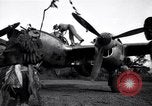
U.S. P-38 crew of 80th Fighter Squadron interacts with native tribesmen in New Guinea, during World War II
U.S. Army Air Forces P-38 pilots of the 80th (Headhunters) Fighter Squadron in New Guinea, during World War 2. Three native tribesmen in regalia gather near a P-38. One U.S. pilot on a wing, waves his arms to indicate flying. Other pilot holds an illustration of a New Guinea warrior near the plane, indicating to a tribesman the intent to paint it on the fuselage. One of the three tribesmen poses for a picture inside the plane cockpit. (Note:The 80th Fighter Squadron was nicknamed the "Headhunters" by Squadron Commander Major Ed "Porky" Cragg in honor of these local New Guinea natives who hated the Japanese and helped American pilots return to their bases if they were shot down.)
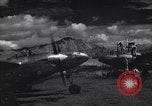
P-38 aircraft and ground crews of U.S. 49th Fighter Group in New Guinea, during World War II.
P-38 Lightning aircraft of the 9th Fighter Squadron, 49th Fighter Group, at Schwimmer Field near Port Moresby, New Guinea, during World War 2. Crew chiefs attend to P-38 aircraft, some with engines running. Ground crewmen manually maneuver nose wheel using towbar. Crew chief cleans the aircraft of American Ace, Captain Richard I. Bong. His P-38, named "Marge," displays large picture of woman and 27 Japanese victory flags ( Bong having just broken Eddie Rickenbacker's World War I record of 26 victories). Staff in control tower use light signals. Aerial view from airplane flying among cumulus clouds.
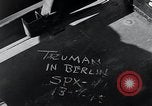
President Truman reviews troops of U.S. 2nd Armored Division, enroute to Berlin for Potsdam Conference
July 16, 1945, with President Truman and his party enroute to Berlin Germany, prior to the "Big Three" conference at Potsdam. President Harry S. Truman is seated in right rear of open car. Secretary of State, James F. Byrnes sits next to him in the center, and Fleet Admiral William D. Leahy, Personal Chief of Staff to the President, is in the left rear seat. U.S. Army Brigadier. An Army Major General stands beside the car speaking to the occupants. Brigadier General Harry H. Vaughan (wearing sun glasses), long time friend and aide to the President, steps close to the car. Scene shifts to the President and his party, standing in a moving vehicle, as they review troops of the 2nd Armored Division, standing in front of their tanks, M10 Tank Destroyers, and other armored vehicles. The President and Secretary Byrnes remove their hats and hold them over their hearts,while military officers render hand salutes as they pass the colors. Views from vehicle passing the formation.View from ground of Presidential party at attention with flag of the 17th Battalion displayed. A Lieutenant from the 17th Armored Engineer Battalion reads a citation and Brigadier General John Howell Collier, Commander, 2nd Armored Division, unfurls unit citation ribbon, that President Truman then ties to the Guidon of Company E, 17th Armored Engineer Battalion. As President Truman reportedly described the event in his diary: "We reviewed the Second Armored Division and tied a citation on the guidon of Company E, 17th Armored Engineer Battalion. General Collier, who seemed to know his stuff, put us in a reconnaissance car built with side seats and no top, just like a hoodlum wagon minus the top on a fire truck, with seats and no hose, and we drove slowly down a mile and a half of good soldiers and some millions of dollars' worth of equipment -- which had amply paid its way to Berlin." (World War II period).
CRITICALPAST.COM: About Us | Contact Us | FAQs - How to Order | License Agreement | My Account | My Lightboxes | Shopping Cart | Advanced Search | Featured Collections | Website Terms & Conditions | Privacy Policy ©2026 CriticalPast LLC.
License Agreement |
Terms & Conditions |
Privacy Policy
©2026 CriticalPast LLC.