


 Francais
 Deutsch
 Italiano
Refine Your Search
US-Gliders- stock footage and images
- Showing 2551 to 2556 of 21924 results more
more Hide
Hide
General William C Westmoreland visits U.S. Airborne Brigade base camp in Phanrang, South Vietnam.
General William C Westmoreland, the Commander of U.S. Forces in Vietnam, talks with men of the 1st Battalion, 327th Infantry at the U.S. Airborne Brigade base camp in Phanrang, South Vietnam. General Westmoreland talks with reporters. They pose for camera. General and others leave area in jeep.
U.S. 1st Cavalry Division troops aim their M-16 rifles and descend from CH-47 by a rope ladder in South Vietnam.
U.S. 1st Air Cavalry Division armed with M-16 rifles advance in a grassy area of Ankhe, South Vietnam, during a training mission. Soldiers aim with their rifles and advance. Soldiers descend from a hovering CH-47 helicopter using a rope ladder. (Vietnam War period).
U.S. 1st Air Cavalry Division troops load shell into M-40 Recoilless Rifle in Ankhe, South Vietnam.
U.S. 1st Air Cavalry Division troops at a sandbagged emplacement in Ankhe, Vietnam. Gun crewman holds a 106mm shell, as a Sergeant uses wrench to adjust fuze on its nose. Soldier then loads it into M-40 Recoilless Rifle. Another soldier looks through a scope mounted on side of the weapon. View of the 106mm shell. (Vietnam War period).
Troops of the U.S. 199th Light Infantry Brigade dismantling Fire Support Base Myron before withdrawing from Cambodia
U.S. 199th Light Infantry Brigade troops break sand bag emplacements and bunkers at Fire Support Base Myron, as they prepare to withdraw from Cambodia. They empty sand bags and climb atop bunkers and break them using hammers.
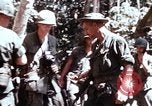
U.S. 199th Light Infantry Brigade troops cross a jungle path during the Vietnam War
U.S. 199th Light Infantry Brigade troops are on an alert at a jungle during the Vietnam War. Officer speaks over radio. He looks at a map with other soldiers. Soldiers walk on jungle path. A soldier uses chain saw to clear brush. Soldiers cross narrow water stream. Soldiers cross open field.
U.S. Soldiers of 199th Light Infantry Brigade eat combat ration and drink lemonade in Saigon.
U.S. 199th Light Infantry Brigade soldiers posted in Saigon during the Vietnam War. Soldier can be seen repairing a radio. Officers have lemonade. U.S. military vehicles move down street. Soldiers distribute cigarette packets to children. Soldiers eat combat ration atop a M42 Duster. Army of the Republic of Vietnam (ARVN) soldiers arrive in a truck.
CRITICALPAST.COM: About Us | Contact Us | FAQs - How to Order | License Agreement | My Account | My Lightboxes | Shopping Cart | Advanced Search | Featured Collections | Website Terms & Conditions | Privacy Policy ©2026 CriticalPast LLC.
License Agreement |
Terms & Conditions |
Privacy Policy
©2026 CriticalPast LLC.