


 Francais
 Deutsch
 Italiano
Refine Your Search
US-Gliders- stock footage and images
- Showing 2749 to 2754 of 21924 results more
more Hide
Hide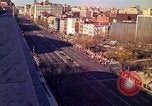
John f. Kennedy's funeral procession proceeding to the U.S. Capitol.
A procession of cars proceeding to the U.S. Capitol in Washington DC. American flags at half-staff at base of Washington Monument following the assassination of United States President John F. Kennedy. Units of U.S. Army, Navy, Air Force, Marines and Coast Guard marching. Crowds gather on opposite sides of the road. Horse-drawn caisson with flag-draped casket and rider less horse going past crowd. Crowds following the procession.
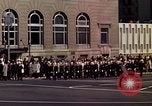
Police diverting crowd while John F. Kennedy's funeral procession passes on street to the U.S. Capitol.
United States military units marching on street to the U.S. Capitol for the funeral of President John F. Kennedy. View of military band followed by marching U.S. military units, the Joint Chief of Staff and caisson with flag-draped casket passing. Crowds assembling in streets. Police diverting traffic, motorcycle police escort lining up.
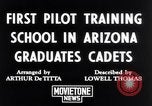
First class of U.S. Army Air Forces Air cadets to be trained under contract, by Southwest Airways, during World War II
First class of Air cadets who were taught by Southwest Airways under private contract with the U.S. Army during World War 2. They are seen in classroom, receiving instruction. Next scene shows them marching in front of a hangar at Thunderbird Field. They stand in a formation and then Air cadets receive their diplomas and shake hands with U.S. Army Air Force officers. Final scene shows cadets taxiing their Stearman PT-17 aircraft out sequentially from the flight line.

Pre World War 2, Major General Jonathan Wainwright and U.S. and Filipino troops in training at Clark Field
U.S. Army mechanics and pilots sleeping in hangar at Clark Field, Pampanga, Philippines in 1941 (before World War 2). P-26 and B-10 aircraft on field taking off and in flight. Local native civilians admire the aircraft. Army officer fixing a notice on notice board outside barracks and Filipino soldiers standing in formation. Major General Jonathan Wainwright talking to other officer nears a river. Men tying military equipment with cloth piece and bamboo. View of them floating equipment across body of water. Water buffalo (carabao) and Philippine troops doing river fording exercises. U.S. aircraft flying overhead and Filipino troops perform live fire practice drills, preparing for future warfare.
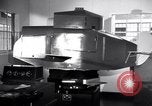
U.S. Military aircraft and training prior to World War II
American military aircraft training circa 1940. A Link Trainer in operation at an aviation training facility. Used for teaching pilots instrument flying, it is seen moving physically in response to the actuation of artificial flight control actions as the trainee responds to instrument indications inside the mockup cockpit. It bears the number 654, on its mock tail. The wings and tail are for decoration only. Scene shifts to formations of various aircraft in flight over a body of water. The aircraft appear to be U.S. Navy types, including: Grumman F4F Wildcat; Douglas TBD Devastator; and Grumman TBF Avenger. Another formation shows many North American training aircraft in flight over the water.
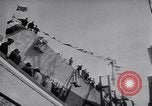
U.S. Destroyer Escort ship USS McConnell (DE-163) is launched in Newark, New Jersey in World War 2
Scene at Federal Shipbuilding and Drydock Company, Port Newark, New Jersey, as the U.S. Destroyer Escort USS McConnell is launched. Shipyard workers aboard the deck and handling lines. U.S. Naval Ensign displayed at her bow and crew looking down. Mrs. Grace Otteson McConnell swings the bottle of champagne and the USS McConnell slides down the ways after christening. View from deck of the McConnell as she goes down the ways. View from water, as she enters, stern-first. Change of scene to high vantage point overlooking the shipyard, at change of shift, when those ending leave and those arriving enter the yard to start work. Workers leaving through guarded gate. Incoming workers punching in on the time clock.
CRITICALPAST.COM: About Us | Contact Us | FAQs - How to Order | License Agreement | My Account | My Lightboxes | Shopping Cart | Advanced Search | Featured Collections | Website Terms & Conditions | Privacy Policy ©2026 CriticalPast LLC.
License Agreement |
Terms & Conditions |
Privacy Policy
©2026 CriticalPast LLC.